 AI-generated analysis published under the editorial responsibility of Rohit Sinnas. How it works →
See the 31 countries
Armenia, Azerbaijan, Bulgaria, Canada, China, Egypt, Germany, Greece, Hong Kong, India, Ireland, Japan, Lithuania, Madagascar, Malaysia, Nepal, New Zealand, Oman, Pakistan, Philippines, Qatar, Romania, Russia, Slovakia, Thailand, Turkey, U.S. Virgin Islands, United Arab Emirates, United Kingdom, United States, Vietnam
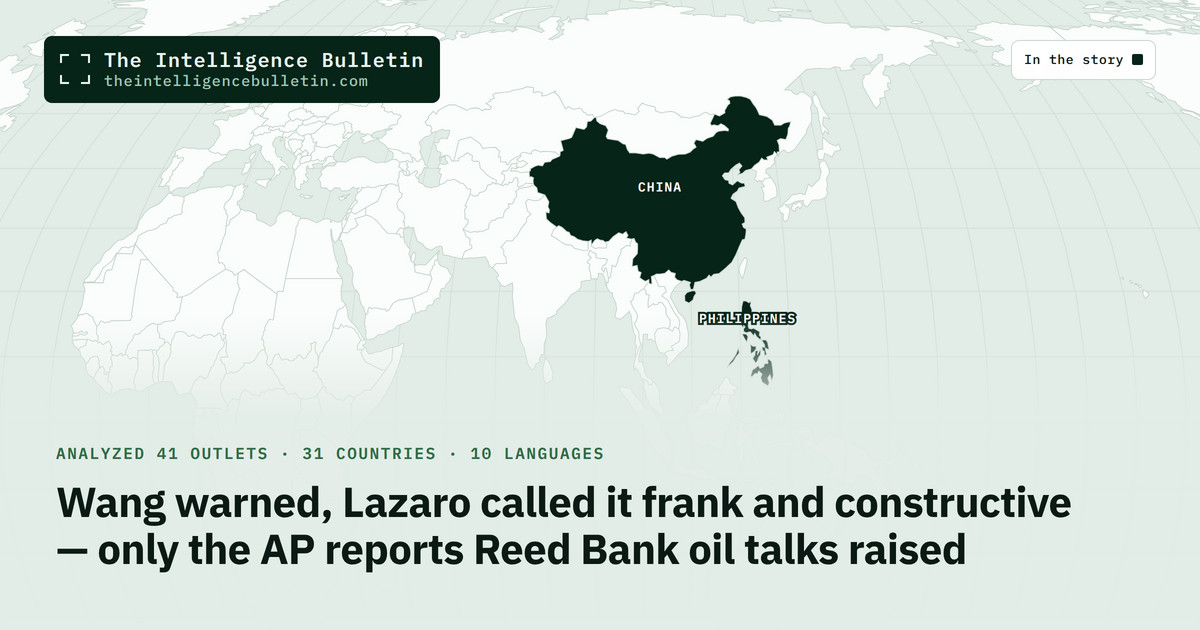
Chinese Foreign Minister Wang Yi told Philippine counterpart Theresa Lazaro that some Filipino politicians are crossing China’s red lines on the South China Sea; she called it frank and constructive. Only the AP reports, citing an unnamed Philippine official, Reed Bank oil talks were raised.
Across the press: China Daily and Manila’s DFA read out the call without mentioning Reed Bank; only the AP, citing an unnamed Philippine official, reports it was raised.
Source base: 5 outlets quoted (China, Philippines, Taiwan, Canada), selected from 41 analyzed. 4 read in full, 1 by its headline only.
- 1 of 5 · winnipegfreepress.com onlyThe two diplomats raised the possible resumption of long-stalled Philippines-China talks on joint oil and gas exploration in the Reed Bank.AP dispatch, citing a Philippine official who spoke on condition of anonymity; carried by Winnipeg Free Press.
- 4 of 5 · reported separatelyForeign Minister Wang Yi and Philippine Foreign Secretary Theresa Lazaro held a phone call on Tuesday, November 3, to discuss bilateral relations and the South China Sea.Chinese Foreign Ministry readout in China Daily; DFA statement in Rappler; Lazaro’s X post quoted by The Philippine Star and the AP wire in Winnipeg.
- 4 of 5 · reported separatelyWang accused a small number of Philippine politicians of attacking and smearing China out of political prejudice and self-interest, crossing China’s red lines, and urged Manila to restrain them and be cautious in words and deeds on the South China Sea.Chinese Foreign Ministry statement reported by China Daily and The Philippine Star; Xinhua version quoted by Rappler; AP wire from Winnipeg.
- 3 of 5 · reported separatelyLazaro characterized the call as frank and constructive, with the DFA adding pragmatic, and said both sides emphasized continued diplomatic dialogue and the proper management of differences.Lazaro’s X post and the DFA statement, quoted by The Philippine Star, Rappler, and the AP wire.
- 2 of 5 · reported separatelyThe Philippine side reaffirmed its commitment to the one-China policy and its willingness to address the South China Sea and other disputes through dialogue and consultation.Chinese Foreign Ministry readout in China Daily and the Philippine DFA statement reported by Rappler.
- November 16–18, 2026ASEAN Summit in Manila — whether Chinese Premier Li Qiang attends and is received without incident will show whether the truce holds.
- Early to mid-2026Any confirmation or denial from either government on Reed Bank talks, which would test the anonymous AP-sourced claim.
- November 18–19, 2026APEC Economic Leaders’ Meeting in Shenzhen — whether Marcos attends and how China treats him.
Full analysis
What happened Why it matters How each country tells it Where accounts conflict Room for disagreement Our assessment Sources and evidence
What happened
On Tuesday, November 3, Chinese Foreign Minister Wang Yi and Philippine Foreign Secretary Theresa Lazaro spoke by telephone in what both governments presented as an attempt to halt weeks of escalating recrimination — just under two weeks before world leaders gather in Manila for the 49th ASEAN Summit, set for November 16 to 18. China Daily reported that the call was made at Lazaro’s request.
Beijing’s readout had Wang telling Lazaro that bilateral relations were “facing malicious interference” and that some Philippine politicians, “out of political prejudice and self-interest, have repeatedly attacked and smeared China.” Their conduct, Wang said, crossed China’s red lines, politicized normal economic, cultural and people-to-people exchanges and infringed on the rights of Chinese nationals and institutions in the Philippines; Manila should restrain them, act on the one-China policy and exercise caution on the South China Sea.
Manila’s account was softer in register but firm in substance. The DFA said on Wednesday the two had a “frank, pragmatic, and constructive” discussion of “the state of bilateral ties at length,” and Lazaro’s own post called the conversation “frank and constructive,” saying both sides emphasized continued diplomatic dialogue and the proper management of differences anchored on mutual respect. Lazaro reaffirmed the one-China policy, which the DFA said rests on the 1975 Joint Communiqué, and said the Philippines was willing to address the South China Sea and other issues through dialogue and consultation. As ASEAN’s rotating chair, she said Manila anticipated China’s greater role in advancing the ASEAN-China partnership.
The two governments agreed to eliminate internal and external factors of interference, oppose malicious provocations, manage differences responsibly and expand shared interests, Beijing’s readout said. They also exchanged views on the East Asia cooperation leaders’ meetings in the Philippines and the APEC Economic Leaders’ Meeting in Shenzhen, scheduled for November 18 and 19.
The call followed a sequence of provocations on both sides. Philippine Defense Secretary Gilberto Teodoro Jr. called China a “troublemaker” in the region, according to the AP. China’s ambassador in Manila said the Philippines should be “fortunate” that China does not use force and that “if we want to use force, we may easily win” — remarks President Ferdinand Marcos Jr. called a “threat,” prompting Lazaro to summon the envoy while some senators sought his expulsion. Beijing in turn accused Manila of “erecting multiple obstacles” to its participation in a regional defense meeting, a claim the defense chief’s side rejected, and at the ASEAN Defense Ministers’ Meeting Plus in Cebu, which opened October 28, China sent only its Manila-based defense attaché, who was not received personally by the China-sanctioned Teodoro, Rappler reported.
One item appears in a single account. An unnamed Philippine official told the Associated Press that the two diplomats raised the possible resumption of long-stalled Philippines-China talks on joint oil and gas exploration in the Reed Bank, an offshore area claimed by both countries but lying within the Philippines’ 200-nautical-mile exclusive economic zone. Neither government’s published readout mentioned Reed Bank.
Why it matters
The call was the first formal senior contact since July, when the same two ministers met on the sidelines of the ASEAN Foreign Ministers’ Meeting shortly after a confrontation at Ayungin (Second Thomas) Shoal injured a Filipino soldier, Rappler notes. What followed was, in Rappler’s words, arguably the tensest period in bilateral relations yet — and the phone call lands directly in front of ASEAN’s biggest event under the Philippine chairmanship.
For Manila, the summit is the prize. Marcos opened 2026 calling for a “reset,” and the DFA statement carries his hope that Chinese Premier Li Qiang attends the summit; Marcos had wanted Xi Jinping to visit if the South China Sea Code of Conduct concluded, but Rappler reports the code is not expected to finish by the summit, and Xi typically does not attend. Rappler’s framing, built around the DFA statement titled “Stable and Predictable Philippines-China Relations,” makes the story Manila’s purchase of calm.
For Beijing, The Philippine Star’s version shows the demand beneath the diplomacy: Wang wants Manila to strengthen oversight of politicians crossing red lines and to speak with a unified voice on China policy. China Daily’s readout supplies the justification — exchanges politicized, Chinese nationals’ rights infringed — the vocabulary Beijing uses when it is casting a relationship as adversarial.
The AP adds an economic stake the official readouts omit. Philippine exploration in the Reed Bank has been hampered for years by Beijing’s opposition, so a revival of joint talks would be the first concrete concession in years; its absence from both capitals’ statements leaves that unconfirmed. Taiwan’s United Daily News headlines the détente — ministers inviting each other’s leaders to summits — rather than the warning.
How each country tells it
- China Daily · China · original reportingBeijing’s state paper leads with Wang Yi urging Manila to send rational, unified messages on China policy and to restrain politicians who cross China’s red lines.
- The Philippine Star · Philippines · original reportingLeads on China telling the Philippines to stop politicians from crossing red lines, presenting the call as a Chinese demand that Manila must answer.
- Rappler · Philippines · original reportingLeads with the Philippines seeking to lower temperatures with China ahead of the ASEAN Summit, citing the DFA’s statement that the call was frank, pragmatic, and constructive.
- United Daily News · Taiwan · original reportingFrames the same foreign-minister contact purely as a thaw, with the two ministers inviting each other’s leaders to summits.
- Winnipeg Free Press · Canada · wire copyCarries AP’s wire report opening with China’s warning for the Philippines to be cautious over the South China Sea, then adds the Reed Bank oil and gas talk possibility and Teodoro’s troublemaker remark.
Where accounts conflict
The call itself is not in dispute, and the readouts converge on its broad shape: Wang warned, Lazaro called the conversation frank and constructive, Beijing’s readout in China Daily and Manila’s DFA statement both record the one-China reaffirmation, and every account carries the commitment to keep talking.
The material divergence is Reed Bank. The AP dispatch, carried by the Winnipeg Free Press, alone reports that resuming long-stalled joint oil and gas exploration in the Reed Bank was raised, citing an unnamed Philippine official. China Daily’s readout names the summits and the anti-interference consensus but not energy; Manila’s DFA statement says the call covered maritime issues and focused on returning the relationship to an even keel and upholding the 1975 Joint Communiqué, without naming Reed Bank; The Philippine Star does not carry the item. Either a substantive agenda item was left out of both governments’ public readouts, or the anonymous official’s account is wrong.
A softer divergence concerns initiative. China Daily states the call was made at Lazaro’s request; Manila’s published statements do not say who placed it. Beijing’s account makes the call a Philippine effort to manage a problem of its own making, while the DFA’s account casts it as a mutual reset.
Room for disagreement
The strongest case that this is a turning point rather than a pause rests on commitments both governments actually made. The DFA’s three principles are explicit and mutual: both sides “avoid actions and rhetoric that could needlessly undermine relations or heighten tensions.” Wang, in Beijing’s own readout, agreed to eliminate internal and external interference and expand shared interests. And the AP’s unnamed official says the one agenda item that would constitute a real concession — Reed Bank — was put on the table, whatever the readouts omitted. Both capitals have a summit to protect: China needs Li Qiang received properly in Manila and Marcos at Shenzhen, and Marcos has staked his chairmanship on a reset since early 2026. United Daily News’s framing, which turns the call into a story of mutual summit invitations, captures this shared interest. On this view, the incentives binding the two governments extend beyond November 18.
Our assessment
The likely outcome is a managed truce that survives the ASEAN Summit and the Shenzhen APEC but does not move the South China Sea dispute itself. The evidence for the truce is strong and comes through independent channels: Beijing’s readout via China Daily and Xinhua, Manila’s DFA statement and Lazaro’s own post all converge on commitments to dialogue, restraint and managed differences. The evidence against a deeper reset is just as consistent. Wang’s red-lines warning appears in every account, Rappler records that West Philippine Sea confrontations continued even as Manila attempted its reset, and the one item that would mark a concession survives only as anonymous AP sourcing neither government has confirmed. Both capitals have an interest in the appearance of a thaw ahead of the summit, the condition under which public readouts promise more than they hand over.
What would change this: confirmation from either government that joint Reed Bank exploration talks will resume, which would convert the truce into a shift on the substance the whole dispute is about.
Sources and evidence
Press quoted
- Will the Reed Bank joint oil and gas exploration talks actually resume, given that only an unnamed Philippine official has raised the possibility and no on-record government statement confirms it?
- Which specific Philippine politicians or officials was Wang Yi accusing of crossing China’s red lines, and did Lazaro accept Beijing’s demand that Manila restrain them?
- Does the call change Beijing’s or Manila’s behavior before the ASEAN Summit in Manila on November 16-18, or is it mainly managing differences to allow the summit and APEC meeting to proceed?
That’s how the world told the story.
Get our daily open-source intelligence on world events in your inbox — one email a day, up to six stories.
Subscribe freeNo spam. One-click unsubscribe. See the latest email →