 AI-generated analysis published under the editorial responsibility of Rohit Sinnas. How it works →
Press quoted
Full analysis
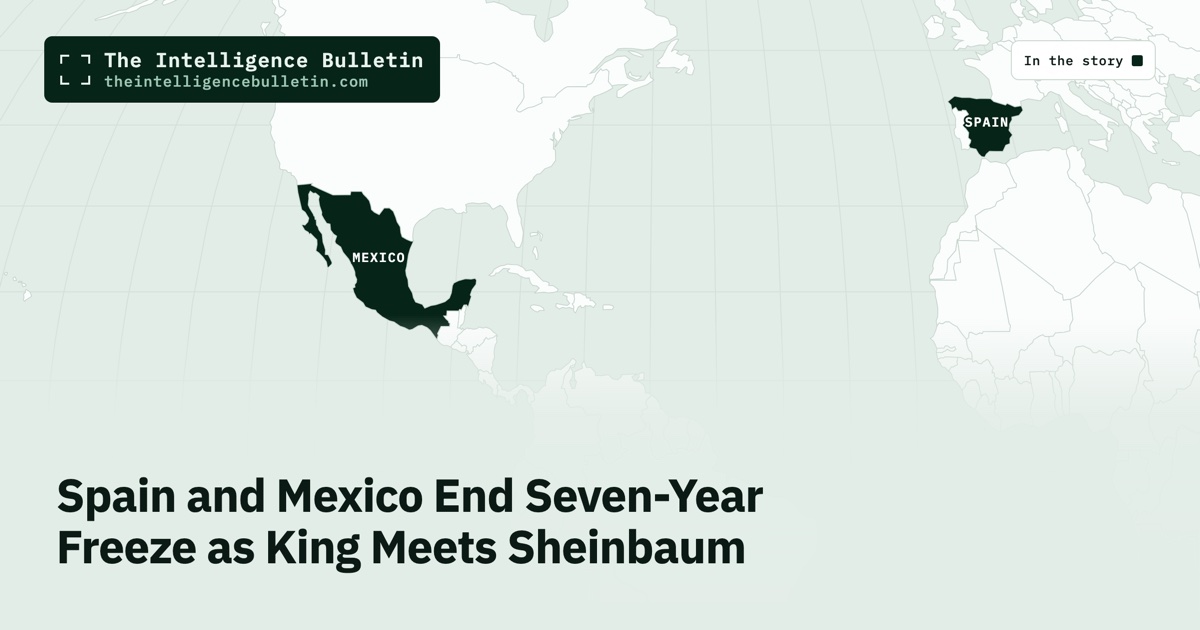
The meeting between King Felipe VI and President Claudia Sheinbaum at Mexico City’s Palacio Nacional on June 25, 2026, delivered more than protocol. It closed a discrete chapter of bilateral friction while exposing how each country’s media reframes the same handshake to suit domestic narratives of restoration, agency, or routine diplomacy.
The dispute began in 2019 when former president Andrés Manuel López Obrador sent a letter to the Spanish Crown demanding an apology for abuses committed during the Conquest. Spain declined, and high-level political contact froze for seven years even as trade, investment, and cultural exchanges continued uninterrupted. Sheinbaum inherited the standoff but signaled early willingness to reopen channels through modest cultural initiatives and invitations. The June encounter, timed around the king’s attendance at the Spain-Uruguay World Cup match in Guadalajara, marked the first formal bilateral summit since the rupture.
Spanish coverage from ABC presented the visit as the monarch’s personal return that definitively ends the polemic launched by López Obrador. The paper emphasized the reappearance of the Spanish flag at the National Palace and the symbolic weight of Felipe VI crossing the threshold after years of exclusion. Its reporting framed the moment as royal diplomacy restored, underscoring how the king’s presence itself constituted closure rather than any new substantive agreement.[[1]](https://www.abc.es/espana/casa-real/felipe-vuelve-mexico-terminada-polemica-iniciada-lopez-20260626023933-nt.html)
El País English edition took a different tack, spotlighting Sheinbaum’s deliberate imprint on the reconciliation. The outlet detailed her early gestures—contacts for an Indigenous art exhibition and a measured response to the king’s March acknowledgment of colonial “abuses”—and situated the thaw within a broader strategic recalibration. With U.S. pressure mounting under Donald Trump on trade, migration, and security, Sheinbaum has sought European counterweights. The piece noted her presence at a progressive summit in Barcelona and upcoming Madrid gatherings as evidence of an emerging Ibero-American alignment among left-leaning governments facing rightward electoral shifts elsewhere in the region.[[2]](https://english.elpais.com/international/2026-06-25/sheinbaum-puts-her-own-stamp-on-mexicos-diplomatic-peace-with-spain.html)
Mexican national and regional outlets converged on official protocol and forward momentum while varying in how explicitly they invoked the prior freeze. Plano Informativo relayed the Foreign Ministry’s statement that Mexico and Spain were “strengthening their diplomatic ties for the benefit of the relationship and the well-being of their peoples,” quoting SRE chief Roberto Velasco on the welcome extended at the palace. The tone remained measured and institutional, treating the encounter as the sealing of a normalization process already underway rather than a dramatic rupture with the past.[[3]](https://planoinformativo.com/1153946/sheinbaum-recibe-al-rey-felipe-vi-en-mexico-para-sellar-la-normalizacion-de-la-relacion)
Periódico Correo sharpened the timeline, explicitly quantifying the standoff as seven years and presenting the handshake as the explicit end of diplomatic tension. Its account highlighted the exchange of national anthems, the official photograph before both flags, and the brevity of the meeting—consistent with Sheinbaum’s prior description—while noting that economic links had never been severed. The regional paper used the concrete chronology to underscore the political significance of restored dialogue without dwelling on historical grievances.[[4]](https://periodicocorreo.com.mx/nacional/2026/jun/25/sheinbaum-y-felipe-vi-se-reunen-en-mexico-y-ponen-fin-a-siete-anos-de-tension-diplomatica-160329.html)
La Jornada de Oriente stayed closest to ceremony and logistics. Its Puebla-framed dispatch described the king’s arrival at the airport, the welcome by Velasco, and the gathering at the Puerta de Honor, adding the Spanish foreign minister’s social-media remarks on shared commitments to democracy and multilateralism. The outlet supplied minimal additional context on the preceding conflict, focusing instead on the pageantry and the SRE’s emphasis on mutual benefit.[[5]](https://www.lajornadadeoriente.com.mx/puebla/recibe-claudia-sheinbaum-al-rey-felipe-vi-de-espana-en-palacio-nacional)
Across these accounts, the shared factual core—date, location, participants, and stated purpose of renewed cooperation—remains consistent. Divergence appears in emphasis: Spanish royal correspondents stress monarchical restoration, the English-language international press adds geopolitical layering around U.S. pressure and progressive alliances, and Mexican outlets align with government messaging on delivered normalization, with regional papers leaning more heavily on protocol. None contradict the event itself; each simply selects the lens that resonates with its audience.
Economic realities underpin the political optics. Spain remains Mexico’s second-largest trading partner in the European Union, with bilateral goods trade near $11.1 billion. Cultural and human ties, rooted in language, migration, and family networks, proved resilient throughout the freeze. The meeting therefore restores the political overlay that had been missing, opening space for potential cooperation on trade diversification, cultural programming, and coordinated positions within Ibero-American forums.
The Takeaway
What to watch next is whether the symbolic reset translates into concrete follow-through. Madrid is slated to host another progressive summit later this year, and both governments have referenced expanded cooperation on indigenous heritage exhibitions and multilateral issues. The durability of the thaw will also be tested by how each capital manages domestic constituencies still invested in historical memory or national sovereignty narratives. For now, the June 25 encounter has at least returned the relationship to a functional baseline from which further steps can be taken.
Share this story
That’s how the world told the story.
Get our daily open-source intelligence on world events in your inbox — one email a day, up to six stories.
Subscribe freeNo spam. One-click unsubscribe. See the latest email →