 AI-generated analysis published under the editorial responsibility of Rohit Sinnas. How it works →
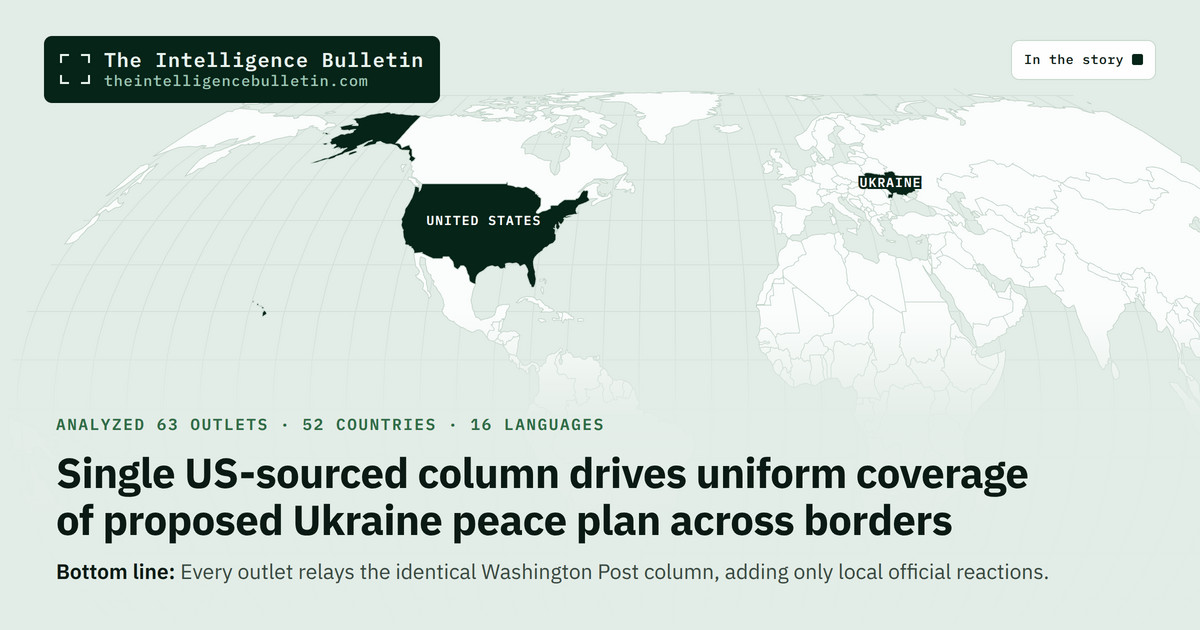
| Press analyzed | 63 outlets · 52 countries · 16 languages |
| Press quoted | 4 sources, each independently reported |
See the 52 countries
Armenia, Azerbaijan, Bangladesh, Belarus, Belgium, Bosnia and Herzegovina, Bulgaria, Canada, China, Croatia, Cyprus, Czech Republic, Egypt, Georgia, Germany, Greece, Hungary, India, Iraq, Ireland, Israel, Italy, Japan, Lebanon, Liberia, Lithuania, Luxembourg, Macedonia, Malaysia, Moldova, Montenegro, Nepal, Netherlands, New Zealand, Nigeria, Oman, Pakistan, Poland, Qatar, Romania, Russia, Serbia, Slovakia, Somalia, South Korea, Switzerland, Turkey, Tuvalu, Ukraine, United Arab Emirates, United Kingdom, United States
Every outlet relays the identical Washington Post column, adding only local official reactions.
- Single sourceUS and European officials are developing a four-point peace proposal including Ukraine reconstruction funding, security guarantees, energy integration with Russia, and a ceasefire on the current front line.Source: Washington Post columnist David Ignatius citing US official
- Single sourceThe plan emerged from Florida talks involving US envoys Kushner and Witkoff with Ukrainian and European representatives.Source: Washington Post columnist David Ignatius citing US official
- Single sourceUkrainian presidential advisor called the WP report ‘good PR’ reflecting only some US positions from the Florida meeting, not a joint US-Europe plan.Source: Espreso TV and Korrespondent quoting Dmytro Lytvyn
- Single sourceKremlin press secretary Peskov said Moscow had seen media reports but had not been informed about any such plan.Source: Vedomosti quoting Dmitry Peskov
- Has Ukraine provided the requested cost estimates and anti-corruption guarantees to negotiators?
- What specific security arrangements for Russia with Europe are under discussion?
- Will Ukrainian leadership accept a ceasefire along the current front line?
Press quoted
Full analysis
A Washington Post column published October 13 described American and European officials working toward a four-point framework meant to end the Russia-Ukraine war by offering postwar economic and security incentives to both sides rather than focusing narrowly on territorial demands. Columnist David Ignatius, citing a U.S. official familiar with the talks, wrote that negotiators wanted to enlarge the problem and the solution so that a territorial compromise no one would fully like could still be accepted. The framework grew out of a six-hour meeting held October 9 at the Shell Bay golf club in Hallandale Beach, Florida, a property owned by U.S. envoy Steve Witkoff. Participants included Witkoff, Jared Kushner, Ukrainian officials, and representatives from Britain, France, and Germany.
The first element of the package would establish financing for Ukraine’s postwar reconstruction. The World Bank and the investment firm BlackRock are developing a mechanism to cover rebuilding of destroyed areas, payments to families of killed and wounded service members, and revival of the economy. Negotiators asked Kyiv for detailed cost estimates and guarantees that reconstruction funds would not be embezzled. Ignatius reported that Ukraine had not yet supplied the figures but was expected to do so within days if the diplomatic effort continued.
The second element would supply security guarantees to Ukraine from the United States and European countries, with a commitment to respond militarily if Russia attacked again. The U.S. official compared the proposed guarantees to NATO’s Article 5 collective-defense clause. Russia would simultaneously negotiate with European capitals over arrangements that address Moscow’s security concerns, though the column left the content of those arrangements unspecified.
The third element would create economic integration among Russia, Ukraine, and Europe through an energy agreement. One possibility discussed was a pipeline carrying Russian oil and gas to Europe whose profits would be shared between Kyiv and Moscow. Such an arrangement would give Russia long-term access to European energy markets, reduce Europe’s energy costs, and set out a timetable for lifting existing sanctions on Moscow.
The fourth and most difficult element would freeze fighting along the current line of contact. Russia would retain physical control of territory it currently occupies, including parts of the Donbas, without formal Ukrainian recognition of that control. The line itself shifts daily because of ongoing combat, complicating any precise demarcation.
The same U.S. official told Ignatius that if Ukrainian forces stopped striking Russian oil refineries, Washington would re-engage more actively and travel to Moscow for further talks. Trump had repeatedly pressed Kyiv to halt those strikes, arguing they raised global energy prices. The Florida meeting occurred hours before Trump announced a separate diesel-fuel supply arrangement with Russia. Ukrainian President Volodymyr Zelensky criticized that arrangement as weak, and Trump responded by threatening to cut intelligence sharing. European diplomats expressed displeasure with the diesel deal yet signaled they would continue supporting the Kushner-Witkoff channel.
Ukrainian presidential communications advisor Dmytro Lytvyn told journalists that the Washington Post column reflected only the views of some American participants in the Florida talks and amounted to “good PR” for the U.S. side. He emphasized that the material did not represent a joint American-European initiative. Russian presidential press secretary Dmitry Peskov stated that Moscow had seen the media reports but had received no official information about any such plan. Peskov added that Russia’s position on bilateral meetings between Vladimir Putin and Zelensky remained unchanged and well known.
The four outlets that carried accounts of the column all reproduced the same four pillars and the same Florida meeting details. The News International in Pakistan presented the report as evidence that the conflict might be nearing an end and stressed the financial and security benefits offered to both Moscow and Kyiv. Vedomosti in Russia foregrounded the American media origin of the story and immediately juxtaposed it with Peskov’s statement that officials in Moscow had not been briefed. Korrespondent in Ukraine reproduced the four points at length and added context on the refinery-strike dispute and its effect on Zelensky’s negotiating leverage. Espreso TV in Ukraine summarized the pillars and then quoted Lytvyn’s characterization of the column as American public relations from the Florida session.
No outlet in the set published independent reporting on the proposal. None quoted European officials directly, and none carried statements from the World Bank, BlackRock, or Russian energy companies. The only on-record reactions came from one Ukrainian advisor and one Russian government spokesman. The uniform reliance on a single Washington Post column means readers of any one of the four articles encounter the same factual spine and encounter national reactions only where the outlet chose to insert them.
What to Watch
The reported proposal therefore remains an American-sourced description of discussions that have not yet produced formal endorsements from Kyiv, Moscow, or European capitals. Its four elements bundle reconstruction financing, security arrangements, energy transit revenue, and a territorial freeze in an attempt to make mutual concessions more palatable. Whether any of those elements advance beyond the Florida meeting depends on steps the column itself left unresolved, including the cost estimates Kyiv has been asked to supply and the precise content of any security understandings offered to Russia. The absence of corroborating accounts from other governments or institutions keeps the plan at the level of one detailed but unattributed U.S. official’s outline.
That’s how the world told the story.
Get our daily open-source intelligence on world events in your inbox — one email a day, up to six stories.
Subscribe freeNo spam. One-click unsubscribe. See the latest email →