 AI-generated analysis published under the editorial responsibility of Rohit Sinnas. How it works →
See the 45 countries
Argentina, Armenia, Australia, Brazil, Brunei, Bulgaria, Chile, China, Colombia, Denmark, Egypt, Finland, France, Ghana, Greece, India, Indonesia, Israel, Japan, Lebanon, Lithuania, Macedonia, Malaysia, Morocco, Netherlands, Nigeria, North Korea, Norway, Paraguay, Peru, Qatar, Russia, Singapore, South Korea, Spain, Sri Lanka, Sweden, Switzerland, Taiwan, Turkey, Tuvalu, Ukraine, United Kingdom, United States, Vietnam
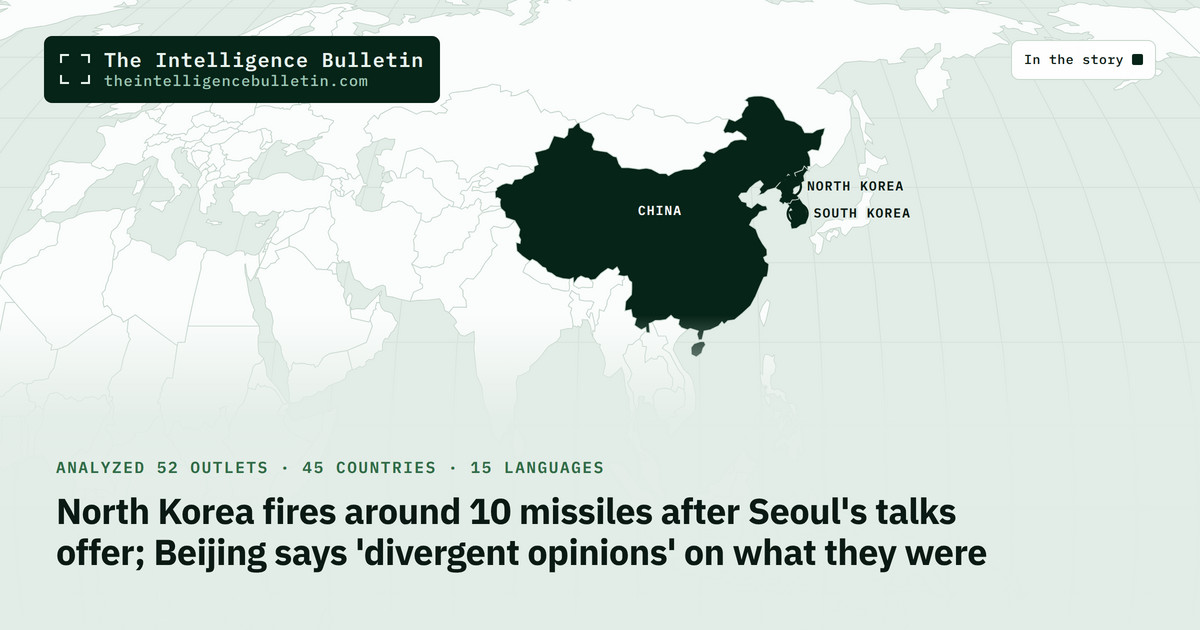
North Korea fired around ten short-range ballistic missiles from Wonsan on October 29, six days after Seoul proposed military talks. Beijing declined to call them missiles, citing ‘divergent opinions’ — carried only by El País — as Seoul and Tokyo condemned a UN Security Council violation.
Across the press: El País alone carries Beijing’s ‘divergent opinions’ caveat distancing China from Seoul’s missile account; South Korean, Japanese and US reports exclude it.
Source base: 5 outlets quoted (South Korea, Japan, United States, Taiwan, Spain), selected from 52 analyzed. 4 read in full, 1 by its headline only.
- 1 of 5 · The Chosun Ilbo onlyThe launch came six days after South Korea’s Defense Ministry proposed inter-Korean military talks to confirm the MDL, restore communication lines and prevent border clashes, and North Korea has not responded.The Chosun Ilbo, citing the Oct. 23 proposal by Defense Ministry policy director Kim Hong-cheol.
- 1 of 5 · El País onlyChina’s Foreign Ministry said there are ‘divergent opinions’ among the parties about the projectiles, distancing Beijing from Seoul’s account.El País, quoting Chinese Foreign Ministry spokesman Guo Jiakun.
- 5 of 5 · reported separatelyNorth Korea fired around 10, or more than 10, short-range ballistic missiles from the Wonsan area toward the sea off its east coast at about 12:30 p.m. local time on Oct. 29.Reported by The Chosun Ilbo, Nippon.com, NBC News and El País, all citing South Korea’s Joint Chiefs of Staff; Liberty Times’ headline alone states more than 10 missiles.
- 3 of 5 · reported separatelyThe missiles fell outside Japan’s exclusive economic zone and no damage to ships or aircraft around Japan was confirmed.Japan’s government, Defense Ministry and Chief Cabinet Secretary, as carried by Nippon.com, The Chosun Ilbo and NBC News.
- 2 of 5 · reported separatelyJapan and South Korea both characterized the launches as violating UN Security Council resolutions and as harmful to regional stability.Japan’s Chief Cabinet Secretary Minoru Kihara, reported by Nippon.com; South Korea’s government, reported by El País.
- Nov 18–19, 2026The APEC summit in Shenzhen — whether Trump and Kim meet, or Pyongyang stays away, will show if the missile volley achieved its leverage goal.
- Within days of Oct 29Whether Pyongyang resumes propaganda loudspeaker broadcasts toward South Korea, as Kim Yo-jong threatened on October 21.
- Within days of Oct 29Whether North Korea responds to Seoul’s October 23 military talks offer, or answers with more launches.
Full analysis
What happened Why it matters How each country tells it Where accounts conflict Room for disagreement Our assessment Sources and evidence
What happened
North Korea fired around ten short-range ballistic missiles into the sea off its east coast at 12:30 p.m. local time on October 29, the first ballistic missile launch in seventeen days. South Korea’s Joint Chiefs of Staff said the missiles were fired from the Wonsan area and flew about 250 kilometers; Japan’s Defense Ministry and Coast Guard confirmed none fell within Japan’s exclusive economic zone and no damage to ships or aircraft was reported around Japan, as Nippon.com’s Jiji Press account and NBC News both carried. The previous ballistic missile firing was October 12, with a separate October 14 submarine-launched cruise missile test, El País added.
Tokyo and Seoul both called the launches a violation of UN Security Council resolutions. Japan’s Chief Cabinet Secretary Minoru Kihara said they "violate U.N. Security Council resolutions and pose a serious problem to the safety of the people," and announced Japan had lodged a protest through its embassy in Beijing, as Nippon.com reported. Seoul’s government took the same position; the National Security Office held an emergency meeting, demanded Pyongyang cease "immediately," and said South Korea was sharing information closely with the United States and Japan, as El País reported.
The Chosun Ilbo alone tied the launch to the floundering diplomacy. The volley came six days after South Korea’s Defense Ministry, through policy director Kim Hong-cheol, formally proposed inter-Korean military talks to confirm the Military Demarcation Line, restore communications, and prevent border clashes. North Korea has not responded, the paper reported, even as provocations mount. The Chosun Ilbo also assessed the weapons as likely 600mm KN-25 super-large rockets with a maximum range of about 400 kilometers — aimed specifically at striking South Korea — and noted Kim Yo-jong’s October 21 warning of renewed loudspeaker broadcasts and 122mm artillery deployed to the western front.
El País supplied the diplomatic frame. Kim Jong-un visited the Chinese border city of Dandong on October 24, crossing a new bridge alongside Chinese Communist Party officials, a trip read as a gesture toward Beijing after years of prioritizing Moscow. Trump had reiterated willingness to meet Kim at the Shenzhen APEC summit set for November 18–19, though Pyongyang maintains it will not talk while denuclearization remains on the table. El País alone also carried China’s response: Foreign Ministry spokesman Guo Jiakun urged the parties to "preserve peace and stability" and seek a "political solution," but said "divergent opinions" exist among the parties about the projectiles, declining to call them missiles.
Why it matters
For South Korea, the launch lands as a rebuke. The Chosun Ilbo framed the volley as arriving six days after Seoul’s military talks offer, signaling Pyongyang’s refusal to de-escalate. The newspaper’s KN-25 assessment sharpens the threat: these are not a demonstration of intercontinental reach but a message within striking distance of the inter-Korean frontier, where soldiers were wounded by landmines in late September and where loudspeaker propaganda, fortification, and artillery deployment are all escalating.
For Japan, the stakes are maritime and legal. Nippon.com’s account centered on the missiles’ failure to enter Japan’s EEZ and the absence of damage, but Tokyo’s embassy-route protest through Beijing signals it treats the launches as a direct breach of UN Security Council resolutions.
For the regional alignment, Beijing’s ambiguity is the most consequential element. "Divergent opinions" preserves a gap between China’s position and the condemnation by Seoul and Tokyo; by refusing to call the projectiles missiles, Beijing holds open that something other than a banned ballistic missile flew over the sea, shielding Pyongyang five days after Kim’s Dandong visit.
How each country tells it
- The Chosun Ilbo · South Korea · original reportingFrames the volley as a rebuff to Seoul’s diplomacy, leading on the fact it came six days after the South’s military-talks offer and assessing the projectiles as 600mm KN-25 weapons aimed specifically at South Korea.
- Nippon.com · Japan · wire copyReports the launch as a Japanese maritime-security and diplomatic matter: ‘some 10’ missiles toward the Sea of Japan, none landing in Japan’s EEZ, no damage, and a Japanese protest lodged through Beijing.
- NBC News · United States · wire copyCarries a neutral wire account attributing the launch to South Korea’s JCS: around 10 SRBMs toward the sea off the east coast, with Japan’s EEZ note and recent test history.
- Liberty Times · TaiwanLeads on inter-Korean border escalation, headlining that North Korea fired more than 10 missiles and that border tensions are heating up.
- El País · Spain · original reportingPlaces the launch within a long-running escalation with South Korea, including September mines, border fortifications and the loudspeaker war, and adds the wider diplomatic frame of Kim’s China visit, a possible Trump meeting, and Beijing’s response.
Where accounts conflict
The reporting converges on the physical facts: around ten projectiles flew from Wonsan at around 12:30 p.m., traveled about 250 kilometers, and landed at sea outside Japan’s EEZ. The substantive disagreement is over what, exactly, was fired.
Seoul and Tokyo are unambiguous. South Korea’s Joint Chiefs of Staff called the launches short-range ballistic missiles, and Seoul’s National Security Office deemed them a UN Security Council violation, as El País reported; Japan’s Kihara, carried by Nippon.com, made the same characterization.
Beijing demurs. El País alone carried Guo Jiakun’s statement that "divergent opinions" exist among the parties about the projectiles. China’s position rests on its role as Pyongyang’s principal remaining patron, a relationship Kim tended with his Dandong visit five days before the launch, and on Beijing’s preference for a "political solution" in which it stays participant rather than critic.
Room for disagreement
The strongest case that this will not escalate further runs through Beijing and the APEC calendar. El País reported that Pyongyang’s Dandong visit was an overture to China, not a prelude to conflict. Guo Jiakun’s "divergent opinions" line, by withholding China’s endorsement of Seoul’s account, signals Beijing is managing the situation rather than abandoning it. Trump’s reiterated willingness to meet Kim at Shenzhen offers a channel that serious escalation would foreclose. Six days after Seoul’s talks offer and two weeks before the summit where both leaders are expected, the volley reads as pressure: the KN-25’s assessed 400-kilometer range is a calibrated local threat, meant to make Seoul feel exposed without triggering the broader war that would end Pyongyang’s own leverage.
Our assessment
It is likely that this launch is a bargaining maneuver tied to diplomacy rather than preparation for broader military conflict. The warrant is the timing and the weapon. The volley came six days after Seoul’s October 23 talks offer, as The Chosun Ilbo alone reported, and five days after Kim’s unusual border visit, with Trump’s APEC meeting readiness ten days out, both carried by El País. The missiles themselves, if The Chosun Ilbo’s KN-25 assessment is right, are artillery rockets aimed at South Korea — coercive, not annihilating. South Korea’s JCS, Japan’s Defense Ministry, and the US through NBC all described the launches as monitored and absorbed without damage, suggesting an event whose escalation value is political rather than kinetic. Pyongyang is using military display to posture before negotiations, and China’s refusal to call the projectiles missiles preserves the ambiguity Pyongyang needs.
What would change this: if China publicly endorses Seoul’s characterization, or if South Korea’s military reports massed North Korean forces moving toward the border itself, the call would shift toward a genuine escalation cycle.
Sources and evidence
Press quoted
- Has Pyongyang issued its own account of the launch, including the number, type and purpose of the missiles, and does it accept or reject Seoul’s reading that this answers the talks offer?
- Was the battery a preplanned exercise or a direct response to the October 23 talks proposal, given that the selected sources record no North Korean statement and no timing beyond the six-day gap?
- What exactly does Beijing mean by ‘divergent opinions’ about the projectiles, and is it disputing the count, the trajectory, or the characterization of the launches?
That’s how the world told the story.
Get our daily open-source intelligence on world events in your inbox — one email a day, up to six stories.
Subscribe freeNo spam. One-click unsubscribe. See the latest email →