 AI-generated analysis published under the editorial responsibility of Rohit Sinnas. How it works →
See the 27 countries
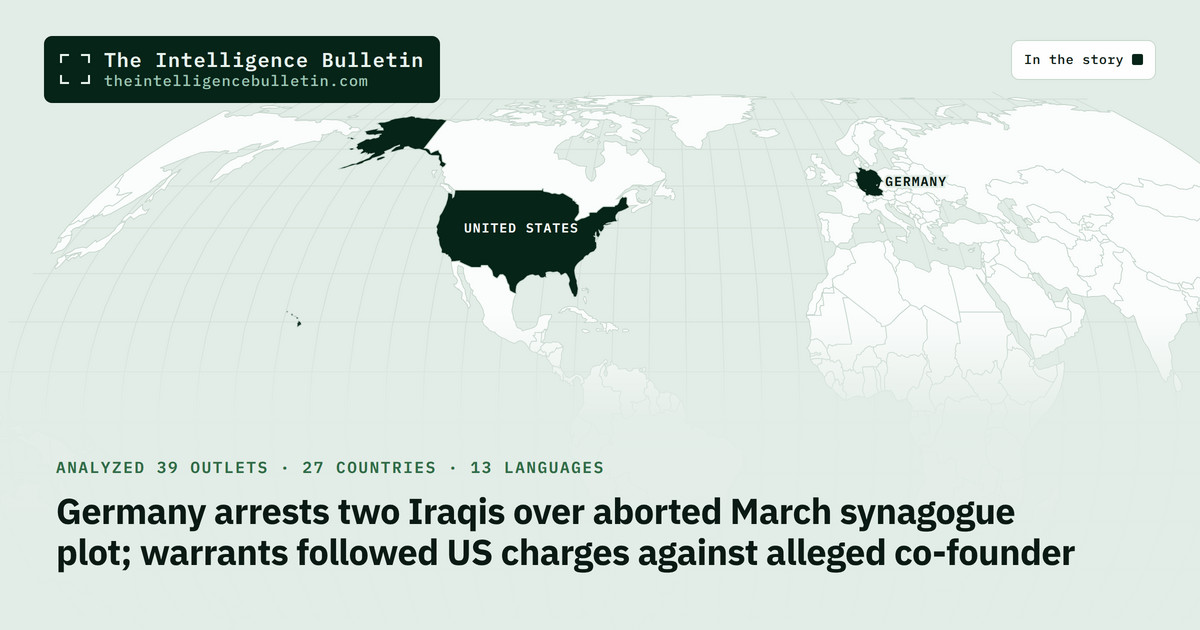
Afghanistan, Albania, Azerbaijan, Bangladesh, China, Cyprus, Denmark, Egypt, France, Germany, Greece, Hungary, India, Iran, Iraq, Israel, Lebanon, Madagascar, Malaysia, Netherlands, Pakistan, Qatar, Russia, Switzerland, United Arab Emirates, United Kingdom, United States
German federal prosecutors arrested two Iraqis accused of belonging to a cell, co-founded with US-charged Mohammad Al-Saadi in late 2025, whose operatives presumably carried explosives to two synagogues in March before abandoning the attacks; Washington calls Al-Saadi’s HAYI network an Iranian Revolutionary Guards front.
Across the press: CBS News alone dates the German warrants to November 18; Reuters, via The National, alone gives the November 10 US indictment that preceded them.
Source base: 5 outlets read in full (Germany, Israel, United Arab Emirates, Switzerland, United States), selected from 39 analyzed.
- 5 of 5 · reported separatelyFederal police arrested two Iraqi nationals, Mostafa Al-R. in Heidelberg and Ameer J. in Cologne, on November 26, with searches at 17 sites in Baden-Württemberg, Hesse and North Rhine-Westphalia.Germany’s Federal Prosecutor, as carried by dpa (SRF), Reuters (The National), CBS News, Deutsche Welle (via Arutz Sheva) and DOMRADIO.DE
- 5 of 5 · reported separatelyMostafa Al-R., Mohammad Al-Saadi, who is charged in the United States, and others founded a separate group in late 2025 to carry out bomb attacks in Germany and Europe, and Ameer J. was a member of it.Federal Prosecutor, across all five accounts
- 5 of 5 · reported separatelyPlots against synagogues in Cologne and an unnamed second European city were not carried out; according to all but Arutz Sheva, unidentified people acting for the group went to the synagogues on two consecutive nights in late March, presumably carrying explosives, then abandoned the attacks for reasons that remain unknown.Federal Prosecutor, as reported by dpa, Reuters, CBS News, Deutsche Welle and DOMRADIO.DE
- 2 of 5 · reported separatelyThe suspects are accused of membership in a domestic terrorist organization under Section 129a of the German Criminal Code, not of membership in HAYI itself.Federal Prosecutor, via dpa (SRF) and CBS News
- 2 of 5 · reported separatelyThe US government regards HAYI as a front for Kataib Hezbollah and the Revolutionary Guards.US government and US prosecutors, as reported by CBS News and by Reuters in The National
Full analysis
What happened Why it matters How each country tells it Room for disagreement Our assessment Sources and evidence
What happened
On the morning of Thursday, November 26, officers of Germany’s Federal Criminal Police Office arrested two Iraqi nationals: Mostafa Al-R. in Heidelberg and Ameer J. in Cologne. Their surnames are withheld under German privacy rules. The officers acted on warrants from an investigating judge at the Federal Court of Justice, and CBS News reports the judge issued them on November 18. Searches ran at the same time at 17 premises. The dpa account carried by SRF lists them as the Rhein-Neckar and Biberach districts in Baden-Württemberg, Rüsselsheim am Main in Hesse, and Bergisch Gladbach, Hürth, Kerpen, Remscheid and the Euskirchen district in North Rhine-Westphalia. CBS and Deutsche Welle put the force at more than 250 federal and state officers. The search in Hürth targeted a third suspect, who was neither arrested nor named. The other searches touched people who are not under suspicion.
The accusation comes from the Federal Prosecutor’s statement, which all five reports reproduce. In late 2025, prosecutors say, Mostafa Al-R., Mohammad Al-Saadi and others founded a separate group to carry out bomb attacks in Germany and elsewhere in Europe, and Ameer J. was a member. The statement, quoted by SRF from dpa, says the group "beschaffte sich Gelder und rekrutierte mehrere externe Personen für die Begehung von Sprengstoffanschlägen" (it raised money and recruited several outside people to carry out bomb attacks). Prosecutors say that on two consecutive nights in late March, unidentified people acting for the group went to a synagogue in Cologne and to one in another European city, presumably carrying explosive devices. Neither attack was carried out, for reasons prosecutors say are unknown. No report names the Cologne synagogue or the second city.
The charge is membership in a domestic terrorist organization under Section 129a of the German Criminal Code, not membership in HAYI. Prosecutors describe the group as pro-Iranian. The case began with intelligence from the Federal Office for the Protection of the Constitution, Germany’s domestic intelligence service. Both men were due before the investigating judge in Karlsruhe on Thursday for a decision on pretrial detention, and none of the five reports gives the outcome. CBS notes that prosecutors would not say how long the men had lived in Germany, what their immigration status was, or whether they hold other nationalities.
Al-Saadi is the link to the wider network. German prosecutors call him a key figure in Harakat Ashab al-Yamin al-Islamiyya, or HAYI. They say the group surfaced after the Iran war began early this year and has claimed attacks on US, Israeli and Jewish institutions in Europe since March. CBS adds three points. Germany’s domestic intelligence agency ties HAYI to attacks in Britain, France, Belgium and the Netherlands. Britain has designated HAYI a terrorist organization. The US government calls it a front for the Revolutionary Guards and Kataib Hezbollah.
Reuters, carried by The National, gives the American case in detail. US prosecutors say Al-Saadi holds Iranian and Iraqi citizenship and is a member of both Kataib Hezbollah and the Revolutionary Guards. On November 10 the Justice Department unsealed an eight-count indictment against him and two others: Mohsen Mohajeri, an Iranian, and Mohammad Ali Al Hassani, an Iraqi. The indictment alleges plots that include one in September against RAF Fairford, a British base then housing US aircraft. It also links the three men to a spring campaign of arson, explosives attacks and a London stabbing that seriously injured two Jewish men. Al-Saadi is in a New York prison awaiting trial. The whereabouts of his co-defendants are unknown.
Two public reactions appear in the reporting. North Rhine-Westphalia Premier Hendrik Wüst wrote, as quoted by Deutsche Welle and carried by Arutz Sheva: "Anyone who attacks it attacks us all." Heiko Teggatz, who heads the German Police Union, told dpa that "Unsere Freiheit darf nicht dem Terror weichen" (our freedom must not give way to terror).
Why it matters
The arrests did not stop the March attack. By the prosecutors’ own account, people presumably carrying bombs reached two synagogues and turned back on their own, for reasons nobody has explained. Those people are still unidentified eight months later. The arrests remove two alleged organizers, but the operatives who actually went to the buildings remain at large.
The dates also change how the story should be read. Prosecutors place the cell’s founding at the end of 2025, before HAYI emerged publicly after the war began. DOMRADIO.DE gives both dates explicitly. On that account, the network was built before it had a banner. That undercuts the reading the editor brought to this story: that the Iran confrontation, now reaching into Kuwait, is newly reaching Europe’s Jewish communities. None of the five reports mentions Kuwait or the Gulf front, and the reach into Europe they describe happened in the spring.
Two vantages are missing from this set. It includes no Iraqi or Iranian outlet, and none of the five reports carries any response from Baghdad or Tehran. The home government of the two accused men is not heard at all.
The November 18 warrants came eight days after the November 10 unsealing in Washington. No outlet reports coordination between the two, so this is a sequence rather than a demonstrated link. Still, it places the German case in step with the American prosecution. The German charge is also built so that a court in Karlsruhe will not have to rule on whether HAYI is an Iranian proxy.
How each country tells it
- DOMRADIO.DE · Germany · carries Federal Public Prosecutor General (Bundesanwaltschaft)A close restatement of the Federal Prosecutor’s announcement: the arrests in Heidelberg and Cologne, the 17 searches, the late-2025 founding of the cell and the aborted March run at synagogues.
- Arutz Sheva (Israel National News) · Israel · carries Deutsche WelleRetells Deutsche Welle’s report and places the arrests in a wave of attacks on European Jewish institutions since the Iran war began, adding last month’s German sentencing of two men in an Iranian-directed assassination plot.
- The National · United Arab Emirates · wire copyTies the cell to the US case against Mohammad Al-Saadi, citing US prosecutors who call HAYI a front for Kataib Hezbollah and Al-Saadi a member of both that militia and the Revolutionary Guards.
- SRF (Schweizer Radio und Fernsehen) · Switzerland · wire copyGives the fullest procedural account: every search location by district, the charge of membership in a domestic terrorist organization, the court appearance in Karlsruhe, and a translation of HAYI’s name.
- CBS News · United States · original reportingDatelined Berlin, it builds the story around HAYI as a network that Washington calls a front for the Revolutionary Guards and Kataib Hezbollah, and that Britain has designated a terrorist organization.
Room for disagreement
The strongest case against treating this as an old, contained plot comes from the reporting itself. Prosecutors say the group recruited outside operatives and raised money, and those recruits are unaccounted for. A third suspect was searched in Hürth but not detained. According to the US indictment, the wider network was planning against RAF Fairford in September, six months after Cologne. Teggatz’s warning ahead of the Christmas season reads as a police judgment that the danger is current.
On the question of Iran, the weight of state assessments points one way. Washington calls HAYI a Revolutionary Guards front, London has designated it, and German intelligence links it to attacks in four other countries. Berlin’s own prosecutors call the cell pro-Iranian.
Our assessment
The link between these arrests and HAYI is likely to hold in the form German prosecutors have stated it, a personal tie running through Mohammad Al-Saadi, while the German case is built to stop short of proving Iranian direction.
Every account traces back to one primary source: the Federal Prosecutor’s statement. It reached readers through four separate chains (dpa, Reuters, Deutsche Welle and CBS), so what is confirmed is what prosecutors said, not that a court has tested it. The Iran attribution rests on the US government and US prosecutors. Washington is at war with Iran and is prosecuting Al-Saadi, so it has a direct interest in the reader seeing HAYI as Tehran’s instrument. German prosecutors, by choosing a domestic-organization charge, have avoided having to carry that claim into court.
What would change this: German prosecutors filing charges that name HAYI as a foreign terrorist organization or allege Iranian state direction, or investigators identifying the people who went to the synagogues in March.
Sources and evidence
Press quoted
- Who were the people who reached the Cologne synagogue in March and turned back, and is the third suspect whose home in Hürth was searched one of them?
- Which Cologne synagogue and which second European city were targeted, and has that city’s government acted on the same plot?
- What does Baghdad say about two of its citizens being charged in a plot that US prosecutors tie to an Iraqi militia, given that the selected sources include no Iraqi outlet and German prosecutors disclosed neither the suspects’ residency status nor any other nationality?
That’s how the world told the story.
Get our daily open-source intelligence on world events in your inbox — one email a day, up to six stories.
Subscribe freeNo spam. One-click unsubscribe. See the latest email →