 AI-generated analysis published under the editorial responsibility of Rohit Sinnas. How it works →
See the 54 countries
Afghanistan, Argentina, Armenia, Austria, Azerbaijan, Bangladesh, Belgium, Brazil, Bulgaria, Burundi, Canada, China, Colombia, Croatia, Cyprus, Denmark, Egypt, Estonia, Finland, France, Germany, Greece, Hungary, Indonesia, Ireland, Israel, Italy, Latvia, Lebanon, Lithuania, Luxembourg, Mali, Mexico, Moldova, Morocco, New Zealand, Nigeria, Pakistan, Qatar, Romania, Russia, Senegal, Serbia, Somalia, South Africa, Spain, Sweden, Switzerland, Syria, Taiwan, Turkey, Ukraine, United Arab Emirates, United States
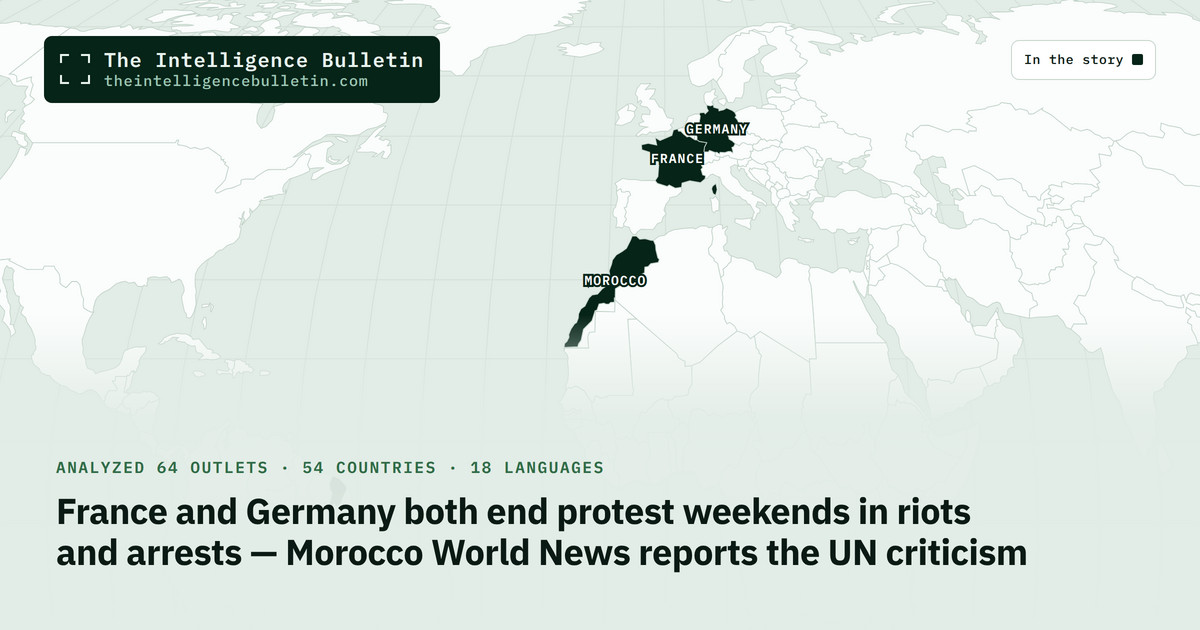
France’s third protest weekend ended with more than 500 arrests after evening riots, while Germany’s first ‘Gen Z regelt’ mobilisation turned to looting in Frankfurt. Only Morocco World News carries the UN’s criticism of France’s response to the crackdown.
Across the press: Morocco World News alone carries the UN’s criticism of France’s use of force, absent from all four European outlets.
Source base: 5 outlets read in full (France, Germany, Austria, Morocco, Romania), selected from 64 analyzed.
- 1 of 5 · Antena 3 onlyA Paris gendarme was struck by a Molotov cocktail and seriously burned; Interior Minister Nuñez called the incident attempted murder.Antena 3, citing Nuñez via The Guardian; Kurier independently reports BFMTV images showing officers caught in flames but does not name the gendarme or Nuñez’s characterization.
- 4 of 5 · reported separatelyFrance held its third consecutive weekend of national protest over the cost of living and public services on Oct 31, 2026, with marches in Paris and dozens of other cities.Le Nouvel Obs (own reporting), Kurier (own roundup), Morocco World News (own compilation), and Antena 3 (citing French official sources) all report the third weekend of mobilisation.
- 4 of 5 · reported separatelyThe French state deployed 70,000 police and gendarmes nationwide, and the Council of State barred the planned central Paris Bastille–Nation march, relegating the cortege to Porte de Bagnolet–Porte de Charenton.Le Nouvel Obs (citing Interior Minister Laurent Nuñez and the march’s route), Morocco World News (own reporting of the Council of State ruling), Kurier and Antena 3 (citing Nuñez).
- 3 of 5 · reported separatelyAfter largely peaceful afternoon rallies, rioting and looting broke out in Frankfurt and other German cities during the ‘Gen Z regelt’ protest wave, with water cannon deployed in Cologne and Frankfurt.taz (Frankfurt police and Hesse Interior Ministry figures), Kurier (own roundup of German cities), Antena 3 (Reuters witness account and Bild).
- 2 of 5 · reported separatelyFrench police arrested more than 500 people nationwide on Oct 31 — Interior Minister Nuñez gave 520 (as reported by Kurier), while the Interior Ministry’s Saturday evening count reached 565 (as reported by Antena 3).Kurier citing Nuñez and Antena 3 citing the Interior Ministry; both independent chains agree the figure exceeded 500.
- November 3–5Student blockades in French high schools and universities, then the November 5 general strike called by the unions — the first test of whether the third weekend’s turnout decline continues.
- November 6–7Renewed strikes and blockades on November 6 and the gilets jaunes’ ‘Act IV’ on November 7 — whether the movement’s scheduled escalation materialises at the same scale.
- November 20‘Gen Z regelt’ has named this Europe-wide protest date, while Hesse Interior Minister Roman Poseck has already said it ‘must not take place’ — a legal and street confrontation in waiting.
- Any court ruling on Poseck’s ban bidA court ruling upholding or rejecting Poseck’s call to ban the November 20 demonstration would preempt or inflame the next German escalation.
Full analysis
What happened Why it matters How each country tells it Where accounts conflict Room for disagreement Our assessment Sources and evidence
What happened
On the third Saturday running, France marched against the cost of living and public services, while the youth protest wave that had already touched France, Italy and Spain reached Germany the same afternoon. In Paris on October 31, the authorized cortege was pushed from its organizers’ chosen Bastille–Nation route to the city’s south-eastern edge, Porte de Bagnolet to Porte de Charenton, after the Council of State overturned a lower court decision; Le Nouvel Obs and Morocco World News both report the ruling.
Behind the route change stood a deployment of 70,000 police and gendarmes nationwide, for what Interior Minister Laurent Nuñez called a day of "very high risk" — more than 10,000 officers heavier than the previous demonstration, by Morocco World News’s count, with over 40 Paris metro stations closed. The Interior Ministry put participation at about 320,000, down from 410,000 the week before, and the marches were peaceful through the afternoon; Nuñez said about 150 scheduled demonstrations passed without incident.
Trouble came at the edges as evening fell. At Porte de Charenton, the Paris police prefecture described "a hard core of several hundred violent people"; in Toulouse water cannons dispersed an unauthorized march of several thousand, mostly young, and in Lyon, Marseille and Rennes came reports of tear gas, burning objects and thrown projectiles. The night’s most serious claim rests on one outlet: Antena 3, citing Nuñez via The Guardian, says a gendarme was struck by a Molotov cocktail and seriously burned, and that the minister called it attempted murder. Kurier independently reports BFMTV images of officers caught in flames in Paris, but names no singled-out gendarme and carries no "attempted murder" line. The Interior Ministry’s Saturday evening count put arrests at 565; Nuñez himself had spoken of 520.
In Germany the same afternoon, the new initiative "Gen Z regelt" held its first national day of action — "Jetzt sind wir dran," now it is our turn. Kurier counts 34 registered demonstrations in German cities, four organized directly by the initiative, demanding more money for schools, addiction help and psychotherapy, action on living costs, social justice, climate protection, and rejection of compulsory military service and state surveillance. In Frankfurt, taz reports, about 10,000 gathered, including a 15-year-old from the Eichendorffschule named Sheriff, who said his school’s toilets are broken, teachers are lacking, "and we cannot learn properly." The march held peaceful until just before the Konstablerwache; shortly after 6 p.m. police used water cannons and dissolved it. Overnight up to a hundred rioters and looters smashed shop windows, briefly raised barricades and threw firecrackers; Frankfurt police counted 17 damaged shops, the Hesse Interior Ministry put forces at 1,300 with more than 100 officers injured, one losing several teeth to a stone, and 54 arrests, aged 13 to 29, mostly German citizens from what Interior Minister Roman Poseck called a "migrantisches Milieu." Poseck attributed the violence to about 100 "left-extremist motivated" perpetrators and said police would now focus on "young migrant men." Antena 3 adds that masked protesters in Frankfurt smashed a weapons-store window and stole arms, recovered later by police. The same arc played out in Cologne, Stuttgart, Berlin, Hamburg and Bremen, where a police spokesman said "one can no longer speak of a completely peaceful course." Vienna’s two demonstrations under the same slogan passed quietly, with no incidents, ending in the early evening, according to Kurier. In Tirana, an anti-government rally turned when dozens of masked youths threw cobblestones and Molotovs at police, renewing demands for Prime Minister Edi Rama’s resignation.
The weekend closed with the organizers’ next dates already announced. The gilets jaunes called for pot-banging Friday before the November 5 general strike, then renewed strikes and blockades November 6 and an "Act IV" November 7. Student unions, unconvinced by the government’s promised replacement of the Parcoursup admissions system, threatened new blockades Tuesday and Thursday, before joining the November 5 march, as Union Étudiante’s Sabrine Kharbach put it. "Gen Z regelt" distanced itself the same evening — "violence was and is never part of our movement" — and announced it would join European-wide protests on November 20, a date Poseck said "must not take place," vowing "robust" policing "from the start."
Why it matters
Three things are at stake. First, the French movement has an organized calendar and the state an organized response, both hardening in step — 70,000 deployed this time, more than 10,000 above last weekend; November 5, 6 and 7 already named; the government preparing. This is a wave scheduling, not subsiding.
Second, the revolt has become generational and border-crossing. "Gen Z regelt" presents itself as continuing what already reached France, Italy and Spain, and has named November 20 as a European date. France’s student unions, Germany’s school students and Albania’s masked youth share grievances and take them to the street.
Third, the heaviest cost is falling on the handling of the protests, and there the coverage splits. Morocco World News, alone, carries the UN human rights office’s criticism of France’s "excessive use of force and mass arrests of high school and university students." None of the four European outlets reports it, so a reader of Le Nouvel Obs, taz, Kurier or Antena 3 sees 70,000 officers, the route ban, 565 arrests as necessary containment, and never learns an international body faulted it. Each outlet’s framing is distinct: Le Nouvel Obs reads the mobilization from inside, taz from the ground while relaying Poseck’s "migrantisches Milieu" without challenge, Kurier as a Central European round-up whose Vienna stayed quiet, Antena 3 as "scenes like war in Europe." Only Morocco World News sees the international fault-line.
How each country tells it
- Le Nouvel Obs · France · original reportingReads the mobilisation from inside it — the Paris route from Porte de Bagnolet, the 70,000-strong deployment, the government’s unconvincing Parcoursup concession, and the already-planned escalation of Nov 5–7.
- taz · Germany · original reportingTreats the Frankfurt riots as home news: a peaceful 10,000-strong rally that curdled near the Konstablerwache, reported partly from the ground with the demonstrators’ school grievances quoted by name, while carrying Interior Minister Poseck’s ‘migrantisches Milieu’ and far-left attribution at face value.
- Kurier · Austria · original reportingReads the weekend as a cross-border Central European wave — water cannon in Cologne, riots in Hamburg and Stuttgart, 34 German cities in all — from an affected neighbour whose own Vienna protests stayed calm.
- Morocco World News · MoroccoSees France as a security story from across the Mediterranean: 70,000 officers, 40 closed metro stations, the Council of State’s route ban, and — alone in the set — the UN human rights office’s criticism of France’s excessive force and mass arrests.
- Antena 3 · RomaniaThe Eastern European law-and-order reading: ‘scenes like war in Europe’, weapons stolen from a Frankfurt arms shop, a gendarme engulfed in flames, and the Interior Minister’s ‘attempted murder’ line — the weekend as a warning about disorder in the heart of the EU.
Where accounts conflict
The weekend’s most serious claim — a Paris gendarme struck by a Molotov cocktail and seriously burned, with Nuñez calling it attempted murder — rests on a single outlet, Antena 3, citing Nuñez via The Guardian. Kurier independently reports BFMTV images of officers in flames, which is compatible but names no singled-out gendarme and carries no "attempted murder" line. Le Nouvel Obs and Morocco World News carry no Molotov attack at all. The Saturday-evening arrest count likewise splits along official lines: Nuñez spoke of 520, as Kurier reports; the Interior Ministry’s count, as Antena 3 reports it, came in at 565. Both exceed 500, which is the settled figure for the night, but each carries the name of whoever released it.
Room for disagreement
The strongest case against expecting this to continue and intensify is that the movement may already be cresting: the police count for October 31 was 320,000, below 410,000 the previous Saturday and 550,000 on October 17, as Le Nouvel Obs reports. The violent minority is tiny — "a hard core of several hundred" among 70,000 in Paris, about 100 among 10,000 in Frankfurt. Poseck is vowing to have November 20 banned; a court could agree and preempt it. The organizers themselves distanced themselves from violence, which may thin the crowd that returns. On this view, the third weekend was the hard core riding a shrinking wave, and the crackdown may deter the peaceful majority; if turnout falls again, the November dates will draw further from fewer and the wave will spend itself.
Our assessment
Very likely that the protest wave continues and escalates through the scheduled November actions — student blockades Tuesday and Thursday, the November 5 general strike, November 7’s "Act IV" and November 20 — and that the state will meet each with force at least as heavy as Saturday’s. The warrant is on the record and corroborated across independent reporting chains: the CGT, gilets jaunes and student unions named those dates in advance, Le Nouvel Obs and Kurier report them, and "Gen Z regelt" named November 20 in its own voice to dpa. Governments are preparing for the same dates; Poseck’s promise of "robust from the start" policing and France’s 70,000-strong deployment are commitments to meet them the same way. No party with power has an incentive to stand down. The editor’s brief expected "unrest in Vienna"; the only Vienna reporting in the set, Kurier’s, describes calm, incident-free demonstrations, so the unrest the story was picked for turns out to have been elsewhere — Tirana, and the edges of Paris, Frankfurt, Cologne and Hamburg.
What would change this: a court ruling upholding Poseck’s bid to ban November 20, or a further drop in turnout that persuades organizers to stop scheduling.
Sources and evidence
Press quoted
- What was the final confirmed arrest toll in France — 520 as Nuñez said Saturday evening per Kurier, or 565 as the Interior Ministry’s later count has it per Antena 3 — and how many people were wounded across the country?
- Did masked protesters actually break into a Frankfurt weapons shop and steal arms, as Antena 3 reports, given that neither German source in the set mentions it?
- Who were the ‘hard core of a few hundred violent people’ the Paris Police Prefecture says attacked officers, and why do the four European outlets not carry the UN human rights office’s criticism of France’s use of force and mass arrests?
That’s how the world told the story.
Get our daily open-source intelligence on world events in your inbox — one email a day, up to six stories.
Subscribe freeNo spam. One-click unsubscribe. See the latest email →