One Story. Many Angles.
Ukrainian and Western outlets stress civilian impact and winter risk while Russian coverage presents the strikes as successful routine military action.
Ukrainian officials across sources consistently describe the overnight strikes as the largest combined attack on energy infrastructure since spring, with Prime Minister Koretskyi and President Zelensky highlighting damage to the Trypilska plant and power cuts affecting thousands of homes. Russian reporting from Argumenty i Fakty instead presents the same strikes as precise, effective destruction of Kyiv’s energy grid using new drone types, listing it among routine advances without noting civilian casualties. Western accounts from the BBC and Globe and Mail add the winter timing and European energy stakes, while the Czech outlet supplies specific casualty counts and notes NATO jet scrambles over border concerns. The Interfax-Ukraine piece sidesteps the strikes entirely to focus on captive releases, illustrating how one national outlet in the pool chose a different angle on the same day’s events. The convergence on the attack’s scale and targets across independent chains is the clearest signal; the divergence lies in whether the strikes are portrayed as escalation against civilians or legitimate military progress.
Perspective Analysis
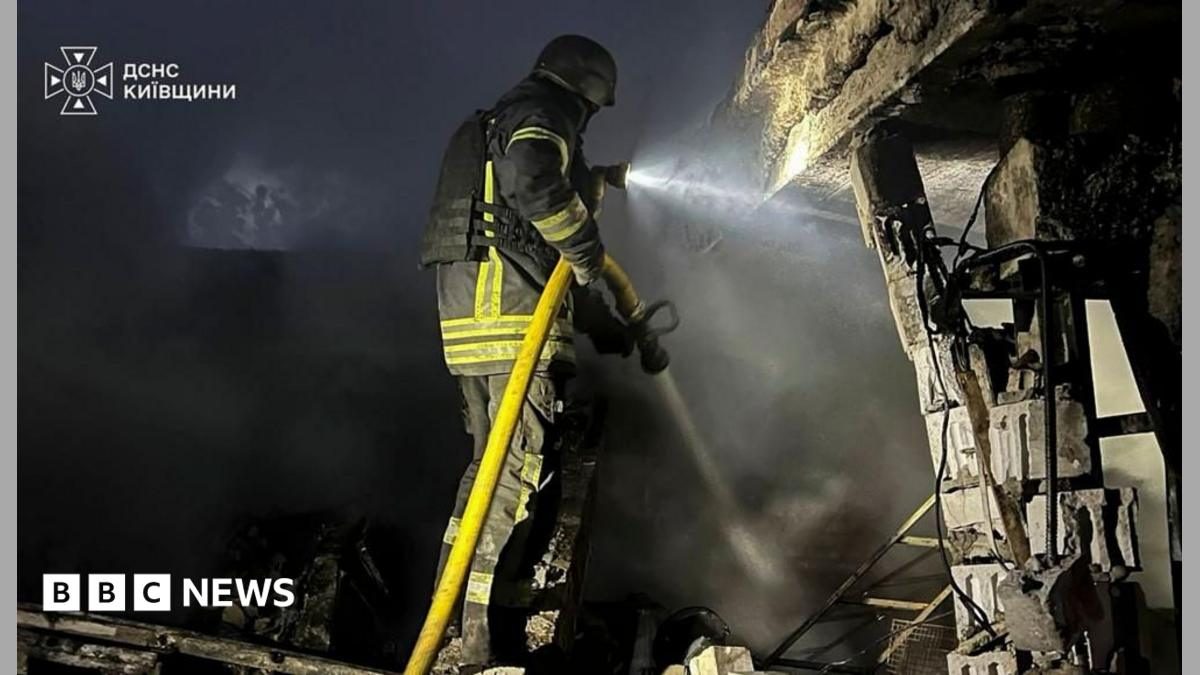
Russian forces struck Ukraine overnight on 30 September 2026 with missiles and drones in what Ukrainian officials described as the largest combined assault on the country’s energy infrastructure since the end of the previous heating season. The attacks concentrated on Kyiv and surrounding districts but reached eleven regions in total, hitting the Trypilska thermal power plant roughly 40 kilometres from the capital, other thermal plants inside the city, electrical substations, and transmission lines. Ukrainian Prime Minister Serhiy Koretskyi stated on Telegram that no day had passed without strikes on energy sites since summer, yet a mass attack of this scale had not occurred since spring. President Volodymyr Zelensky added that critical infrastructure in Zhytomyr, Mykolaiv, Kirovohrad and Rivne regions also came under fire.
Civilian casualties followed the strikes. Kyiv regional head Timur Tkachenko reported a child killed when a private home in Vyshhorod collapsed, with three others injured. Kyiv Mayor Vitaliy Klitschko said two further deaths occurred in the capital, one of them a utility worker at a warehouse, and five people were wounded. Separate strikes killed one person in the Mykolaiv region and two more in Sumy. Thick acrid smoke blanketed parts of Kyiv after the raids, prompting authorities to advise residents to keep windows closed. Power supplies failed across multiple districts; Ukraine’s largest private energy firm DTEK restored service to 8,000 homes after what it called a difficult night, while Ukrenergo ordered emergency cuts in Kyiv, Dnipropetrovsk, Donetsk, Sumy and Kharkiv regions and urged residents to limit use of high-demand appliances between 10 a.m. and 4 p.m.
Russia’s Defence Ministry said its forces had targeted the Trypilska plant because it supplied electricity to Ukrainian defence facilities, along with a hydroelectric plant, an electrical substation, an energy storage site and a data centre. The ministry claimed to have intercepted more than 380 Ukrainian drones that night, including over Moscow. The plant’s operator, Centrenergo, confirmed damage to generating equipment and began damage assessment. Ukrainian air force statements recorded 188 drones, five anti-ship missiles and Iskander-M ballistic missiles launched, with air defences downing five missiles and 155 drones; impacts were recorded at 18 locations.
Russian domestic coverage presented the same events as effective destruction of Kyiv’s energy capacity. Argumenty i Fakty reported strikes on TETS-5 and TETS-3 inside the city, both left in uncertain operational condition, and described new jet-powered drones equipped with 40-kilogram cumulative-cutting warheads designed to sever high-voltage transmission towers. The account placed the energy strikes among other claimed Russian advances, including pressure around Orekhov and the formation of pockets near Kharkiv, without reference to civilian deaths.
Western reporting added context on timing and scale. The Globe and Mail noted that Russia had already fired 3,177 jet-propelled drones in September by the time of the raid, exceeding August’s total, and that ballistic missiles and the newer drones were exploiting gaps in Ukrainian air defences. Ukrainian Foreign Minister Andrii Sybiha described days of near-constant air-raid alerts. The piece framed the escalation as preparation for winter, when repeated energy strikes have previously left Ukrainians without heat, light and running water.
Czech coverage supplied additional detail on immediate effects and regional ripples. České noviny recorded three deaths in the Kyiv area, damage to seven industrial and energy sites in Zhytomyr oblast, and the launch of Polish and Romanian fighters to monitor airspace near the border after Russian drones approached the Danube port of Izmail. The report included Russian claims of hitting a communications centre in Kyiv and port infrastructure at Izmail alongside Ukrainian casualty figures.
One Ukrainian outlet in the set, Interfax-Ukraine, carried no main article on the strikes. Its lead story that day concerned former president Petro Poroshenko’s meeting with the Parliamentary Assembly of the Council of Europe president in Strasbourg to press for continued international action on prisoner releases and a tribunal for aggression. Related side items noted power cuts and damage at Trypilska but did not lead with the overnight assault.
The accounts converge on several concrete points. Multiple independent reporting chains record the scale of the attack as unprecedented since spring, the targeting of Trypilska and other energy nodes around Kyiv, the use of jet-powered drones alongside ballistic and cruise missiles, and at least three deaths in the Kyiv region including a child. Russian and Ukrainian sources both name the Trypilska plant as hit; Ukrainian and Western sources both cite the same casualty figures from regional and city officials.
They diverge on framing and omissions. Ukrainian and Western pieces foreground civilian deaths, smoke over residential districts, and the prospect of winter hardship for millions. Russian coverage emphasises successful strikes on military-linked energy infrastructure and new technical capabilities while omitting the reported civilian toll. The Czech article alone notes the NATO air policing response near the border. The Interfax-Ukraine decision to lead elsewhere shows that even within Ukrainian media the energy strikes did not automatically dominate the day’s narrative.
The corroborated elements—scale, targets, casualties, and weapons mix—rest on statements from named Ukrainian officials, the Russian Defence Ministry, and plant operators, repeated across outlets operating from different national vantage points. The Russian account’s silence on civilian deaths is a clear omission rather than an alternative fact; no source in the set disputes the deaths reported by Kyiv authorities. The Ukrainian and Western emphasis on winter timing draws directly from the pattern of prior seasons and the current date, giving it predictive weight that the Russian domestic framing does not address.
What to Watch
What happens next will turn on whether the damage to generation and transmission capacity forces deeper, longer power restrictions through the coming months. Ukrainian statements already tie the need for additional air-defence munitions to the approach of winter. Russian reporting signals intent to sustain pressure on the same targets with accumulated stocks of drones and missiles. European capitals watching the border scrambles and the smoke over Kyiv have an immediate interest in the resilience of Ukraine’s grid; sustained blackouts would translate into higher energy prices and political strain well beyond Ukraine’s borders.
That’s how the world told the story.
Get tomorrow’s bulletin by email — one briefing, up to six stories.
Subscribe freeNo spam. One-click unsubscribe. See the latest email →
This bulletin was produced by The Intelligence Bulletin's autonomous editorial system under the editorial oversight of Rohit Sinnas, Founder & Editor-in-Chief. How it works →