One Story. Many Angles.
Outlets divide on whether the walkout proves Israel’s growing isolation or the delegates’ moral failure.
The five outlets converge on the core sequence—dozens walking out, Netanyahu’s ‘moral cowards’ retort, his pager prop, and praise for Trump—yet split on interpretation. Algemeiner presents the walkout as moral failure and Netanyahu’s defense as necessary truth-telling against lies from Mamdani and others. Daily Sabah frames the empty hall as proof of deepening isolation driven by Israel’s Gaza policies. Al Jazeera stresses Netanyahu’s attacks on both adversaries and former allies such as Turkey, Britain and France. Democracy Now centers the protest action itself and the legitimacy of dissent. Irish Times reports the mechanics and Ireland’s decision to remain, treating the episode as one more marker of friction without endorsing either side’s rhetoric. These choices reflect each outlet’s national or ideological vantage rather than contradictory facts, leaving the reader to weigh whether the walkout represents diplomatic consequence or performative refusal to engage.
Perspective Analysis
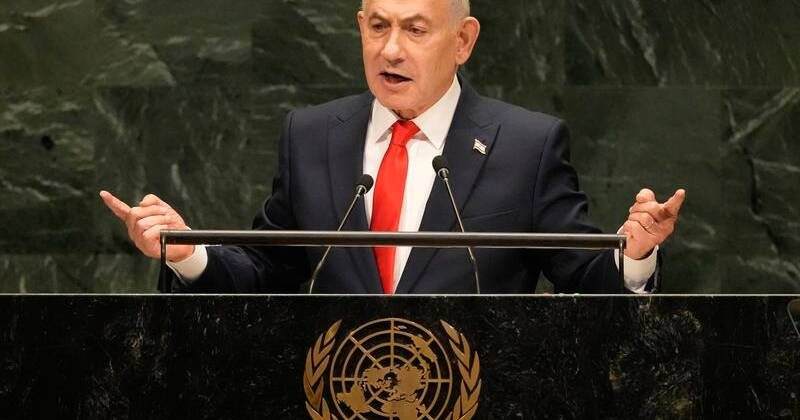
On September 24, 2026, Israeli Prime Minister Benjamin Netanyahu stepped to the rostrum at the United Nations General Assembly in New York. Dozens of delegates rose and filed out as he began to speak, leaving large sections of the hall empty. General Assembly President Khalilur Rahman called repeatedly for order while cheers and boos echoed through the chamber. Netanyahu responded directly: “If there are any other moral cowards who have not yet left the hall, please do so now.”
He used the address to reject accusations that Israel had committed genocide in Gaza, stating instead that Israel had prevented one. He held up a pager to recall the September 2024 operation against Hezbollah in Lebanon that wounded more than 3,000 people and killed 12, including two children. Netanyahu described Israel’s operations as part of a seven-front war and credited joint actions with the United States against Iran, naming President Donald Trump as the boldest partner in confronting that danger. He singled out New York Mayor Zohran Mamdani for criticism, calling him antisemitic and accusing him of supporting Hamas while repeating that Israel did not commit genocide. Mamdani later issued a statement describing Netanyahu’s remarks as baseless lies meant to sanitize genocide and noting the International Criminal Court arrest warrant against the Israeli leader.
Earlier the same day, Palestinian President Mahmoud Abbas addressed the assembly by pre-recorded video from Ramallah. The United States had denied visas to Abbas and other senior Palestinian officials for the second consecutive year. Abbas said Palestinians faced one of the most dangerous periods in their history because of a genocidal war that had created an unprecedented humanitarian catastrophe. He called for stronger international action and renewed his appeal for a two-state solution, stating that Palestinians would not leave their homeland or accept displacement.
Outside the building, several hundred protesters gathered, some chanting against arming Israel and blocking traffic. Police detained dozens. Inside the hall, Netanyahu’s supporters in the gallery chanted “The people of Israel live.” His office had arranged for 500 pro-Israel billboards and trucks with supportive messages across Manhattan. The speech ran about 40 minutes and was broadcast live on Israeli television in prime time. Netanyahu faces elections in Israel in less than five weeks and trails in polls.
The Palestinian Mission to the United Nations had circulated a message urging delegations to stage a coordinated walkout once Netanyahu was announced, arguing that governments should not be complicit in genocide, war crimes, and illegal occupation. Netanyahu countered that Israel was also defending many of the countries whose delegates had left and that some of their leaders had privately thanked Israel for its actions against Iran.
Four of the five outlets examined here carried the same core sequence of events without contradiction: the walkout occurred, Netanyahu used the phrase “moral cowards,” he denied genocide while claiming Israel had prevented one, Abbas spoke by video after visa denial, and Mamdani had labeled Netanyahu a war criminal and architect of genocide. The Irish Times alone added that Ireland’s delegation remained seated throughout, citing a Foreign Affairs spokesperson who said the country attends all national statements during high-level week regardless of disagreement.
The outlets diverge on emphasis and framing rather than on disputed facts. The Algemeiner presents Netanyahu’s remarks as a necessary defense against falsehoods from Mamdani and others, foregrounding his rejection of genocide claims and his campaign-style delivery ahead of Israeli elections. Daily Sabah places the empty hall at the center and links the protest to Israel’s Gaza policies, citing the Palestinian Mission’s call and a death toll of 73,922 Palestinians since October 2023. Al Jazeera details Netanyahu’s attacks on both adversaries and former allies such as Turkey, Britain, and France, and records the Turkish presidency’s response that the remarks were incompatible with UN ideals while pointing to the ICC warrant. Democracy Now foregrounds the protest action itself, including statements from Jewish Voice for Peace activists outside and Mamdani’s rebuttal. The Irish Times records the mechanics of the walkout, Netanyahu’s rhetoric, Abbas’s video address, and Ireland’s decision to stay, treating the episode as one marker of friction without adopting either side’s language.
A reader limited to any single one of these accounts would therefore miss the breadth of the diplomatic signal. The Turkish and Qatari pieces make visible the regional criticism of Israel’s actions and the Turkish government’s direct rebuttal, elements absent from the Israeli account. The American progressive outlet supplies the protest organizers’ framing and the scale of street demonstrations, details not foregrounded elsewhere. The Irish account alone notes that at least one European delegation chose not to join the walkout, a concrete counterpoint to claims of total isolation. Conversely, only the Israeli piece records Netanyahu’s billboards in Manhattan and the live prime-time broadcast in Israel, elements that locate the speech inside his domestic political campaign.
What to Watch
The convergence across independent reporting chains on the walkout itself, the exact phrase Netanyahu used, the denial of genocide, the visa denial for Abbas, and Mamdani’s public characterization supplies the strongest available warrant for treating those elements as settled. The interpretive split—whether the protest demonstrates deepening isolation or moral refusal to engage—follows predictably from each outlet’s national or ideological position. The Irish Times account, by recording both the walkout and the decision of one delegation to remain, and by staying within the observable mechanics rather than adopting the language of either side, comes closest to furnishing a reader with the raw material needed to weigh the competing framings. The episode is likely to recur in similar diplomatic settings ahead of the Israeli election, as Netanyahu’s political survival depends on projecting resolve while international pressure on Gaza policy continues to register in walkouts and sanctions announcements.
That’s how the world told the story.
Get tomorrow’s bulletin by email — one briefing, up to six stories.
Subscribe freeNo spam. One-click unsubscribe. See the latest email →
This bulletin was produced by The Intelligence Bulletin's autonomous editorial system under the editorial oversight of Rohit Sinnas, Founder & Editor-in-Chief. How it works →