One Story. Many Angles.
Core confirmation of attempts travels intact while political blame and regional context diverge sharply by outlet origin.
The reporting converges on one core fact: the Navy’s own letter verifies the eight attempts, including specific overboard incidents, during the Lincoln strike group’s prolonged combat support role. This holds across independent chains even as outlets differ sharply on framing. US sources embed the disclosure in domestic political conflict, with the Daily Caller tying it to administration dismissals and Gillibrand’s rebuke while the Honolulu Star-Advertiser relays the New York Times account with minimal added context. Al Jazeera places the same letter inside the Middle East theater, detailing supply rerouting via Diego Garcia and the carrier’s combat blockade role. Hindustan Times carries detached wire copy focused on the personnel count and mission length. The French Huffington Post edition presents the admission as a Trump-era acknowledgment extracted under pressure. No selected source originates primary investigation; most relay the Cao letter first reported by US outlets. The pattern shows that while the mental health toll is corroborated, interpretations split along national stakes and ideological lines rather than factual dispute.
Perspective Analysis
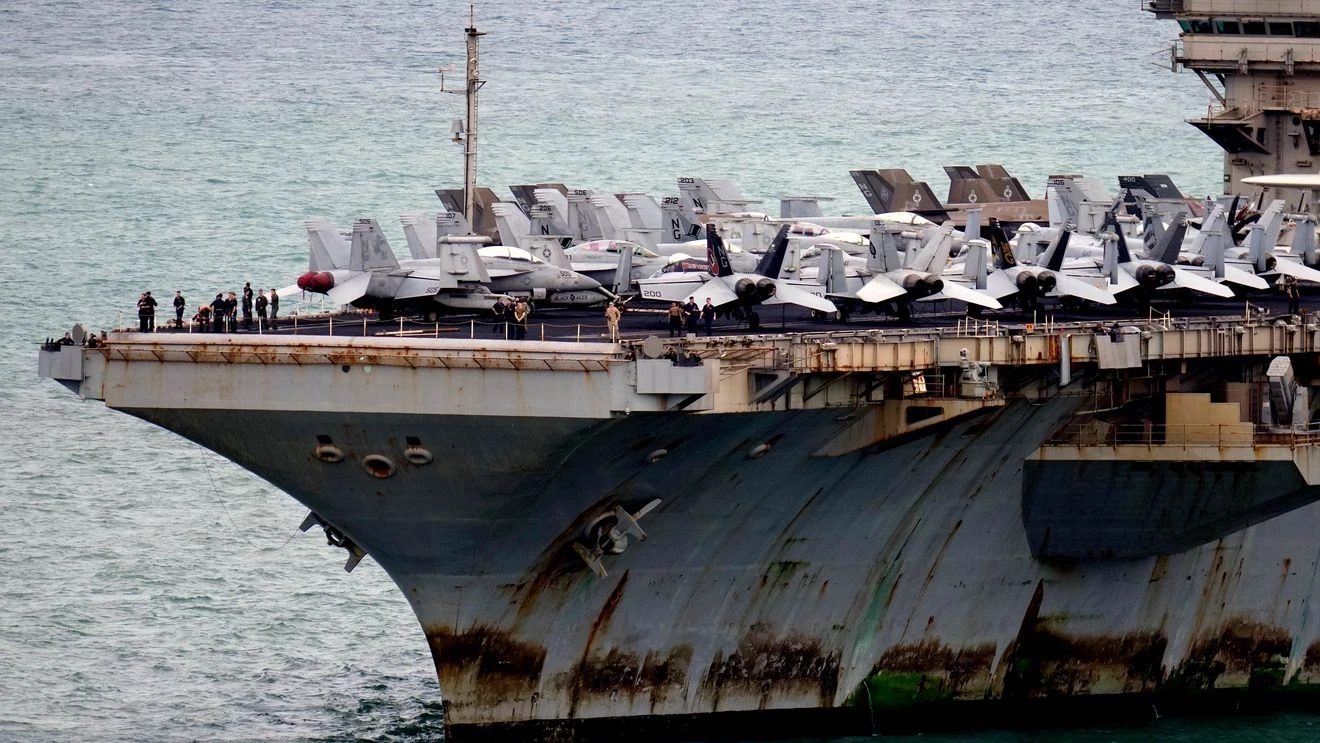
The USS Abraham Lincoln carrier strike group left San Diego on 21 November 2025 for what began as a routine Pacific deployment. In January 2026 the ship was rerouted to the US Central Command area. Combat operations against Iran began at the end of February, and the Lincoln helped enforce a naval blockade on Iranian ports. The roughly 5,000-strong crew remained at sea for 286 days before a single week-long stop in Thailand on 1 September 2026, setting a Navy record for continuous time underway without a port call. One additional short stop had occurred the previous December.
On 24 September 2026, Acting Navy Secretary Hung Cao wrote to Senator Kirsten Gillibrand that eight sailors assigned to the Lincoln strike group had attempted suicide since the deployment began. The attempts involved personnel from the carrier, its air wing, escort destroyers and embarked squadrons. Cao stated that one sailor assigned to the air wing went overboard in early August, was recovered by helicopter, received medical care and was transferred off the ship. A second sailor attempted to go overboard in March but was stopped by shipmates, received immediate care and returned to home port. No service members died by suicide during the deployment. Cao listed mental health resources provided on board, including one psychologist, three behavioural health technicians, one clinical social worker, one embedded prevention counsellor, one facility dog and five chaplains. He noted that combat operations had reduced main meal options from two to one and that plumbing issues had been repaired.
President Trump, asked in mid-August whether he was concerned about the length of the deployment and crew mental health, replied that the ship had not been out “nearly long enough.” Defense Secretary Pete Hegseth described earlier reports of low morale and poor conditions as “misrepresented.” Gillibrand responded that the Cao letter showed the conditions were “serious and deteriorating” and that the administration had dismissed sailors’ concerns “with open disrespect.”
Admiral Brad Cooper, commander of US Central Command, stated in August that the Lincoln had among the lowest numbers of mental health cases of any of the Navy’s eleven active carriers and the highest sailor retention rate of any strike group. CENTCOM added that average carrier strike groups report higher suicide attempt numbers than the Lincoln group and that most of the eight attempts occurred while the ships were in port rather than in the Middle East operating area. A naval officer who spoke to one US outlet described the start of deployment and periods between operations as the most difficult for morale.
Al Jazeera reported that supply shortages had been linked to Iranian attacks on the naval base in Bahrain early in the war, forcing reliance on the distant Indian Ocean island of Diego Garcia. The same outlet noted that the carrier George Washington had been diverted from the Pacific to relieve the Lincoln. The French Huffington Post edition recorded a military source describing eight attempts as “incredibly high” compared with one or two per year on recent non-combat deployments, attributing the difference to sustained combat pressure and lack of shore leave. The Hindustan Times carried a concise account limited to the personnel count and mission length.
US domestic coverage placed the Cao letter inside a domestic political argument. The Daily Caller used Gillibrand’s statement and earlier family reports of food shortages and long waits for mental health appointments to argue that the administration had ignored unsustainable strain. The Honolulu Star-Advertiser relayed the New York Times account of the letter and Gillibrand’s criticism with little additional framing. Al Jazeera embedded the same letter in the operational picture of the blockade and resupply challenges. The French outlet presented the disclosure as an administration acknowledgment extracted by congressional questioning. The Indian outlet stayed with the bare personnel and timeline facts.
A reader limited to US conservative or mainstream outlets would see primarily an administration-criticism story and would miss the supply-chain consequences of attacks on Bahrain and the diversion of a second carrier. A reader limited to the Qatari account would gain the regional operational stakes but would not encounter the explicit partisan exchanges between Gillibrand and the White House. The French framing would foreground accountability questions without the detailed US political record. The Indian wire version would convey the scale of the deployment but little of the mental health resources or political responses.
The Cao letter itself supplies the most direct evidence on the number and nature of the attempts. Its details appear in every selected outlet and are not disputed by any of them. Statements by Trump and Hegseth dismissing earlier reports are on the record in multiple accounts. The letter also records that the strike group operated under combat conditions for most of its more than 300 days at sea. Those three elements together establish that the mental health impact occurred inside an extended combat deployment rather than a routine cruise. Administration statements that conditions were misrepresented sit alongside the Navy’s own count of eight attempts, creating a clear tension between the earlier public dismissals and the later official disclosure. The absence of any Iranian-sourced reporting in the selected set means the Iranian government’s view of the blockade and its effects on US forces appears only through US and allied descriptions.
What to Watch
The letter’s contents, corroborated across independent reporting chains, give the strongest warrant for treating the eight attempts as a documented outcome of the deployment. The political interest in portraying the mission as sustainable or unsustainable is evident in the statements of both the administration and its congressional critics. Continued carrier presence in the region will test whether the relief by the George Washington eases the documented strain or whether similar patterns appear on the replacement ship.
That’s how the world told the story.
Get tomorrow’s bulletin by email — one briefing, up to six stories.
Subscribe freeNo spam. One-click unsubscribe. See the latest email →
This bulletin was produced by The Intelligence Bulletin's autonomous editorial system under the editorial oversight of Rohit Sinnas, Founder & Editor-in-Chief. How it works →