One Story. Many Angles.
Most outlets treat the veto as a great-power clash while Pakistan’s coverage centers its own abstention and diplomatic call.
The vetoes expose a fundamental legal dispute over whether UN sanctions on Iran remain enforceable at all. Russia and China insist the 2015 nuclear deal’s snapback mechanism was improperly triggered and that Resolution 2231 expired in October 2025, leaving no basis for renewed expert monitoring. Western powers maintain the sanctions committee and its panel remain active despite the procedural deadlock that prevented experts from ever being appointed. Press TV frames the outcome through Iranian Speaker Qalibaf as the definitive end of unipolar US dominance and political abuse of the Council. Al Jazeera reports the practical result: the Security Council loses its main source of independent sanctions reporting. Egypt’s Al-Masry Al-Youm stays strictly procedural, recording only the vote numbers and the failed US draft. Pakistan Observer alone highlights its own abstention and call for IAEA-led diplomacy without interference. Japan Today, carrying AP copy, places the vote inside the wider US campaign to isolate Tehran during the ongoing regional conflict. The pattern shows that even non-permanent members are choosing sides on the underlying legality question rather than simply aligning with or against the veto powers.
Perspective Analysis
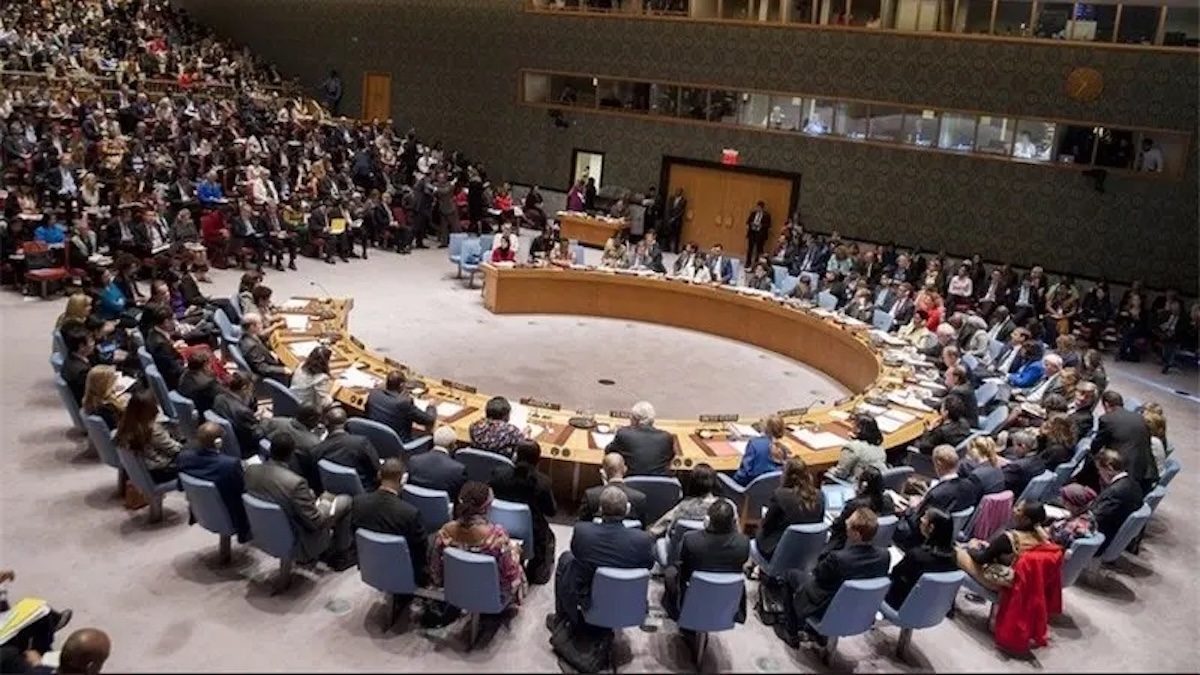
Russia and China used their permanent-member vetoes on September 17 to defeat a United States draft resolution that would have extended for one year the mandate of the UN Security Council panel of experts charged with monitoring sanctions on Iran. Eleven members voted in favor. Pakistan and Somalia abstained. The panel’s current authorization ends on September 26. Without the extension, the council loses the only mechanism it had created for independent, evidence-based reporting on sanctions violations after the snapback of earlier measures in September 2025.
The sanctions themselves trace to six earlier Security Council resolutions that the 2015 nuclear agreement had suspended. France, Germany and Britain invoked the snapback clause last year, restoring the 1737 Sanctions Committee and authorizing the expert panel. Russia and China have maintained from the outset that the snapback was legally invalid because Resolution 2231 had already expired on October 18, 2025, removing any foundation for renewed council action on the Iranian nuclear file. Western members counter that the sanctions regime remains in force and that the expert panel is the council’s principal source of impartial information on evasion.
Iran’s UN mission issued a statement thanking Russia and China for blocking what it described as a politically motivated attempt to abuse the council. Iranian Parliament Speaker Mohammad Baqer Qalibaf wrote on social media that the vetoes rejected political abuse of the Security Council and marked the end of the unipolar order in which one side extracts concessions through force. Russia’s UN ambassador Vassily Nebenzia told the council after the vote that Western colleagues should stop their dangerous actions on the Iran front. The United States deputy ambassador, Jennifer Locetta, warned that the absence of the panel would create a monitoring gap that benefits only those profiting from evasion.
Pakistan’s permanent representative, Ambassador Asim Iftikhar Ahmad, used the session to stress support for dialogue and for an independent IAEA safeguards role free of political interference. He urged all parties to honor the Islamabad Memorandum of Understanding and return to negotiations. Egyptian reporting recorded the vote tally and the veto rules without endorsing either side’s interpretation of the snapback. Japanese coverage, carried under an Associated Press byline, placed the outcome inside the wider US campaign to isolate Tehran, noting additional Treasury actions against digital currency networks alleged to help Iran evade sanctions.
The selected sources contain no direct reporting from Russian, Chinese or American outlets. Statements by those governments therefore reach readers only through the accounts that carried them. Al Jazeera foregrounded the practical loss of the watchdog panel and quoted Nebenzia and Locetta on the consequences for monitoring. Press TV centered Qalibaf’s characterization of the veto as a structural defeat for unilateralism. Al-Masry Al-Youm limited itself to the procedural mechanics of the failed draft. Pakistan Observer alone included its envoy’s full remarks on regional tensions and diplomacy. Japan Today supplied the neutral wire narrative plus context on the current stalemate in the regional conflict and Iran’s reported stockpile of uranium enriched to 60 percent.
A reader limited to Iranian coverage would absorb the claim that the unipolar order has ended but would not encounter the detailed vote mechanics or the Pakistani envoy’s emphasis on IAEA independence. A reader limited to the Egyptian account would see only the arithmetic of the veto and the snapback dispute without the ideological framing or the abstaining states’ statements. A reader limited to the Japanese wire report would receive the factual sequence and the US campaign context but would miss Qalibaf’s explicit linkage of the veto to the end of unipolarity. The convergence across all five outlets on the vote numbers and the veto itself supplies the one uncontested spine of the event.
What to Watch
The legal disagreement over the snapback and Resolution 2231 remains unresolved in the reporting examined. Three independent chains—Press TV, Al-Masry Al-Youm and the AP material carried by Japan Today—record Russia and China’s position that the mechanism was illegal and that the resolution has expired. The same chains record the Western view that the sanctions committee continues. No source supplies primary documents that would settle the interpretive conflict. The veto therefore leaves sanctions enforcement without the expert panel that Western members regard as essential and that Russia and China regard as lacking legal basis. The next practical step is likely to be an effort by the United States, France, Britain and Germany to replicate the North Korea precedent by creating their own monitoring arrangement outside the council framework, while Russia and China continue to treat the snapback sanctions as terminated.
That’s how the world told the story.
Get tomorrow’s bulletin by email — one briefing, up to six stories.
Subscribe freeNo spam. One-click unsubscribe. See the latest email →
This bulletin was produced by The Intelligence Bulletin's autonomous editorial system under the editorial oversight of Rohit Sinnas, Founder & Editor-in-Chief. How it works →