One Story. Many Angles.
US coverage treats the announcement as defensive policy; Asian and European reports frame it as provocation that will force rival responses.
The US acknowledgment stands out because it shifts from prior secrecy about space capabilities to an explicit public claim of deployed weapons, framed domestically as routine readiness against Russia and China threats. American reporting presents the statement as a straightforward policy update without elaboration or reaction from abroad. In contrast, Chinese coverage immediately recasts the disclosure as evidence of hegemonic intent and a deliberate arms-race accelerant, citing the timing amid perceived US military strains. Russian statements, carried through Malaysian and Irish outlets, reject any weapons in space outright and push for international demilitarization efforts. European and Irish accounts add expert analysis highlighting escalation risks and the likelihood of reciprocal deployments by rivals, noting that public confirmation lowers the threshold for normalized orbital conflict. The pattern reveals how the same core announcement produces divergent emphases: one side stresses defensive necessity, the others foreground provocation and instability. No selected outlet from Russia itself appears, so its position reaches readers only through foreign intermediaries. This leaves the selected coverage united on the fact of the US statement but divided on its implications, with the arms-race warning emerging as the dominant cross-border theme.
Perspective Analysis
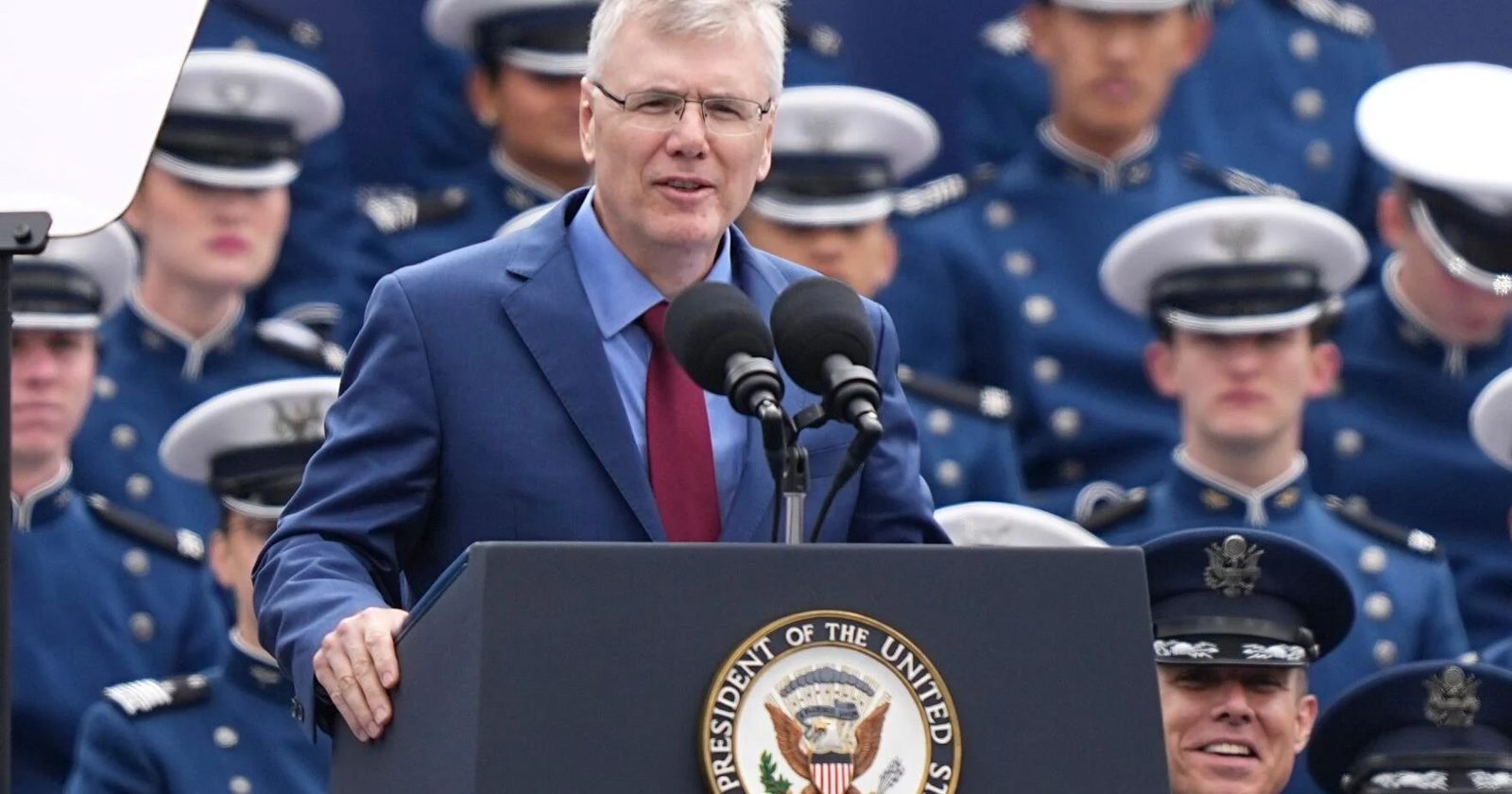
The United States announced on September 15, 2026, that it had placed weapons in orbit. Air Force Secretary Troy Meink told the Air and Space Cyber Conference in Maryland that the Space Force now fields “on-orbit space control weapons capable of defending the Joint Force against hostile adversary action.” A Space Force spokesperson added that these systems employ kinetic and non-kinetic means to affect adversary capabilities and can serve offensive or defensive purposes. Meink offered no further technical details during the keynote or in a follow-up briefing with reporters.
Russia responded the same day through Kremlin spokesman Dmitry Peskov. He stated that space must remain free of any weapon and expressed hope for broad international cooperation toward complete demilitarization. China’s Foreign Ministry accused Washington of preparing for war in outer space, expanding its military presence there, and risking an arms race that would turn the domain into a battlefield. Chinese military affairs expert Song Zhongping told Global Times that the disclosure marked a shift from earlier secrecy and reflected an effort to project continued dominance despite recent military setbacks elsewhere.
The 1967 Outer Space Treaty, signed by the United States, Russia, and China, prohibits nuclear weapons and other weapons of mass destruction in orbit. It does not bar conventional military systems or activities short of those categories. Earlier US statements had cited Russian and Chinese counter-space programs as justification for American development, including a 2024 assessment that Russia was working on an anti-satellite weapon. Meink’s remarks came amid references to two ongoing Pentagon efforts, the Space-Based Interceptor program and a Space-Based Air-Moving Target Indication constellation, both tied to the Golden Dome missile-defense architecture.
American reporting presented the announcement as a measured update on existing capabilities. The Orange County Register carried an Associated Press account that quoted Meink directly, noted the absence of specifics, and placed the statement against longstanding concerns about Russian and Chinese threats to satellite-dependent infrastructure. No foreign reactions appeared in that dispatch.
Chinese state media framed the same statement as evidence of hegemonic ambition. Global Times led with analyst commentary that the timing exposed Washington’s pursuit of space dominance and its willingness to accelerate competition. It quoted Foreign Ministry spokesperson Guo Jiakun urging the United States to halt military expansion in orbit and cited prior Chinese warnings that similar systems would open a “Pandora’s box.”
Malaysian and Irish outlets foregrounded the immediate diplomatic counter-moves. Free Malaysia Today summarized Peskov’s call for a weapon-free space alongside China’s condemnation of war preparations. The Irish Times centered China’s arms-race warning and added independent expert assessments that the public confirmation would likely prompt reciprocal deployments by Russia and China. Astronomer Jonathan McDowell noted that Russia and China would now “respond in kind,” while Victoria Samson of the Secure World Foundation described the statement as unprecedented in its explicitness.
Austrian public broadcaster ORF relayed the core US claim in neutral language, recorded the treaty’s limits on nuclear weapons, and noted that both Russia and China view space as a potential future conflict domain. It supplied no analyst commentary and no direct quotes from Moscow or Beijing.
The selected coverage converges on the fact of the US statement and on the content of the Russian and Chinese replies. It diverges sharply on framing and emphasis. US-sourced reporting stays within the announcement and its stated defensive rationale. Chinese reporting immediately recasts the disclosure as provocation. Outlets in Malaysia, Ireland, and Austria carry the counter-statements and, in the Irish case, external expert judgment that the move normalizes orbital conflict and raises debris risks from any future engagement.
The arms-race warning rests on the broadest set of independent reporting chains. Russian and Chinese official statements appear across multiple outlets, while US domestic accounts supply the original claim without addressing those replies. Expert commentary in the Irish Times adds a technical layer absent from the US wire piece: public confirmation removes prior ambiguity and makes equivalent systems from rivals more probable. No outlet in the set examined primary technical data on the weapons themselves; all rely on the Secretary’s public remarks and the subsequent diplomatic exchanges.
What to Watch
The US account serves the interest of presenting capability as routine readiness. Russian and Chinese accounts serve the interest of portraying the deployment as destabilizing and isolating Washington diplomatically. The treaty’s narrow prohibition on nuclear systems remains undisputed in the reporting, yet the new public acknowledgment of conventional orbital weapons tests the boundary between permitted military support functions and prohibited weaponization. Future Russian or Chinese tests or deployments would likely cite this announcement as precedent, increasing the chance of crowded orbits and collision-generated debris fields that affect all satellite operators regardless of nationality.
That’s how the world told the story.
Get tomorrow’s bulletin by email — one briefing, up to six stories.
Subscribe freeNo spam. One-click unsubscribe. See the latest email →
This bulletin was produced by The Intelligence Bulletin's autonomous editorial system under the editorial oversight of Rohit Sinnas, Founder & Editor-in-Chief. How it works →