One Story. Many Angles.
Danish and Swedish reports treat the incident as a direct local boundary test while UK and US accounts embed it in NATO tensions.
Danish reporting centers the official national response, quoting Prime Minister Mette Frederiksen directly on Russia’s hybrid warfare and the need for tighter European defense cooperation, while Swedish coverage frames the event as a regional maritime security shift in the Baltic without the same diplomatic emphasis. The Moscow Times relays the summons and Danish statements factually from exile, noting the embassy’s silence and the straits’ strategic role for Russian shipping. BBC and New York Post accounts both draw on Danish statements but add NATO alliance context and sharper notes on potential danger, with the Post highlighting narrow misses and escalation risks. All five sources converge on the core sequence of events and Danish actions, with no contradictions or Russian rebuttals appearing in the selected coverage. This pattern reveals how Baltic neighbors treat the incident as an immediate operational boundary test, while distant observers embed it in alliance friction, and the exile outlet avoids adopting either framing.
Perspective Analysis
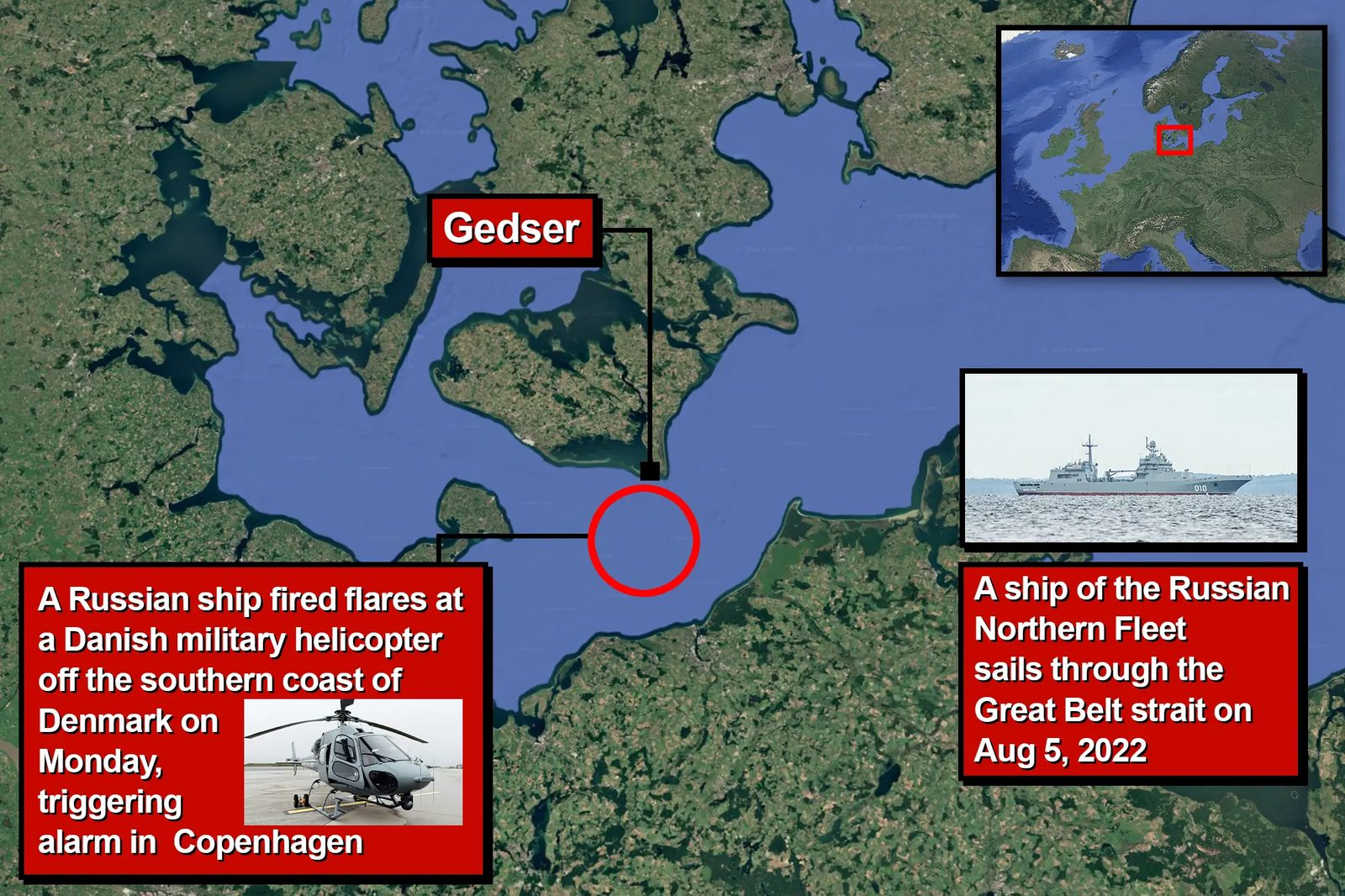
A Russian frigate fired two flares at a Danish Fennec military helicopter on a routine photography mission in international waters south of Gedser on the Danish island of Falster. One flare passed close to the aircraft. No one was injured and the helicopter sustained no damage. Danish defense officials described the mission as standard surveillance of a foreign warship operating near Danish waters. The incident occurred on a Monday, and coverage appeared the following day.
Danish Foreign Minister Lars Løkke Rasmussen called the foreign ministry’s action to summon the Russian ambassador. He stated that the event could have endangered human lives and that Russia was gradually shifting what it considered acceptable conduct at sea. Denmark’s defense minister, Jeppe Bruus, described the firing as unprofessional seamanship and said the armed forces would continue their legitimate surveillance tasks without change. Prime Minister Mette Frederiksen issued a written statement framing the episode as part of a broader pattern of Russian hybrid operations across Europe, aimed at sowing fear and division, and testing NATO cohesion. She said the response should be closer European coordination and stronger defense.
The helicopter had been photographing the frigate when the flares were launched. Danish officials noted that the frigate lay close to Denmark and that photographing such vessels forms part of normal defense monitoring. The flares are described in Danish accounts as signal devices normally used for warning at sea. Swedish reporting referred to them as distress rockets and recorded the same close passage without injury.
The exiled Moscow Times carried the Danish statements and the summons while noting that the Russian embassy in Copenhagen offered no immediate comment. It also recorded the location of the incident in the Danish straits, the main commercial and military route in and out of the Baltic Sea and a corridor used by Russian tankers operating outside Western sanctions.
Swedish coverage from Svenska Dagbladet, drawing on wire material, presented the event as evidence that Russian risk thresholds at sea had moved. The report quoted the Danish defense minister on the unprofessional nature of the action and on Denmark’s intent to maintain its surveillance flights. It placed the episode in the immediate Baltic maritime setting rather than in alliance-wide diplomacy.
BBC reporting placed the same Danish statements inside ongoing NATO-Russia tensions on the eastern flank. It recorded the foreign minister’s description of the incident as unacceptable and the summons of the ambassador. The New York Post account, also carrying Danish material, stressed the narrow miss and the potential danger to the crew.
No account in the set contained a Russian rebuttal or alternative sequence of events. The Russian embassy did not respond to requests for comment outside regular hours in the reporting that reached publication. All five outlets agreed on the sequence of the firing, the close passage of one flare, the absence of harm, the routine nature of the Danish flight, and the fact of the ambassador’s summons.
Danish domestic coverage foregrounded the prime minister’s characterization of Russia as aggressive and self-assertive, linking the episode directly to hybrid warfare and the need for European defense consolidation. Swedish reporting stayed closer to the operational detail of risk thresholds in the Baltic approaches and the continuation of Danish flights. The Moscow Times kept the diplomatic fact of the summons and the embassy silence at the center while adding the straits’ role in sanctioned oil shipments. BBC and New York Post accounts both relayed the Danish statements but situated them in alliance friction, with the American outlet giving more space to the physical proximity of the flare to the helicopter.
The convergence across independent reporting chains on the core facts leaves little room for dispute about what occurred. Danish officials supplied the primary account of the flight purpose, the firing, and the diplomatic response, and that account traveled intact through outlets in Denmark, Sweden, the United Kingdom, the United States, and the exiled Russian newsroom. Where the accounts differ is in emphasis: one national voice stresses hybrid warfare and alliance solidarity, a neighboring voice stresses local maritime boundaries, and distant observers add the NATO frame without altering the sequence itself.
What to Watch
The Danish account carries the strongest warrant because it rests on on-record statements from the prime minister, foreign minister, and defense minister, each tied to the same incident details that appear unchanged in every other outlet. Those officials have a direct interest in presenting the event as part of a pattern that justifies increased defense spending and tighter coordination inside NATO and the European Union. The absence of any contradictory Russian account in the available reporting means the Danish sequence stands as the most widely corroborated description. The incident supplies a single, concrete data point in the longer record of Russian naval activity in the Baltic approaches, showing that surveillance flights continue and that Denmark responds through standard diplomatic channels rather than escalation.
That’s how the world told the story.
Get tomorrow’s bulletin by email — one briefing, up to six stories.
Subscribe freeNo spam. One-click unsubscribe. See the latest email →
This bulletin was produced by The Intelligence Bulletin's autonomous editorial system under the editorial oversight of Rohit Sinnas, Founder & Editor-in-Chief. How it works →