One Story. Many Angles.
Actor countries stress bilateral gains and NATO continuity; distant observers highlight transatlantic uncertainty driving the move.
Finnish domestic reporting centers on President Stubb’s press appearance and the national decision as a logical extension of Nordic participation, while French coverage frames the accession as evidence of successful diversification of European deterrence options for a Russia-bordering state. Observer outlets from Qatar and Hong Kong explicitly tie the step to doubts over US reliability under Trump and Russia’s threat, presenting it as part of Europe’s reassessment of security architecture. Turkish coverage stresses Finland’s insistence that NATO remains primary. All accounts converge on the initiative’s non-binding nature, the absence of peacetime basing in Finland, and its compatibility with existing treaties. The pattern reveals that actor countries emphasize bilateral gains and reassurance, whereas distant observers foreground the transatlantic fault line the move implicitly addresses. No source claims the step challenges NATO directly, and every report repeats Stubb’s clarification that the US umbrella stays central. This consistency across independent chains indicates the announcement was tightly coordinated, yet the interpretive weight each outlet assigns reveals differing national priorities in how European nuclear cooperation is presented to readers.
Perspective Analysis
Finland announced on 14 September 2026 that it would join France’s forward nuclear deterrence initiative, becoming the tenth European participant. The two countries issued a joint statement that day in Helsinki, where Finnish and French foreign ministers also signed a new strategic bilateral partnership. A nuclear steering group will be established in the coming months to begin implementation. The arrangement allows for joint exercises in which Finland may participate as an observer and, at the furthest extent, for temporary visits by French strategic air assets. No French nuclear weapons will be stationed in Finland during peacetime.
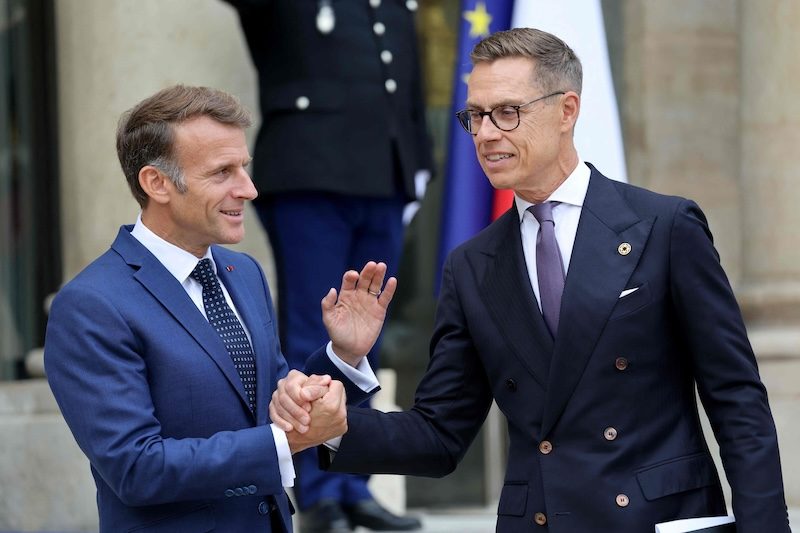
Finnish President Alexander Stubb addressed the announcement in a press conference at Mäntyniemi. He described the step as strengthening European security and bilateral cooperation, offering opportunities for strategic signaling and escalation management below the nuclear threshold. Stubb stressed that Finland’s primary nuclear umbrella remains NATO’s, and specifically the United States component. Defense Minister Antti Häkkänen noted in a ministry statement that participation was natural given that Norway, Sweden and Denmark were already members. He added that each participating country sets its own pace, that France imposes no collective-defense obligations or cost-sharing requirements, and that the French deterrent stays strictly defensive under existing non-proliferation treaties.
France had launched the initiative in March 2026 when President Emmanuel Macron updated national doctrine at the Île Longue base. The goal was to extend French nuclear coverage to willing European partners through consultations and exercises while retaining sole French authority over any use decision. Eight countries joined at the outset; Norway followed in May. Finland’s accession brings the total to ten. Estonia’s prime minister has said his country is in discussion with Paris. The joint statement with Finland described the move as an important step for European security and bilateral ties that would not alter international legal obligations.
Finland shares a 1,340-kilometre land border with Russia and joined NATO in April 2023 after decades of military non-alignment. In June 2026 its parliament passed legislation removing a total ban on nuclear weapons, aligning its rules more closely with its Nordic neighbors. France has separately committed troops to NATO’s forward presence in Finland under Swedish command. The new Finnish-French arrangement therefore sits alongside both the Alliance framework and existing bilateral military ties.
Coverage from the countries directly involved and from more distant observers converged on the core mechanics and on Finland’s explicit reassurance that NATO remains central. Every outlet that quoted Stubb carried his statement that the American umbrella stays primary and that the French step adds planning value without replacing it. All reported the absence of peacetime basing and the non-binding character of participation. The joint statement’s language on strategic signaling and escalation management below the threshold appeared in full in both Finnish and French domestic accounts and was summarized in the others.
Where the accounts diverged was in emphasis rather than in disputed facts. Uusi Suomi placed the decision inside Finnish domestic politics, highlighting Stubb’s media availability that afternoon and Häkkänen’s ministry release. Challenges framed the accession as validation of Macron’s doctrine, noting that a Russia-bordering state had chosen to diversify its options through the French initiative. Al Jazeera connected the timing to Russian pressure and to questions over United States commitment under President Trump, describing the move as part of Europe’s broader security reassessment. South China Morning Post, carrying an agency dispatch, stressed the forward character of the French deterrent and its implications for continental architecture. Anadolu Agency foregrounded Finland’s repeated insistence on NATO primacy, presenting the step from the viewpoint of a fellow Alliance member.
These differences track the vantage of each outlet. Finnish reporting treated the announcement as the outcome of confidential bilateral talks at political and official levels and as a logical Nordic extension. French reporting presented it as evidence that European partners see value in an independent French contribution. Outlets farther from the event supplied the transatlantic and Russian context that the actor countries mentioned only in passing. No source claimed the French step challenges NATO or alters existing treaty commitments.
What to Watch
The consistency of the factual spine across five independent reporting chains indicates the announcement was prepared and coordinated in advance. The interpretive weight each outlet assigned reflects its audience’s primary security reference point: bilateral reassurance for Finns and French, Alliance continuity for Turks, and hedging against American uncertainty for readers in Doha and Hong Kong. Because the core claims rest on the joint statement and on Stubb’s on-record remarks rather than on any single national narrative, the accounts that foreground those elements come closest to the record that all outlets could verify from the same primary documents. The next concrete steps will be the formation of the steering group and the first agreed exercises; both sides have already signaled that these will be limited and reversible.
That’s how the world told the story.
Get tomorrow’s bulletin by email — one briefing, up to six stories.
Subscribe freeNo spam. One-click unsubscribe. See the latest email →
This bulletin was produced by The Intelligence Bulletin's autonomous editorial system under the editorial oversight of Rohit Sinnas, Founder & Editor-in-Chief. How it works →