One Story. Many Angles.
Outlets agree on the report’s core accusations but frame them through local priorities from institutional validation to calls for sanctions.
The selected sources converge on B’Tselem’s central finding that Israeli actions in the West Bank constitute a deliberate, accelerating project to erase Palestinian collective presence, yet they diverge sharply in tone and framing that reveals national priorities. Palestinian outlet Wafa presents the report as authoritative confirmation of an accelerated erasure project tied to settlement expansion and PA concerns, treating it as institutional validation rather than one group’s view. The UAE’s The National highlights elimination language and settler-colonial history, pressing for consequences beyond settlement sanctions amid recent Western measures. UK outlets split: IBTimes stresses economic data and links to British foreign secretary statements on ethnic cleansing, while Middle East Monitor emphasizes internal Israeli critique and specific displacement figures. Germany’s Deutschlandfunk offers the most detached account, noting casualty numbers and international inaction without regional advocacy. This pattern shows how the same Israeli-sourced report travels through different filters: actor endorsement in Palestine, regional accusation in the UAE, legal-international context in Britain, and human-rights warning in Germany. The absence of direct Israeli government rebuttal in these accounts leaves the report’s claims standing largely unchallenged within the set, underscoring how coverage outside Israel amplifies the rights group’s narrative while the underlying data on killings, displacements and land control remains consistent across chains.
Perspective Analysis
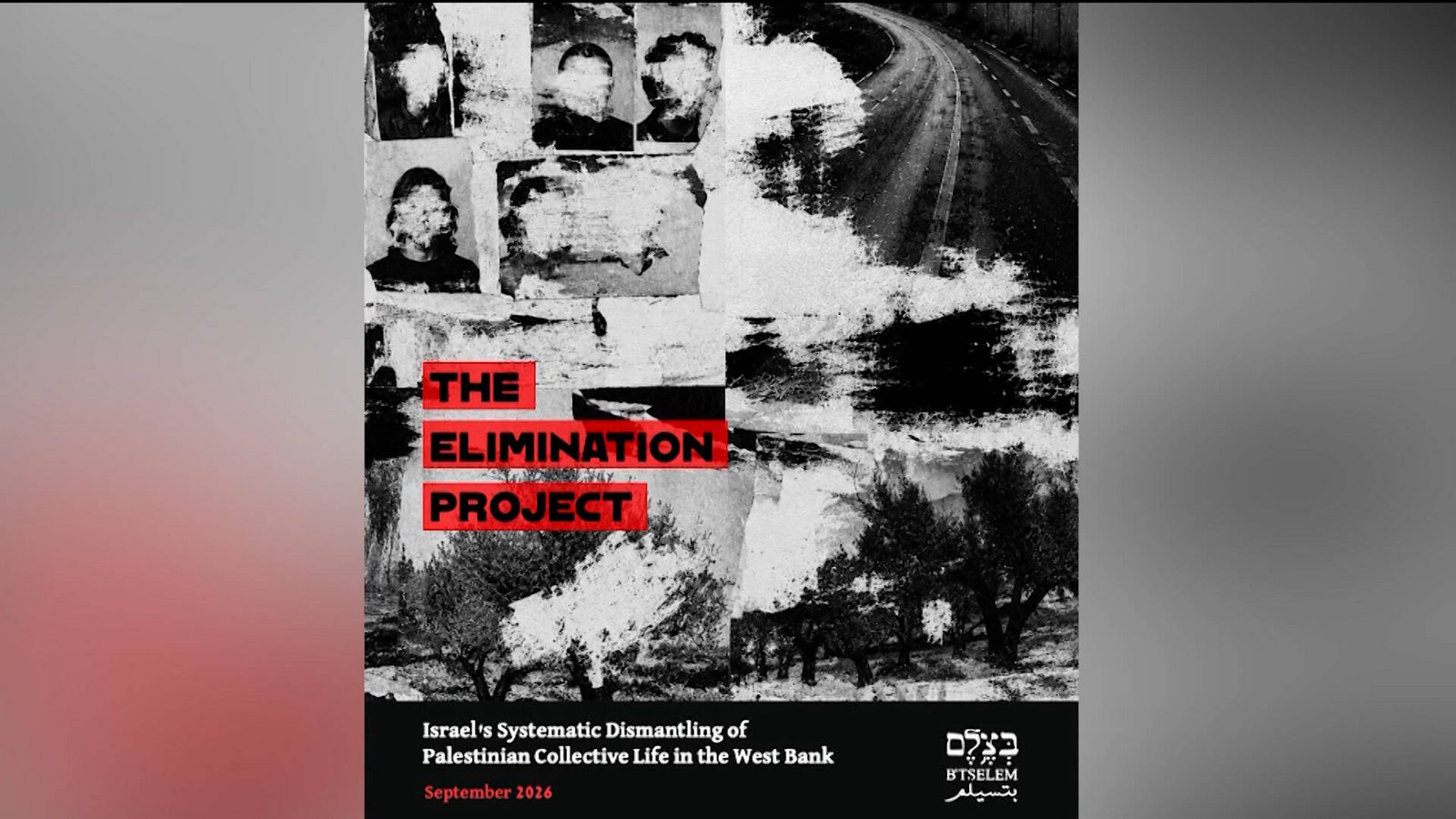
The Israeli human rights organization B’Tselem published a report on September 14, 2026, titled in various renderings as “The Erasure Project: Israel’s Elimination of Palestinian Presence in the West Bank” or “The Elimination Project.” The document argues that Israeli policies in the occupied West Bank form an integrated system aimed at dismantling the conditions that allow Palestinians to sustain their presence as individuals, communities and a political collective. It identifies five interconnected mechanisms: violence and the instilling of terror, movement restrictions, economic strangulation, political and social destruction, and ethnic cleansing paired with the seizure of space. The report rests on more than 2,000 Palestinian testimonies recorded since October 2023, alongside three decades of B’Tselem documentation, and links the acceleration of these practices to the Israeli government formed in late 2022 and to tactics transferred from operations in Gaza after October 2023.
All five outlets that carried the story on the day of release relayed content from this single B’Tselem document. None conducted separate on-the-ground verification or introduced new primary evidence. Their differences lie entirely in selection, emphasis and surrounding context drawn from their own national environments. Wafa, the official Palestinian news agency, led with the report’s description of an “accelerated Israeli project to erase Palestinian presence” and placed the findings inside a daily bulletin that also listed fresh incidents of settler violence and home raids near Nablus and Jenin. It reproduced the five-pillar framework almost verbatim and closed with B’Tselem’s call for an end to military control rather than piecemeal reforms, aligning the material with Palestinian Authority framing of settlement expansion as the core threat.
International Business Times, publishing from the United Kingdom, foregrounded economic data and tied the report to recent British statements. Its account highlighted unemployment rising from 13.1 percent in 2022 to 31.3 percent in 2024 according to Palestinian Central Bureau of Statistics figures cited by B’Tselem, and it noted Finance Minister Bezalel Smotrich’s 2017 “Decisive Plan” as a blueprint. The piece also referenced UK Foreign Secretary Ed Miliband’s accusation of ethnic cleansing in the West Bank, positioning the report as additional documentation supporting diplomatic pressure already under way in London.
The National, based in the United Arab Emirates, opened with the phrase “Palestinian elimination” and quoted B’Tselem executive director Yuli Novak describing the strategy as “central to settler colonialist projects throughout history.” It added Novak’s press-conference remark that recent sanctions by the UK and other governments represented a move from condemnation to consequences, yet remained insufficient because the violations were embedded in state policy. The article placed the report against the backdrop of Israeli elections scheduled for the following month and noted Novak’s assessment that no major shift in West Bank policy would follow even if the current coalition lost power.
Deutschlandfunk, Germany’s public broadcaster, produced the shortest treatment. Its dispatch summarized the report as a warning of “Auslöschung” directed at the Netanyahu government, recorded the figure of more than 1,100 Palestinians killed in the West Bank between October 2023 and August 2026, and listed 75 communities plus 33,000 residents from northern refugee camps as displaced. It noted parallel practices in Gaza described by B’Tselem as reaching the level of genocide and closed with the organization’s criticism of international inaction, without additional commentary or linkage to German policy.
Middle East Monitor, also publishing from the United Kingdom, emphasized internal Israeli critique and supplied the most granular statistics from the report. It listed 1,107 Palestinians killed, including 245 children, between October 2023 and August 31, 2026; 75 communities displaced; 33,000 people removed from northern refugee camps; and settler outposts and farms controlling 1.07 million dunams, or 18 percent of the West Bank. The piece cited Anadolu Agency photography of the Jerusalem press conference and quoted field research director Kareem Jubran on the single underlying goal of eliminating Palestinians as a collective. It framed the material within the outlet’s established focus on Palestinian civil society and added reference to Palestinian Finance Minister Estephan Salameh’s warnings about withheld clearance revenues.
These choices of headline language, length and added context illustrate how a single originating document travels through different editorial environments. Wafa integrated the report into the daily ledger of occupation incidents that its readers already track. International Business Times supplied British political coordinates and unemployment numbers that resonate with UK audiences following sanctions debates. The National amplified elimination terminology and pressed for wider accountability measures already visible in Emirati regional coverage. Deutschlandfunk maintained a concise, numbers-driven neutrality typical of its public-service mandate. Middle East Monitor expanded the statistical detail and connected the findings to Palestinian institutional voices on revenue withholding.
What to Watch
The pattern shows consistent selection of the report’s most pointed language and figures across all five outlets, with each adding only the surrounding references already familiar to its own readership. No outlet introduced independent sourcing that altered the underlying claims. The result is five distinct presentations of one Israeli organization’s assessment, each shaped by the institutional and national lens through which the dispatch passed.
That’s how the world told the story.
Get tomorrow’s bulletin by email — one briefing, up to six stories.
Subscribe freeNo spam. One-click unsubscribe. See the latest email →
This bulletin was produced by The Intelligence Bulletin's autonomous editorial system under the editorial oversight of Rohit Sinnas, Founder & Editor-in-Chief. How it works →