One Story. Many Angles.
Actor-country outlets treat the near-miss as deliberate intimidation of NATO while neutral ones report the timing and official reactions without that framing.
Reporting across the sources converges on the same sequence: a drone hit an ordinary passenger train minutes after the diplomatic one cleared the station, with no casualties but immediate political fallout. Ukrainian and Polish voices frame it as deliberate intimidation of NATO and EU partners, citing the proximity to the border crossing that funnels Western aid. UK coverage adds Boris Johnson’s personal condemnation of the “random and senseless” attack on civilian infrastructure. Indian and Qatari outlets relay the timing relative to the dignitaries without strong alliance rhetoric, while the Turkish source quotes French condemnation that the strike aimed to divide and intimidate European allies. The Independent carries an internal note questioning whether any VIP train was directly threatened, yet still leads with the NATO-doorstep warning. What stands out is the absence of any Russian-sourced detail beyond the generic infrastructure claim, leaving the intended-target assertion resting on Ukrzaliznytsia alone. The pattern shows actor countries stressing security implications for Europe while neutral outlets focus on the sequence of events and official reactions, underscoring how the same facts support both a narrow incident report and a broader escalation narrative depending on the outlet’s location.
Perspective Analysis
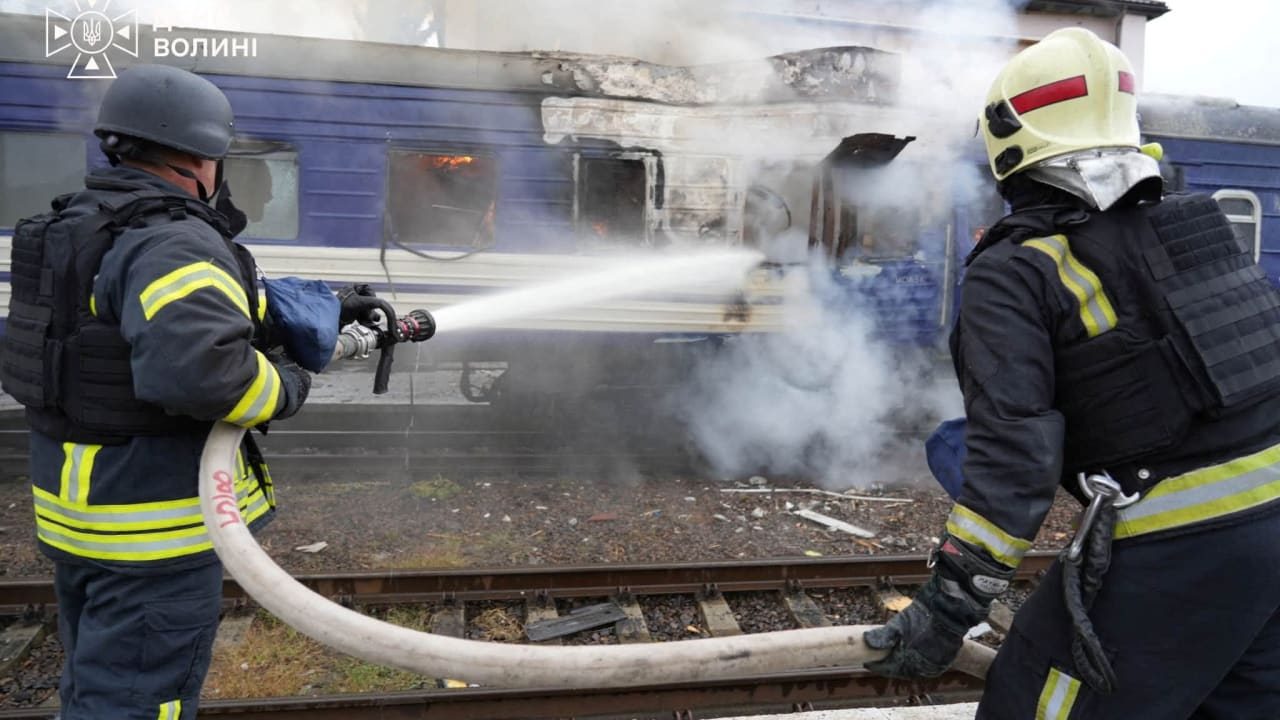
A Russian jet-powered drone struck the engine carriage of a Kyiv-Warsaw passenger train near the Yahodyn border crossing on September 13, 2026. The crossing lies roughly two kilometres inside Ukraine from the Polish frontier. Ukraine’s state railway operator had received advance warning of the incoming drone and ordered the train evacuated before impact. No passengers or crew were injured. The 206 people aboard reached safety, and operations at the crossing were only briefly disrupted.
Minutes earlier, a separate diplomatic train carrying former British Prime Minister Boris Johnson, former Swedish Prime Minister Carl Bildt and security advisers from several European Union states had cleared the same station. The diplomatic train had departed ahead of its original schedule because rail timetables were being adjusted in real time to avoid Russian strikes. Another train, carrying former CIA director David Petraeus, remained at Yahodyn station when the drone hit. Bildt later posted that the struck train was the one just minutes behind his own and that his train had received an evacuation alert before being cleared to proceed. Johnson wrote on X that he did not know what “warped logic” had driven the attack on a stationary Ukrainian locomotive and described it as the sort of “random and senseless” strike civilians in Ukraine endure daily.
Ukraine’s rail operator stated that the diplomatic train may have been the intended target. The operator noted that the schedule change placed the officials’ train out of harm’s way. Ukrainian Foreign Minister Andrii Sybiha called the strikes “Putin’s terror knocking directly on the doors of the EU and NATO” and said Russian forces were at the gate of Ukraine’s partners. President Volodymyr Zelenskyy described the border attack as deliberate. Polish Prime Minister Donald Tusk convened an emergency security meeting and warned that Russian actions were increasingly approaching Poland’s border. He singled out the growing use of jet-powered drones, which are faster and harder to intercept than propeller-driven models. Polish Foreign Minister Radoslaw Sikorski said the escalation should lead allies to double their support for Ukraine. A second drone struck a truck about 800 metres from the same crossing, forcing a temporary closure.
Russia’s Defence Ministry said the strikes targeted infrastructure used to transport military cargo from Europe into Ukraine. No further detail on the specific target or the drone’s guidance was released by Moscow. Kremlin spokesperson Dmitry Peskov has previously acknowledged that Russia strikes a wide range of sites once Ukraine began hitting economic targets inside Russia, though that statement was not tied directly to the Yahodyn incident.
The five outlets examined all report the same core sequence: the drone hit an ordinary passenger train after the diplomatic train had already left the station, with no casualties on any of the trains involved. Kyiv Post foregrounds the rail operator’s assessment that the diplomatic train was likely the intended target and places the episode inside Ukraine’s broader argument that Russian attacks now reach NATO’s immediate vicinity. The Independent leads with the same near-miss for Johnson and uses the phrase “knocking on Nato’s door,” yet also carries a separate note from its political editor stating that sources indicated none of the VIP trains were directly involved and that the visible wreckage came from an ordinary passenger train, possibly linked to a nearby gas-station strike. Al Jazeera relays the Polish and Ukrainian accusations of escalation and notes past Russian strikes that crossed into Polish territory, including the 2022 incident in Przewodow. The Hindu, drawing on AP copy, sticks to the chronology of the dignitaries’ passage and the early departure of their train. Anadolu Agency quotes a French statement that the strike sought to “divide” and “intimidate” European allies.
The accounts converge on the physical event and on the immediate political reactions from Kyiv and Warsaw. They diverge on the question of intent. Only the Ukrainian rail operator asserts that the diplomatic train was probably the target; no independent reporting chain supplies additional evidence for or against that reading. The Russian claim that the strike hit military-supply infrastructure rests solely on the Defence Ministry statement. The Independent’s internal note introduces the only published doubt within the set about whether the diplomatic train itself was under direct threat. Neutral and Global South outlets avoid endorsing either the targeting claim or the broader NATO-escalation framing, while actor-country outlets treat those interpretations as the central meaning of the incident.
What to Watch
The corroborated facts are therefore the strike on the passenger train, its timing relative to the diplomatic train’s passage, the absence of casualties, and the public statements from Polish and Ukrainian officials warning of escalation. The intended-target assertion and the Russian infrastructure claim each stand on a single reporting chain and should be carried with that limitation visible. Actor governments have a clear interest in presenting the episode as evidence that the war has reached NATO’s doorstep, because that framing supports calls for additional air defences and sanctions. Outlets in non-belligerent countries have less stake in that presentation and therefore foreground the timeline and the movement of officials. The next developments most likely to follow are tightened Polish air-defence posture along the border and renewed Ukrainian requests for systems capable of intercepting jet-powered drones at greater range; both steps flow directly from the corroborated proximity of the strike to NATO territory rather than from the single-source claims about intent.
That’s how the world told the story.
Get tomorrow’s bulletin by email — one briefing, up to six stories.
Subscribe freeNo spam. One-click unsubscribe. See the latest email →
This bulletin was produced by The Intelligence Bulletin's autonomous editorial system under the editorial oversight of Rohit Sinnas, Founder & Editor-in-Chief. How it works →