One Story. Many Angles.
Kyiv signals openness to direct talks in the US while Moscow insists any meeting must occur only in Russia.
The selected reporting reveals a clear split between openness from Kyiv and outright rejection from Moscow on the proposed Miami encounter, while the Russian G20 energy participation draws little direct commentary beyond confirmation. Zelenskyy’s interview with Deutsche Welle frames the offer as pragmatic and conditional on Putin’s attendance, a stance echoed in Kyiv Post coverage that stresses Ukrainian agency and battlefield strength. The Hindu and BSS News both relay the same AFP dispatch that presents the two developments side by side without emphasis, treating Russian participation as routine under the US G20 presidency. URA News, by contrast, leads exclusively with Peskov’s dismissal and redirects attention to Moscow as the only acceptable venue. This pattern shows how the same factual signals—Zelenskyy’s conditional yes and the Houston delegation—produce divergent narratives once filtered through actor-country outlets versus wire or European framing. The absence of any selected US source leaves Washington’s role visible only through statements carried elsewhere, underscoring that the diplomatic momentum is being reported most sharply where national interests are directly at stake.
Perspective Analysis
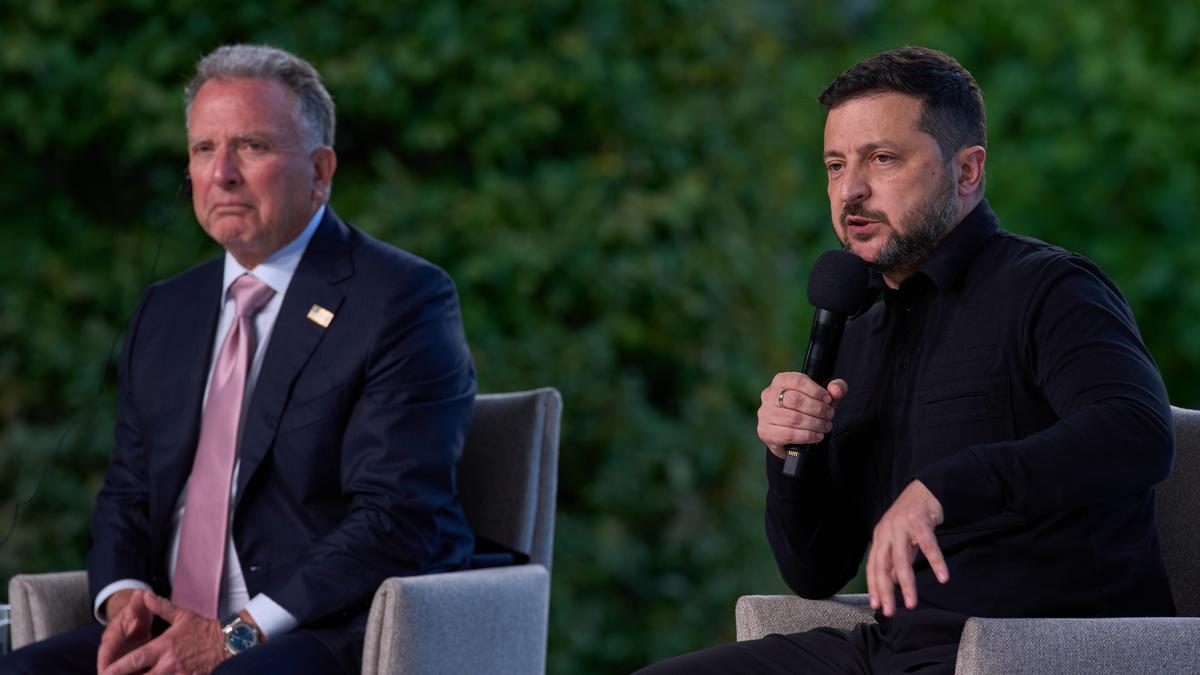
Ukrainian President Volodymyr Zelenskyy said he would travel to Miami for the December G20 leaders summit and meet Russian President Vladimir Putin there if Putin attended, telling German broadcaster Deutsche Welle in an interview conducted on September 11 in Canada that the two sides must meet, speak and make decisions. He added that results mattered more than any exchange of words. The same day a Russian diplomat announced that Moscow would send officials from its energy, foreign and natural resources ministries to the G20 energy ministers meeting scheduled for September 14 to 16 in Houston under the current United States presidency of the group. Kremlin spokesman Dmitry Peskov stated that a Putin-Zelenskyy meeting at the Miami summit was impossible and that any talks could take place only in Moscow.
The G20 comprises 19 countries plus the European Union and the African Union. Its leaders summit this year is set for Miami in December. The United States has already hosted earlier ministerial gatherings, including a finance ministers meeting in North Carolina that drew Russian Finance Minister Anton Siluanov and prompted expressions of discomfort from European allies. Canadian Finance Minister Francois-Philippe Champagne described the presence as causing unease, while European Union economy chief Valdis Dombrovskis said the bloc did not think it was time to normalise Russia or its participation in such talks. Days after that Asheville gathering, President Donald Trump dispatched envoys Steve Witkoff and Jared Kushner to both Moscow and Kyiv to discuss ending the fighting in Ukraine.
Zelenskyy described the envoys’ visits to both capitals as a good signal and said Ukraine now stood in a stronger position for negotiations than a year earlier. He pointed to heavy Russian battlefield losses and the high price Moscow was paying for limited territorial gains. In the Deutsche Welle interview he also addressed Ukraine’s need for additional Patriot interceptor missiles ahead of winter, noting that Russia produces 140 ballistic missiles per month and that NATO standards would require roughly twice that number of interceptors to neutralise them, a volume Ukraine cannot realistically obtain. He called even 100 missiles per month a huge challenge and urged European allies to provide maximum support while mentioning ongoing work with European companies on a Ukrainian-led anti-missile system called FREYJA.
The Russian energy delegation announcement came from Marat Berdyev, the ambassador overseeing G20 issues, who posted on Telegram that Russian ideas on flexible energy mixes, technological neutrality, fossil fuels and peaceful nuclear energy were increasingly sought after. The Hindu and BSS News both carried this statement alongside Zelenskyy’s remarks in nearly identical language drawn from the same agency dispatch, presenting the two developments as concurrent signals under the American G20 chairmanship without further elaboration on either side’s motives.
Kyiv Post coverage, drawing directly from the Deutsche Welle interview, stressed Zelenskyy’s conditional openness and his insistence on concrete outcomes rather than rhetoric. It noted that any such Miami encounter would mark the first direct meeting between the two leaders since December 2019 in Paris under the Normandy Four format. The outlet also recorded Zelenskyy’s references to possible energy and grain ceasefires as an initial step toward broader talks.
URA News, reporting from Moscow, led with Peskov’s on-record rejection of the Miami venue and his reminder that Moscow remained open to negotiations only on Russian territory. The piece framed the story around the impossibility of a United States-hosted encounter and made no mention of the Houston energy meeting.
The two wire-service accounts and the European interview source converge on the factual core: a confirmed Russian delegation to Houston and Zelenskyy’s stated willingness to meet in Miami if Putin attends. The Russian domestic account supplies the only direct rebuttal on venue. A reader limited to any single one of these outlets would therefore miss either the explicit Russian rejection, the Ukrainian emphasis on results and battlefield position, or the neutral juxtaposition of both developments as routine G20 business.
The corroborated elements rest on separate reporting chains. The Houston delegation is attributed to Berdyev in multiple outlets carrying the same dispatch. Zelenskyy’s offer originates in the Deutsche Welle interview and is carried forward by Kyiv Post and the wire accounts. Peskov’s statement appears only in the Russian outlet and stands as a single-source claim. No selected source from the United States itself appears in the set, so Washington’s role surfaces only through statements and context supplied by others.
Zelenskyy’s account carries the strongest independent warrant because it rests on his own on-record interview rather than second-hand summary. The Russian rejection, while single-sourced here, comes from an official spokesman speaking for the record and aligns with Moscow’s consistent preference for controlling the location of any direct contact. Both sides have clear interests in shaping perceptions of momentum: Kyiv benefits from portraying itself as open to talks from a position of relative strength, while Moscow gains by keeping the venue question open only on its own terms. The Houston energy participation, treated as routine across the wire accounts, suggests that lower-level G20 engagement continues even as higher-level summit diplomacy remains contested.
What to Watch
What happens next will depend on whether Putin chooses to attend the Miami summit at all. If he does, Zelenskyy’s conditional offer creates a concrete opportunity for the first direct encounter in years. If he declines, the Russian position that talks belong only in Moscow will have been tested in public without immediate contradiction from the Ukrainian side. Either path keeps the United States, as G20 host, at the centre of the calendar even though no American outlet was selected for this coverage.
That’s how the world told the story.
Get tomorrow’s bulletin by email — one briefing, up to six stories.
Subscribe freeNo spam. One-click unsubscribe. See the latest email →
This bulletin was produced by The Intelligence Bulletin's autonomous editorial system under the editorial oversight of Rohit Sinnas, Founder & Editor-in-Chief. How it works →