One Story. Many Angles.
Indian coverage stresses ceremony while Russian and South African reporting foreground institutional power shifts and accountability demands.
Coverage of the BRICS opening reveals a shared factual core of arrivals and institutional talks that quickly fractures along national priorities. Indian reporting centers the ceremonial welcome and bilateral diplomacy with Putin, including gift exchanges and progress reviews in defense and energy. Russian accounts foreground warnings from Putin, Modi and Xi about the end of unipolar order, institutional reforms and resistance from established powers. South African pieces stress Ramaphosa’s explicit demands for UN Security Council expansion, accountability for violations in Palestine, Sudan and Iran, and multilateralism under international law. Al Jazeera situates the event against wars in the Middle East and Ukraine plus energy strains, while noting the India-China thaw signaled by Xi’s visit. Deutsche Welle tracks the Xi-Modi meeting as the key bilateral development. The pattern shows each outlet amplifying the element most salient to its audience or government stance rather than converging on a single narrative of bloc unity or anti-Western alignment.
Perspective Analysis
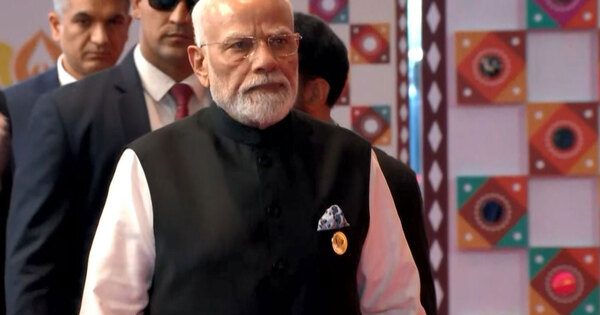
Prime Minister Narendra Modi greeted Russian President Vladimir Putin at Bharat Mandapam in New Delhi on September 12, 2026, marking the formal opening of the 18th BRICS Summit under India’s chairship. The two leaders met for the second time in two weeks, exchanged gifts including a Tamil text on wisdom, and continued discussions during a shared car ride to an industrial exhibition. Modi had already held separate sessions the previous day with Putin, Iranian President Masoud Pezeshkian, United Nations Secretary-General António Guterres, and Ethiopian Prime Minister Abiy Ahmed Ali. Chinese President Xi Jinping arrived the same morning for his first visit to India since 2019, with a bilateral meeting set for later that day.
The summit brought together leaders from the 11-member bloc, which now includes Brazil, China, Egypt, Ethiopia, India, Indonesia, Iran, Russia, Saudi Arabia, South Africa and the United Arab Emirates. India set the theme of building resilience, innovation, cooperation and sustainability. A joint statement from the grouping was expected after overnight negotiations that produced consensus on several points despite earlier differences. Modi urged members to convert internal unity into concrete global outcomes and proposed ten new initiatives plus a continuity mechanism for decisions. Putin described the bloc as representing one-third of the planet’s land, nearly half its population and 40 percent of world GDP, and argued that the unipolar system was giving way to a redistribution of power toward the Global South and East.
South African President Cyril Ramaphosa addressed a session on inclusive global governance and stressed the need for United Nations Security Council reform to give Africa permanent representation. He called for accountability on violations of international law, citing the situation in Palestine, Sudan and the conflict involving Iran, and said multilateralism must rest on sovereign equality and the UN Charter. Chinese and Russian statements echoed the reform theme. Xi called on BRICS states to lead improvements in global governance and to play a larger role in peace and innovation. Putin urged coordinated work inside the International Monetary Fund, World Bank and World Trade Organization while also developing BRICS financial tools such as the New Development Bank.
Coverage of the same arrivals and talks diverged immediately on emphasis. Indian reporting centered the ceremonial aspects of Modi’s welcome for Putin and the schedule of bilateral meetings that included defense, energy and space cooperation. Russian accounts placed the day’s main weight on explicit warnings from Putin, Modi and Xi about resistance from powers accustomed to a hierarchical order and on the need to end that hierarchy. South African reporting isolated Ramaphosa’s demands for accountability mechanisms and for an end to selective application of international rules. Al Jazeera placed the entire gathering against the backdrop of wars in the Middle East and Ukraine and the resulting energy and trade pressures, while noting the significance of Xi’s presence for India-China relations. Deutsche Welle tracked the scheduled Xi-Modi encounter as the central bilateral development and the clearest sign yet of a gradual thaw after the 2020 border clash.
These differences are not simple omissions. The Indian account records the exchange of a sacred Tamil book and progress on people-to-people ties but does not foreground calls to restrain established powers. The Russian text records Putin stating that tariff wars, sanctions and interference are tools used by those unwilling to accept a changed balance, a framing absent from the Indian report. The South African piece alone records Ramaphosa naming specific conflicts and insisting that the same principles apply to all states. Al Jazeera alone opens with the wars that have disrupted shipping and energy markets, while Deutsche Welle alone highlights the 5:45 p.m. local time slot reserved for the Xi-Modi session and the expert view that early progress on the border is required before broader economic ties can deepen.
The shared factual spine across the reports is narrow but consistent. Modi did welcome Putin at the venue. Xi did arrive for his first visit since 2019. Leaders from multiple countries did raise United Nations Security Council reform and broader governance changes. Only one account records the specific list of conflicts Ramaphosa invoked when demanding accountability.
The Indian and German reporting on the practical mechanics of the summit—arrivals, bilateral scheduling, and the India-China track—aligns with the corroborated record of who met whom and when. The Russian emphasis on systemic warnings reflects Moscow’s interest in portraying the gathering as evidence of irreversible multipolar momentum. The South African emphasis on accountability reflects Pretoria’s long-standing position on institutional reform and selective enforcement. Al Jazeera’s focus on active conflicts reflects its regional vantage on the Middle East and the direct effects on energy routes and shipping. None of the accounts constructs a single narrative of seamless bloc unity or uniform anti-Western alignment; each amplifies the dimension most relevant to its own government’s stance or audience.
What to Watch
The most reliable picture is therefore the one that keeps the corroborated mechanics of the opening day in view while treating the interpretive overlays as national readings rather than collective conclusions. The summit marks a concrete step in the expanded grouping’s institutional routine, yet the reporting shows that routine still produces markedly different accounts of what the step signifies. The next test will be whether the expected joint statement and the scheduled bilateral follow-through translate into measurable coordination on the very institutions the leaders named, or whether the differing national framings continue to shape what each capital claims the summit achieved.
That’s how the world told the story.
Get tomorrow’s bulletin by email — one briefing, up to six stories.
Subscribe freeNo spam. One-click unsubscribe. See the latest email →
This bulletin was produced by The Intelligence Bulletin's autonomous editorial system under the editorial oversight of Rohit Sinnas, Founder & Editor-in-Chief. How it works →