 AI-generated analysis published under the editorial responsibility of Rohit Sinnas. How it works →
Press quoted
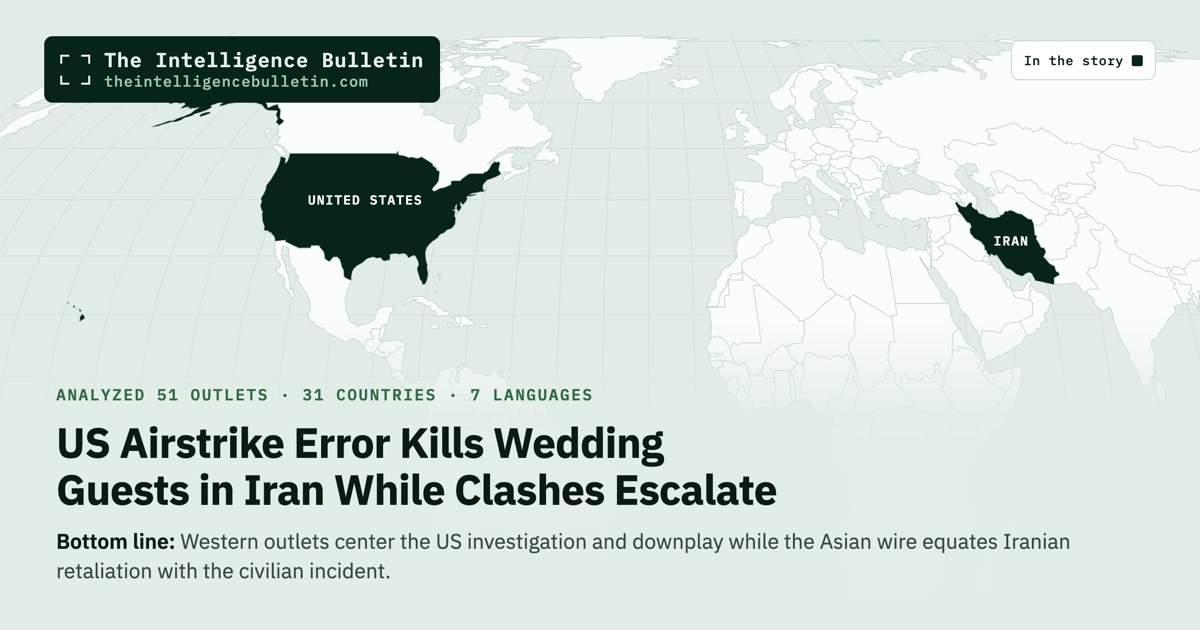
Western outlets center the US investigation and downplay while the Asian wire equates Iranian retaliation with the civilian incident.
The Spokesman-Review centers the civilian deaths and Pentagon investigation into the errant bomb, drawing on Washington Post reporting that verifies the 440-foot miss and munitions details. The Independent folds the incident into a live blog on Hormuz tensions and quotes US officials downplaying Iranian accounts while noting Red Crescent calls for an ICC probe. The Manila Times balances the wedding strike with Iranian missile hits on US-linked bases in Kuwait and the UAE, presenting both sides’ military actions from a Southeast Asian wire perspective. All three corroborate the core sequence of a US strike gone wrong amid ongoing exchanges, yet differ sharply in emphasis: one isolates the mishap as the lead, another subordinates it to political reactions and oil risks, and the third equates it with Iranian retaliation. This pattern shows how proximity to Washington shapes focus on investigation and denials, while distance allows equal weight on Iranian strikes. The absence of direct Iranian outlets in the set leaves official Tehran statements visible only through foreign filters that either verify or question them.
Full analysis
A US Navy jet dropped six glide bombs on a communications tower complex in the coastal Iranian town of Kuhestak on Tuesday. Five struck their intended target. The sixth landed on the roof of a house 440 feet away where a wedding celebration was underway. Iranian health officials reported that at least four civilians died in the blast, including two women and two children aged four and sixteen. More than ninety others suffered injuries. The Pentagon is examining whether the errant bomb caused the deaths.
US officials described the tower complex as a site used in part by Iranian forces for operations against American troops and shipping. The complex sat in a populated area. The strike formed part of a wider wave of American attacks in southern Iran that day, framed by Washington as retaliation for threats to its forces and commercial vessels. Iranian state media and the Red Crescent Society circulated video of emergency workers entering damaged buildings and spraying water on fires. The Red Crescent called the location civilian in character and urged an independent international investigation.
Vice President JD Vance told reporters that authorities were looking into the incident. He added that Iranian state media had not been reliable on events in the conflict so far. A Central Command spokesman stated that the US military never targets civilians, unlike Iran’s Revolutionary Guard. Officials assessed other possible explanations for the explosion, such as an air-defense missile falling short, but weapons analysts reviewing images judged that scenario unlikely. The munitions involved were Joint Standoff Weapons, glide bombs whose remnants matched debris photographed at the site.
Iranian officials accused the United States of striking a civilian gathering and labeled the act a war crime. The Red Crescent asked the International Criminal Court to open an inquiry. Iranian Revolutionary Guard leaders vowed that the blood of the victims would not go unanswered. In the days surrounding the Kuhestak incident, Iranian forces launched missiles and drones toward US-linked facilities in Kuwait and the United Arab Emirates, according to statements from Tehran. Kuwait reported intercepting some of the incoming projectiles. Washington dismissed Iranian claims of successful hits on American vessels as false.
The six-month conflict between the United States and Iran has already seen earlier episodes of civilian harm. An American strike on a military compound in February hit a nearby school, killing at least 175 people according to Iranian accounts. That incident was later attributed to outdated targeting data. The current ceasefire has been punctuated by sporadic exchanges, including attacks on oil tankers that have pushed Brent crude prices toward one hundred dollars a barrel.
Three English-language outlets covered the Kuhestak strike in the immediate hours after it occurred. The Spokesman-Review placed the civilian deaths and the Pentagon investigation at the center of its account, drawing on Washington Post reporting that included verified photographs, distance measurements, and statements from a person familiar with the targeting process. That piece supplied technical detail on the six-bomb salvo, the 440-foot offset, and the type of munition used. It also noted the Red Crescent video and Iranian casualty figures without endorsing them as independently confirmed.
The Independent embedded the incident inside a live blog tracking Hormuz shipping restrictions, oil-price movements, and political reactions in Washington. Its headline highlighted Vance’s remark that “sometimes things happen.” The text recorded Iranian accusations and the Red Crescent’s call for an ICC probe while giving space to American denials that civilians were deliberately targeted. Broader context on tanker attacks and exclusion zones received equal prominence.
The Manila Times, carrying an Agence France-Presse dispatch, opened with Iranian missile strikes on US-linked bases in Kuwait and the UAE, then noted Washington’s ongoing probe of the wedding incident. It reported Iranian vows of revenge alongside US skepticism of Iranian casualty claims and quoted Vance expressing doubt about Tehran’s media accounts. The dispatch presented the wedding deaths as one element in a sequence of mutual strikes rather than the focal event.
These differences in framing produce distinct pictures for readers. Someone relying only on the Spokesman-Review account would come away with the clearest technical reconstruction of how one bomb left its intended path. A reader limited to the Independent would see the episode primarily through the lens of Washington politics and energy-market consequences. A reader of the Manila Times dispatch would register the wedding casualties as one data point balanced against Iranian military responses in neighboring countries. All three pieces record the same core sequence of an apparent US targeting error amid active clashes, yet none supplies an Iranian domestic outlet’s direct reporting on the same events.
The Spokesman-Review account rests on the strongest independent corroboration for its central claim about the bomb’s trajectory. Washington Post reporters cross-checked social-media imagery against known geography, consulted weapons analysts on munition signatures, and spoke with an official familiar with the operation who described the intended target and the single stray bomb. Those details align with the corroborated facts that a US bomb missed its mark by roughly 440 feet and that the Pentagon has opened an investigation. The other two accounts rely more heavily on official statements from both sides without adding comparable verification steps.
US officials have an interest in emphasizing investigation and the absence of deliberate civilian targeting, because that framing limits political damage at home. Iranian officials have an interest in publicizing civilian deaths to rally domestic support and press international bodies. The absence of direct Iranian press in the source set means statements from Tehran appear only through foreign filters that either accept or question them.
What to Watch
The next development likely to matter is the outcome of the Pentagon review. If it confirms a guidance or intelligence failure and releases findings on steps taken to reduce civilian risk, that information will shape whether the incident remains an isolated mishap or feeds into wider accusations of recklessness. If the review stalls or produces limited disclosure, Iranian accusations will gain additional traction in coverage outside the United States. Either path keeps the civilian toll at the center of arguments over how the conflict is conducted.
That’s how the world told the story.
Get our daily open-source intelligence on world events in your inbox — one email a day, up to six stories.
Subscribe freeNo spam. One-click unsubscribe. See the latest email →