 AI-generated analysis published under the editorial responsibility of Rohit Sinnas. How it works →
Press quoted
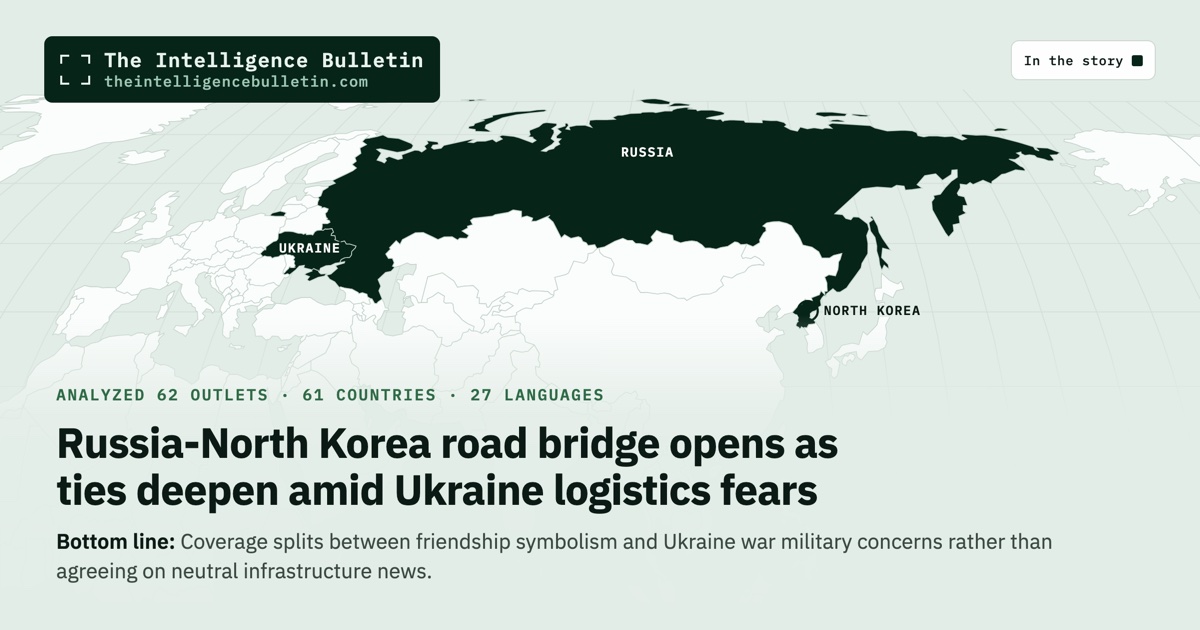
Coverage splits between friendship symbolism and Ukraine war military concerns rather than agreeing on neutral infrastructure news.
The selected sources converge on the bridge’s technical details and official Russian framing as a historic infrastructure milestone boosting trade and ties, yet diverge sharply on its geopolitical meaning. Western and Australian outlets embed the opening in the Ukraine war context, highlighting Ukrainian warnings of a covert military corridor for North Korean troops and Russian resources. Japan’s Asahi stresses risks of enhanced troop and weapons transport supporting Russia’s invasion. In contrast, the Hong Kong-based SCMP and North Korea specialist NK News foreground the ceremony and friendship symbolism drawn from Russian and state media accounts, with minimal reference to conflict logistics. This split reveals how proximity and alignment shape emphasis: regional security anxieties surface where direct stakes exist, while actor-aligned or distant reporting prioritizes the alliance narrative without contradiction on the event itself. The absence of a direct Russian outlet in the set leaves official claims unchallenged within the coverage, underscoring that the bridge’s dual-use potential remains a point of interpretive tension rather than factual dispute across independent chains.
Full analysis
The one-kilometre road bridge across the Tumen River opened to traffic on September 7, 2026, after a ceremony that featured remote addresses by Russian Prime Minister Mikhail Mishustin and North Korean Premier Pak Thae Song. The crossing links the Russian settlement of Khasan in Primorsky Krai with Tumangang on the North Korean side, a remote stretch a few miles from the Sea of Japan coast. Russian government statements described the structure as capable of handling 300 vehicles and 2,325 people each day once fully operational, with immediate cargo use and passenger traffic planned by the end of the year. The bridge forms part of a larger 4.7-kilometre border-crossing project that includes new checkpoint facilities on both sides.
Construction began in April 2025 following an agreement reached during President Vladimir Putin’s 2024 visit to Pyongyang. The project had faced delays from an initial June target tied to the second anniversary of that summit. Russian authorities reported the crossing at 65 percent complete as late as late August. The bridge rests on foundations reaching 45 metres deep on the North Korean side and 30 metres on the Russian side, with 16 sections between columns, the middle two built jointly. Russian state media noted that the existing railway bridge upstream had served as the sole link since the late 1950s, with temporary planks occasionally placed for vehicles. The new road bridge now provides the first dedicated automobile connection.
The structure carries the name of Soviet officer Yakov Novichenko, credited with saving North Korea’s founding leader Kim Il-sung from an assassination attempt in 1946. A car once belonging to Novichenko led the Russian procession across the span after the ceremony. Columns of flag-adorned trucks crossed from both directions. Mishustin told participants that the expansion of cross-border infrastructure would deliver a powerful impetus for trade, economic, scientific, technological and cultural cooperation, describing the opening as a genuinely historic event and the ties between the two countries as already at an unprecedented high level. North Korean state media carried parallel accounts of the event through Russian wire services.
Russia and North Korea already maintain direct flights between Vladivostok and Pyongyang and the railway link. The new bridge is expected to connect to Russia’s federal road network and the transport corridor running from Vladivostok to St Petersburg. Russian officials projected reduced logistics costs and expanded trade volume. The project’s cost on the Russian side had risen to at least double the initial $100 million allocation, with an obscure contractor appearing to front for a larger Chechen construction firm.
Ukrainian human rights organisation Truth Hounds stated that the bridge could function as a covert military logistics corridor rather than primarily facilitating trade. The group warned it would allow movement of North Korean troops, construction brigades and military officials into Russia while enabling Russian technology and resources to flow in the opposite direction with reduced risk of detection. North Korea has already sent thousands of troops to Russia’s Kursk region to help counter a Ukrainian incursion there, and Ukrainian President Volodymyr Zelenskyy has publicly estimated that up to 50,000 North Korean soldiers could ultimately be deployed. In return, South Korean intelligence has assessed that Russia has supplied North Korea with air-defence missiles, electronic warfare equipment, drones and spy-satellite technology.
The five outlets examined converged on the basic sequence of the opening, the bridge’s dimensions, its naming and the remote participation of the two prime ministers. They also agreed that the crossing adds the first proper road connection to long-standing rail and air links. Beyond those shared facts, the accounts diverged on the event’s primary significance.
The Guardian and ABC News placed the opening inside the Ukraine war, foregrounding Ukrainian warnings about military logistics and noting North Korea’s troop deployments to Kursk alongside Russian supplies of advanced weaponry to Pyongyang. Asahi Shimbun similarly highlighted risks that the bridge would ease transport of troops and weapons in support of Russia’s invasion, framing the development against the background of expanded military cooperation between the two countries. In contrast, the South China Morning Post presented the bridge as a new symbol of friendship and quoted Mishustin at length on its economic and cooperative benefits without reference to conflict logistics. NK News, drawing directly from TASS and Interfax dispatches, concentrated on ceremony details, construction history, naming conventions and the technical specifications of the crossing while omitting any discussion of Ukrainian concerns or the war context.
No outlet in the set carried reporting from a Russian domestic source that might have elaborated on official Moscow priorities or addressed the dual-use questions raised elsewhere. The selected coverage therefore leaves the Russian government’s stated civilian and trade rationale unchallenged within the articles themselves, while the security implications appear only in the three outlets that drew on Ukrainian or regional security sources.
What to Watch
The interpretive split follows patterns of alignment and proximity. Outlets with direct stakes in North Korean security or Ukrainian battlefield conditions emphasised potential military applications. Those closer to the actors or focused on regional economic ties foregrounded the friendship and infrastructure narrative drawn from the same Russian official statements. The factual record of the opening itself shows no contradiction across the independent reporting chains; the divergence lies entirely in the weight each account assigns to the bridge’s likely uses. Given that Ukrainian groups possess the clearest interest in tracking any new route that could move personnel or materiel into Russia, their logistics warnings rest on the narrowest and most specific attribution among the available accounts. The absence of countervailing detail from Russian domestic reporting in this source set leaves that dimension of the story dependent on the single chain that raised it.
That’s how the world told the story.
Get our daily open-source intelligence on world events in your inbox — one email a day, up to six stories.
Subscribe freeNo spam. One-click unsubscribe. See the latest email →