 AI-generated analysis published under the editorial responsibility of Rohit Sinnas. How it works →
Press quoted
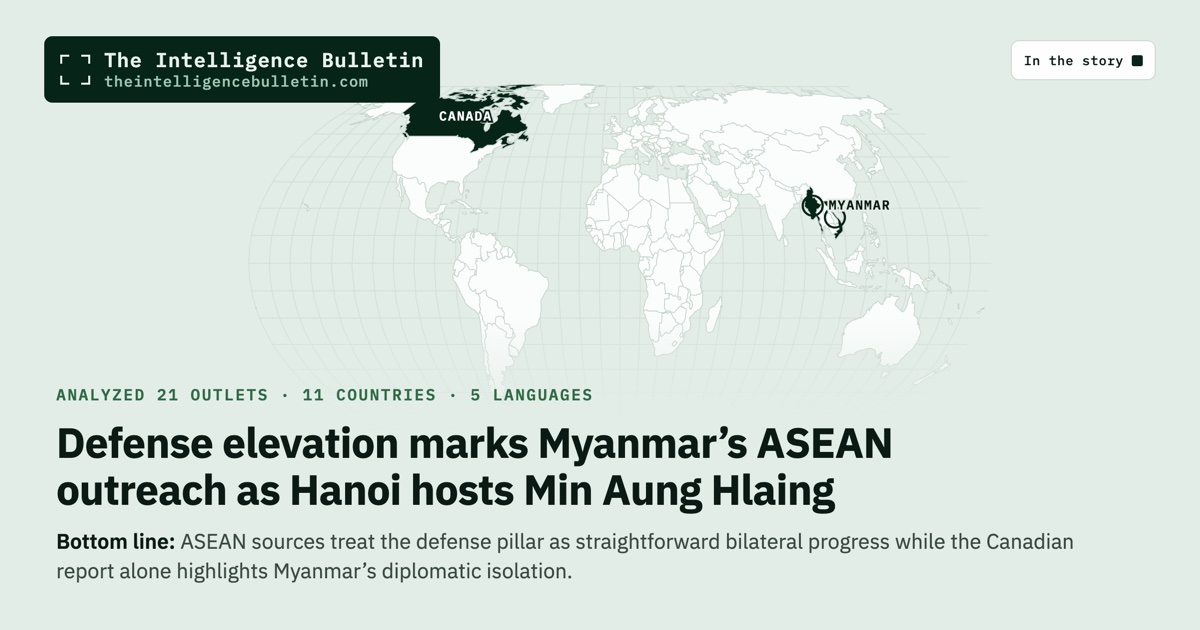
ASEAN sources treat the defense pillar as straightforward bilateral progress while the Canadian report alone highlights Myanmar’s diplomatic isolation.
The reporting converges on the elevation of defense ties to a pillar of Vietnam-Myanmar relations, with leaders committing to training exchanges, search-and-rescue work, disaster response, and cross-border crime coordination while pledging not to allow territory use against each other. Vietnamese domestic coverage from Dai Doan Ket frames the talks through official leadership statements, stressing friendship, shared development experience, and South China Sea peace under UNCLOS as part of a comprehensive partnership upgrade. Free Malaysia Today and Anadolu Agency both highlight the defense agreement and ASEAN-Mekong coordination as the visit’s core outcome. Lianhe Zaobao relays Reuters on the same defense and economic points plus the VinFast and Viettel site visits. Winnipeg Free Press alone places the trip in the context of Min Aung Hlaing’s post-2021 coup efforts to normalize ASEAN ties and attract investment, noting existing military links via Viettel-Mytel and declining trade. The pattern shows actor and ASEAN outlets treating the visit as routine bilateral progress while the Canadian piece supplies the isolation backdrop absent from the others.
Full analysis
On September 5, 2026, Myanmar President Min Aung Hlaing arrived in Hanoi for his first official visit to Vietnam as head of state. Vietnamese General Secretary and President To Lam hosted the talks at the National Assembly House after a formal welcome ceremony. The two leaders issued a joint statement committing to elevate defense and security cooperation to a pillar of the bilateral relationship. They agreed to expand military training programs, exchanges between young officers, search-and-rescue operations, and disaster response efforts. Information sharing and coordination against transnational crime, including drug trafficking, human trafficking, and online fraud, would also increase. Both sides reaffirmed that neither country would permit its territory to be used by any individual or organization against the other.
The statement further recorded pledges to strengthen political trust through more high-level exchanges across party, state, government, and parliamentary channels. Economic cooperation received attention as well, with identified opportunities in high-technology agriculture, food processing, telecommunications, digital transformation, energy, and transport infrastructure. Myanmar’s president expressed interest in learning from Vietnam’s development model and invited Vietnamese firms to expand operations in his country. To Lam offered to share experience on economic security and sustainable growth. The leaders also endorsed continued coordination inside ASEAN and Mekong sub-regional mechanisms and restated support for peace, stability, freedom of navigation, and overflight in the South China Sea in line with the 1982 UN Convention on the Law of the Sea.
Min Aung Hlaing visited a VinFast electric-vehicle factory and the headquarters of the military-linked telecommunications group Viettel during the trip. These stops underscored Myanmar’s interest in Vietnamese expertise in manufacturing and digital infrastructure. The visit occurred against a backdrop of longstanding but uneven ties. Vietnam and Myanmar established a comprehensive partnership in 2017. Trade volumes, however, have declined from $853 million in 2020 to $590 million in 2025 and $335 million in the first half of 2026, according to Vietnamese foreign ministry figures cited in one report. Existing defense links include Viettel’s stake in Myanmar’s Mytel operator.
Four outlets carried the same core account of the defense and security commitments. Dai Doan Ket, a Vietnamese domestic publication, reproduced extended passages from To Lam’s remarks on friendship, mutual development experience, and regional stability. Free Malaysia Today, an ASEAN neighbor outlet, presented the defense elevation and ASEAN-Mekong coordination as the visit’s primary result. Anadolu Agency, a Turkish state wire, summarized the strengthening of defense and security cooperation in similar terms. Lianhe Zaobao, a Singapore-based Chinese-language paper, attributed the same points on training, crime fighting, and economic fields to Reuters reporting of the Vietnamese government statement. All four described the defense measures in nearly identical language and placed the visit inside the existing comprehensive partnership framework.
One outlet supplied additional context absent from the others. The Winnipeg Free Press, drawing on Associated Press reporting, located the Hanoi stop inside Min Aung Hlaing’s broader diplomatic campaign. It noted that he had been sworn in as president in April following an election widely viewed as consolidating military control. The piece recorded his earlier travels to India, China, Laos, Thailand, and several non-ASEAN states, and it observed that Myanmar’s leader remains barred from top-level ASEAN meetings because of the 2021 coup and subsequent failure to implement the bloc’s peace plan. It also cited existing military ties via Viettel-Mytel and the drop in bilateral trade. No other source in the set mentioned the coup, the ASEAN suspension, or the normalization effort in comparable detail.
The defense agreement itself rests on a single primary document—the joint statement issued after the talks—and appears in four independent reporting chains. The normalization framing rests on one chain, the Associated Press dispatch carried by the Winnipeg Free Press. That single-source status does not make the background inaccurate, but it does mean readers of the ASEAN and Turkish accounts receive no indication that Myanmar’s regional standing remains constrained. Conversely, readers of the Canadian account alone would miss the precise language of the defense commitments that the joint statement itself records.
What to Watch
Vietnam has maintained continuous diplomatic and commercial engagement with Myanmar since 2021 and stands to gain from any expansion of defense and economic links that does not trigger new Western sanctions. Myanmar’s leadership gains a public platform and potential investment channels at a time when most Western governments continue to shun its representatives. The corroborated elevation of defense cooperation to a formal pillar supplies a concrete metric—expanded training, officer exchanges, and joint disaster response—that future visits can be measured against. The invitation extended for a reciprocal visit by To Lam in 2027, recorded only in the Vietnamese domestic account, offers one such near-term test. Whether that exchange occurs, and whether it produces further defense or economic deliverables, will indicate how far the September 5 understandings translate into sustained practice.
That’s how the world told the story.
Get our daily open-source intelligence on world events in your inbox — one email a day, up to six stories.
Subscribe freeNo spam. One-click unsubscribe. See the latest email →