 AI-generated analysis published under the editorial responsibility of Rohit Sinnas. How it works →
Press quoted
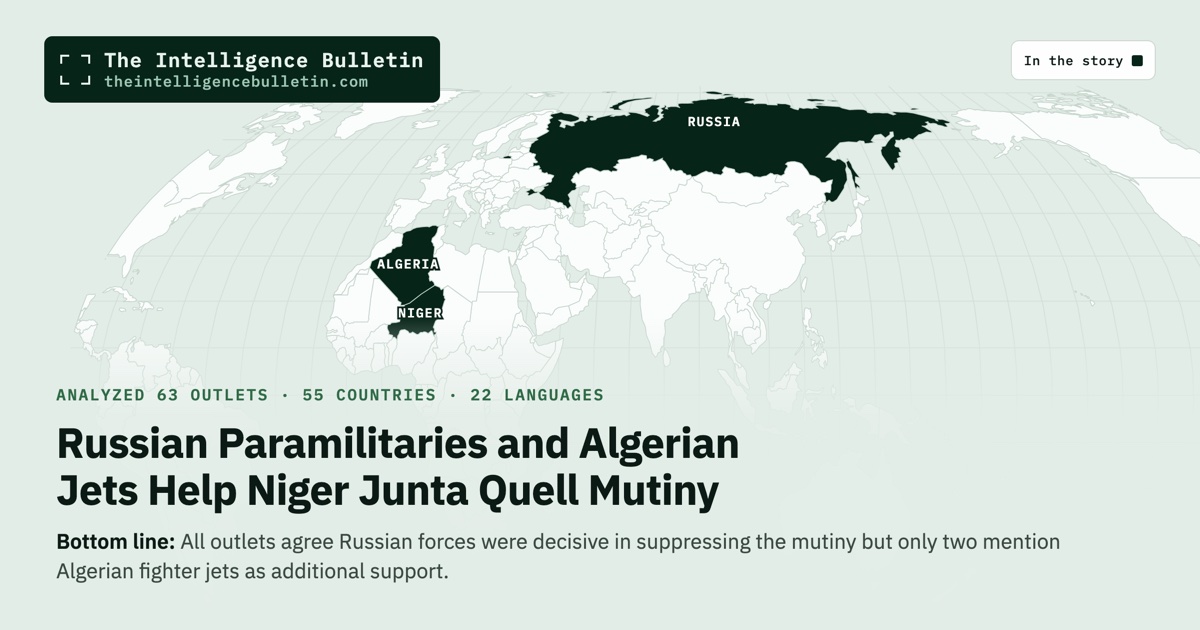
All outlets agree Russian forces were decisive in suppressing the mutiny but only two mention Algerian fighter jets as additional support.
The most striking pattern across these accounts is how uniformly the mutiny suppression is read as proof of swapped dependencies rather than a victory for the junta’s sovereignty rhetoric. Kenyan and South African outlets foreground the tactical Russian intervention as the central fact that undercuts the regime’s anti-foreign-power narrative, while the Benin French-language piece treats Moscow’s own confirmation of decisive aid as the story’s anchor. The French financial outlet sharpens this into a symbol of putschist reliance on the Africa Corps, and the Italian report adds the detail of Algerian Su-30 jets arriving afterward, widening the lens to regional actors without altering the core assessment of Moscow’s role. All five pieces draw from the same cluster of wire reporting on the ambassador’s statements, analyst commentary from Aldebaran and Control Risks, and the Timbuktu Institute note, yet each selects a different emphasis that collectively shows the absence of any counter-narrative in the selected coverage. The lack of an outlet from Russia itself means Russian official lines appear only through foreign relays, and the consistent mention that AES allies offered no help underscores the junta’s isolation even within its own bloc. What the reporting together reveals is that the event did not resolve underlying military grievances or jihadist threats but simply illustrated how quickly the regime turned to its new external guarantor when internal control was at stake.
Full analysis
On the night of August 28 into August 29 2026, gunfire and explosions erupted at several sites in Niger’s capital Niamey, including the presidential palace and Air Base 101 inside the Diori Hamani International Airport complex. Mutinous soldiers, drawn from units based in the capital and from towns such as Ouallam, Tera and Dosso that have seen heavy fighting against Islamist insurgents, seized positions and took hostages among their own colleagues. The attackers focused their efforts on the air base, one of the country’s most strategic military sites.
Loyalist forces responded with several hours of combat. By the following day the base had been retaken, dozens of mutineers killed or captured, and the immediate threat contained. State television later showed some of those detained. No official casualty figures were released by the Nigerien authorities, and the number of soldiers who took part remains unclear; Reuters noted that state media claimed hundreds but could not independently verify the figure.
The decisive external factor in restoring control was the intervention of Russia’s Africa Corps. The Russian ambassador in Niamey, Viktor Voropaev, stated publicly that the Nigerien authorities had requested assistance and that the Africa Corps had supplied ground and air support to help loyalist troops neutralise the mutineers. All five outlets in the set carried this account, drawing on statements from Voropaev and from the Russian Foreign Ministry, which added that calm had been restored and that Moscow would continue supporting Nigerien authorities against “extremists.” Estimates of the Africa Corps contingent inside Niger range from 200 to 300 personnel, with its headquarters at the same air base that became the focus of the fighting.
Two outlets reported an additional layer of external involvement. Algeria dispatched four Su-30MKA fighter jets and an Il-78 tanker aircraft after the mutiny had been quelled. The Algerian Defence Ministry described the mission as one requested by the Nigerien authorities to support the army against destabilisation. No reports indicated that the Algerian aircraft conducted strikes or engaged directly in the ground operation.
Niger’s state television accused France of orchestrating the mutiny, a recurring claim by the junta since the 2023 coup that removed President Mohamed Bazoum. The Russian Foreign Ministry echoed the charge, describing the mutineers as “extremists seemingly incited by European former colonial powers.” France has repeatedly rejected such accusations. The Alliance of Sahel States, the confederation formed by Niger, Mali and Burkina Faso, issued a joint statement supporting the loyalist forces and condemning the “betrayal” by the mutineers, but provided no military assistance during the crisis.
The episode occurred against the background of Niger’s post-coup security arrangements. After breaking military ties with France, its former colonial power and long-standing partner, the junta under General Abdourahmane Tchiani turned to Russia. The Africa Corps, operating under the Russian Defence Ministry and replacing the Wagner Group’s African footprint, is formally present to assist against jihadist groups linked to al-Qaeda and the Islamic State. Analysts quoted across the coverage noted that the mutiny instead illustrated the group’s role as a praetorian force protecting the regime itself. Charlie Werb of Aldebaran Threat Consultants told AFP that the Africa Corps supplied “ground and air support” that proved decisive at the air base. Lou Osborn of All Eyes on Wagner described the Russian promise as primarily one of regime protection. Beverly Ochieng of Control Risks said the Africa Corps fulfilled an obligation to ensure the government prevailed against any threat, not only jihadists.
The Timbuktu Institute, a Dakar-based think tank, observed that the junta had built much of its legitimacy on restoring security sovereignty, yet the need for outside help to contain an internal crisis raised questions about how far strategic autonomy can extend when it produces growing dependence on Moscow. The institute also noted deep divisions and grievances inside the security apparatus, where soldiers face constant exposure to jihadist attacks with limited equipment and supplies. The mutiny did not end those underlying pressures; analysts pointed out that Russian-trained local forces have still struggled to reverse jihadist gains, most recently the loss of Kidal in northern Mali in April.
The five outlets converged on the central sequence of events and on the assessment that the suppression demonstrated swapped dependencies rather than restored sovereignty. Standard Media led with the exposure of the junta’s reliance on Russia after its anti-foreign-power rhetoric. La Nouvelle Tribune anchored its account in Russia’s own confirmation of decisive aid. Boursorama framed the episode as symbolic of putschist dependence on the Africa Corps. DefenceWeb stressed the tactical Russian support that enabled survival amid internal military tensions. Linkiesta added the Algerian jet deployment as part of a broader regional dynamic.
Where the accounts differed in emphasis, the differences were narrow and additive rather than contradictory. Only DefenceWeb and Linkiesta mentioned the Algerian aircraft; the other three did not. All five relayed the same wire-service reporting on Voropaev’s statements and the analyst commentary. None carried an independent Russian or Nigerien-sourced counter-narrative that challenged the dependence framing. The absence of any outlet from Russia itself in the set meant that Russian official lines appeared only through foreign relays. The consistent reporting that AES allies offered no help during the crisis appeared in multiple pieces and underscored the junta’s isolation even within its own bloc.
The corroborated spine of the coverage—that Russian paramilitaries supplied the ground and air support that allowed loyalist forces to retake the air base—rests on the ambassador’s on-record statement and is carried by every outlet through the same wire agencies. That convergence supplies the strongest warrant for treating the dependence finding as the central takeaway. The Algerian jet detail, carried by only two outlets, remains narrower and does not alter the assessment of Moscow’s role on the ground. Nigerien accusations against France and the Russian echo of those claims appear in three outlets but remain one-sided assertions without independent corroboration in the set.
What to Watch
The reporting therefore shows a regime that moved quickly to its new external guarantor when internal control was threatened, while the jihadist insurgency and military grievances that predated the mutiny continue. Moscow gains visible leverage inside the Sahel juntas precisely because the alternative security partnership the juntas rejected has not been replaced by any viable regional substitute. The event is unlikely to resolve those structural weaknesses; it simply made the existing dependence visible in a single night of fighting.
That’s how the world told the story.
Get our daily open-source intelligence on world events in your inbox — one email a day, up to six stories.
Subscribe freeNo spam. One-click unsubscribe. See the latest email →