 AI-generated analysis published under the editorial responsibility of Rohit Sinnas. How it works →
Press quoted
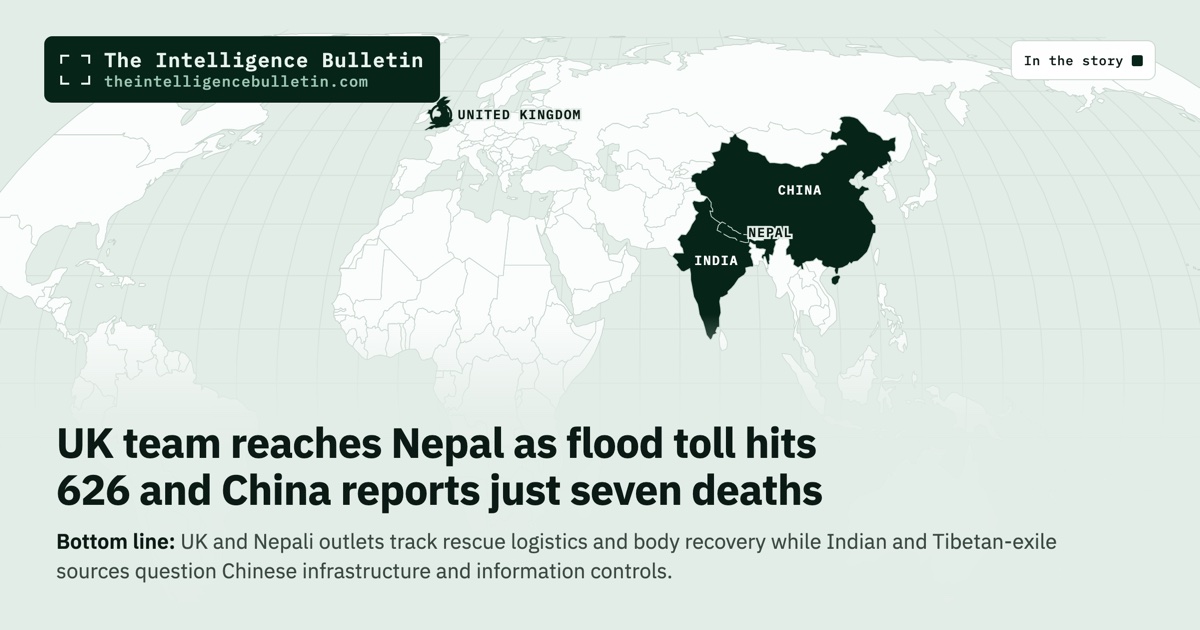
UK and Nepali outlets track rescue logistics and body recovery while Indian and Tibetan-exile sources question Chinese infrastructure and information controls.
UK outlets frame the crisis around the deployment of British personnel and the safety of nationals missing on routes to Mount Kailash, pairing the rising Nepali toll with consular priorities and a £5 million aid package. Nepali reporting, carried via ANI, instead stresses immediate local strain: hospitals in Chitwan and Pokhara converting buildings into temporary morgues because national capacity holds only about 350 bodies, with recoveries continuing days later along the Trishuli and Narayani rivers. The Independent adds scientific context that the collapse site had warmed at five times the global average since the 1960s, linking permafrost thaw and glacier loss to heightened risk without attributing the specific event to climate change. Phayul and Live Hindustan shift focus to upstream Chinese infrastructure and alleged information controls, citing Nepali journalists and analysts who question whether border construction amplified the flood’s downstream effects, while noting Beijing’s rejection of those claims and its low official casualty figures. The pattern shows how the same core facts—glacier trigger, high Nepali toll, low Chinese numbers—produce sharply different emphases once national interests and editorial priorities enter the frame.
Full analysis
On August 26 a section of glacier and mountainside gave way high on Langtang Lirung, a 7,000-metre peak on the Nepal-Tibet border. The resulting mass of ice, rock and debris crashed into the Lhende Khola river, picked up sediment and water, and surged downstream into Nepal’s Rasuwa, Nuwakot and Dhading districts. Rivers rose by as much as nine metres in half an hour. The torrent tore through villages, destroyed bridges and damaged roughly 25 miles of road. A hydropower construction site in Rasuwa trapped more than 100 workers inside a mud-filled tunnel. Helicopter rescues were later suspended because of bad weather and fears of a second flood from a barrier lake formed by the initial landslide.
By the morning of August 29 Nepal’s National Disaster Risk Reduction and Management Authority recorded 626 confirmed deaths and nearly 2,500 people still missing. Among the missing were dozens of British nationals, many of them pilgrims travelling toward Mount Kailash under tour operators including The Trekkers’ Society and Kailash Journeys. Nine British citizens from a single expedition—four men aged 14 to 54 and five women aged 40 to 53—remained unaccounted for, along with additional British travellers whose contact had been lost. Chinese state media, citing the Ministry of Water Resources, reported seven deaths and 554 missing on the Tibetan side of the border. Water levels upstream had fallen ten metres between Thursday and Friday, according to CCTV.
Recovery work in Nepal focused on bodies swept far downstream. Police teams retrieved remains from the Trishuli and Narayani rivers between Phishling and Golaghat in Chitwan district, where nearly 200 bodies had already been collected. Similar finds reached Pokhara from Tanahun, Gorkha, Nawalparasi East and Dhading. Nepal’s nationwide morgue capacity stands at roughly 350 bodies. Hospitals in Chitwan could store between 30 and 50 at a time; those in Kaski held 88. Temporary facilities were opened in an unused industrial building in Bharatpur and additional space was arranged in Pokhara. Under the Unidentified and Unclaimed Bodies Management Guidelines 2021, police photographed, fingerprinted, performed post-mortems and took DNA samples before displaying images for relatives. Bodies that could not be identified were to be managed within one or two weeks through district committees.
The United Kingdom responded with a rapid deployment team scheduled to reach Kathmandu on August 29. The team was tasked with supporting British nationals and their families at the airport, coordinating with the embassy and local authorities, and assisting search efforts for the 33 British citizens still unaccounted for. Foreign Secretary Ed Miliband stated that the safety of British nationals was the top priority and that the deployment would work alongside Nepali emergency services. The UK also committed £5 million in humanitarian aid routed through UN agencies, the Red Cross and NGOs.
Nepali officials described scenes resembling a “tsunami from the sky,” with entire villages erased. Rajendra Pudasaini of the Non-Resident Nepali Association UK, whose own family members were swept away, called the losses irreplaceable and attributed them to global warming. Bishal Nath Upreti of the Nepal Centre for Disaster Management used the same phrase for the scale of destruction.
Accounts of the event’s causes and consequences diverge once the focus shifts beyond the immediate toll. The Independent reported that the Langtang catchment above 4,000 metres has warmed at roughly five times the global average since the 1960s, with the trend accelerating in the past decade. Glaciologist Bethan Davies linked the exposure of darker rock after snow and ice loss to faster heat absorption; Ella Gilbert of the British Antarctic Survey noted that glacier stability is already undermined across the Himalaya and that sudden failures are becoming more likely. Experts cautioned that they could not yet tie the specific August 26 collapse to climate change, though the conditions—unusually warm, low snow cover—matched patterns seen before major calving events. Permafrost thaw was described as removing the “glue” that holds steep slopes together.
Phayul and Live Hindustan instead directed attention upstream. Nepali journalists writing through the Nepal Correspondence platform alleged that Chinese construction around Kyirong, including settlements and alterations to the Trishuli river system, had destabilised slopes and increased downstream water velocity. Analyst Brahma Chellaney argued that Chinese hydrological modifications did not trigger the glacier failure but amplified its cascading effects. Both outlets reported that China had supplied no advance warning of water surges or debris-dam formation, despite commitments after a smaller flood on the same river in 2025. Chinese authorities rejected the claims, attributing the event to an earthquake or earthquake-like tremor and maintaining that rescue teams had been dispatched promptly. Chinese media coverage was described as tightly controlled, with reporters focusing on official relief efforts rather than interviewing affected residents.
A reader limited to UK reporting would see a story centred on British consular action, the £5 million aid pledge and the safety of missing pilgrims, set against a Nepali death toll of 626. The same reader would encounter no detail on the mechanics of body recovery or the nationwide shortage of morgue space. A reader limited to Nepali coverage carried by ANI would encounter the precise logistics of temporary morgues in Chitwan and Pokhara and the continued recovery of bodies days after the flood, yet would find no account of British nationals among the missing or the UK deployment. A reader limited to the Independent would gain the scientific framing of long-term warming and permafrost thaw but would not learn the day-to-day challenges of identifying remains or the specific British response. Readers of Phayul or Live Hindustan would encounter explicit scrutiny of Chinese infrastructure and information controls, including allegations that Tibetans were prevented from speaking to journalists, but would not see the detailed morgue-capacity figures or the UK aid commitment.
The corroborated element across the source set is the Nepali death toll of at least 626 and the scale of missing persons. The UK deployment and aid figure rest solely on statements from the Foreign Secretary and FCDO reported in one outlet. The Chinese casualty numbers appear only in citations of state media. The scientific attribution of heightened risk to regional warming is drawn from named glaciologists in a single climate-focused article. The morgue-capacity constraint and downstream body-recovery logistics are documented through Nepali police and district officials in the ANI material.
What to Watch
The most durable picture comes from combining the Nepali operational detail with the scientific context. Both rest on named local officials and academic specialists rather than diplomatic statements or partisan commentary. The Chinese figures and the infrastructure accusations remain single-chain accounts that conflict on the record with each other. The next developments most likely to clarify the picture are further cross-border data sharing on water levels and barrier-lake stability, and the outcome of any formal request Nepal may make to Beijing about upstream construction impacts—requests already signalled by Nepali analysts but not yet answered in the published record.
That’s how the world told the story.
Get our daily open-source intelligence on world events in your inbox — one email a day, up to six stories.
Subscribe freeNo spam. One-click unsubscribe. See the latest email →