 AI-generated analysis published under the editorial responsibility of Rohit Sinnas. How it works →
Press quoted
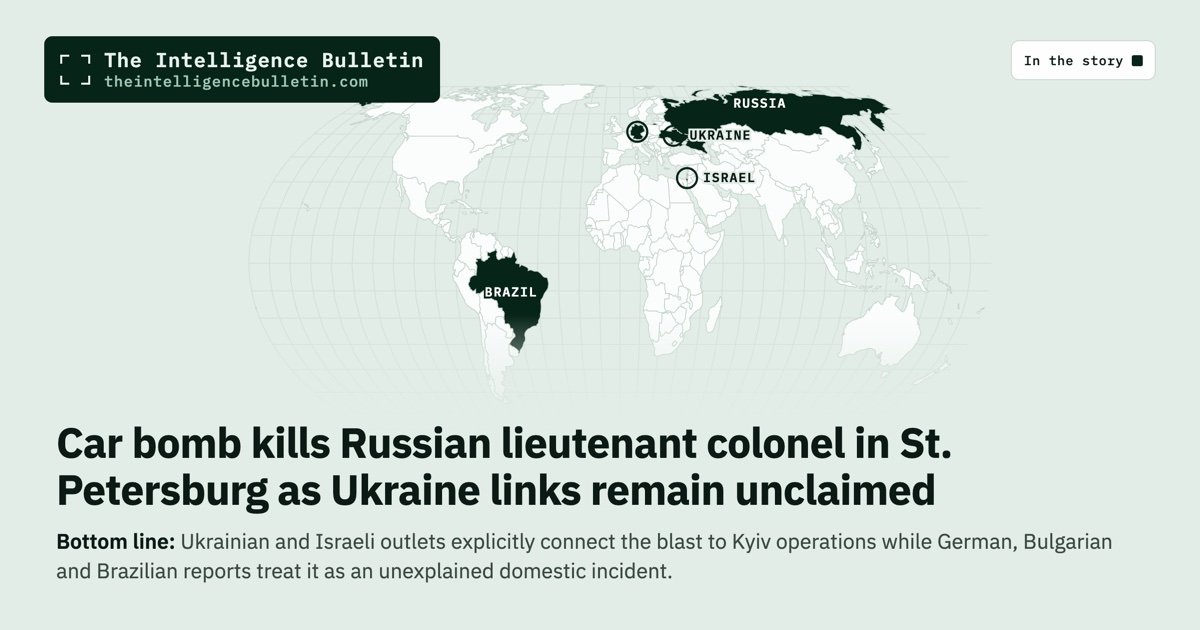
Ukrainian and Israeli outlets explicitly connect the blast to Kyiv operations while German, Bulgarian and Brazilian reports treat it as an unexplained domestic incident.
The selected sources converge on the basic facts of the killing but diverge sharply on context and implication. Ynetnews alone builds an explicit chain linking the blast to prior suspected Ukrainian operations against Russian officers including Kirillov, framing it as part of widening escalation that also includes Russian warnings to Britain. Podrobnosti pairs the bombing with Ukrainian drone strikes far inside Russia, presenting the incident as successful retaliation reaching deep into the country. CartaCapital, citing AFP and local Fontanka reporting, notes the proximity to military housing and recalls Putin’s past admission of security lapses without assigning blame. News.bg relays Reuters copy and records Russia’s historical accusations against Ukraine while stressing the absence of any claim or Kyiv comment in this case. n-tv embeds the item as one brief domestic note inside a Ukraine-war live ticker, offering no attribution or pattern. The absence of any Russian outlet in the set leaves official Moscow statements visible only through foreign relays, while the consistent lack of claimed responsibility across all reports leaves motive and perpetrator unconfirmed. The reporting therefore shows a factual core that every chain accepts and a single interpretive fault line: whether this is treated as an isolated crime or the latest data point in a cross-border assassination campaign.
Full analysis
A Russian lieutenant colonel died on the morning of August 27 when an explosive device inside his car detonated near a supermarket in St. Petersburg’s Shushary district. His wife, who was also in the vehicle, survived but suffered serious injuries. Russian authorities responded by opening a criminal investigation and described the incident in some statements as a vehicle fire rather than a deliberate explosion. The blast occurred around 10 a.m. local time, and emergency services cordoned off the street while crews examined a damaged black car at the scene.
Local reporting identified the victim as serving in Russia’s air and air-defense forces. The couple had reportedly been leaving their home when the device went off. No group claimed responsibility for the attack, and Ukrainian officials issued no public comment on the case. Russian authorities have previously accused Ukraine of carrying out similar operations against military and security figures since the start of the full-scale invasion, though Kyiv has taken responsibility for some past incidents and denied involvement in others.
Coverage of the killing appeared across outlets in Israel, Ukraine, Germany, Bulgaria and Brazil. The Israeli report placed the St. Petersburg blast inside a longer sequence of attacks on Russian officers and security personnel. It noted the December 2024 killing of Lieutenant General Igor Kirillov, head of Russia’s nuclear, biological and chemical protection forces, by an explosive hidden in an electric scooter in Moscow. The same account listed earlier incidents including the June car-bomb death of General Damir Davidov and the December killing of Lieutenant General Fanil Sarvarov in central Moscow. It also referenced the February killing of Armen Sarkisyan and earlier attacks on a former Ukrainian naval commander in Crimea and managers at drone-production plants. The report framed the latest death as part of widening escalation that also includes Russian warnings to Britain over Ukrainian use of British-supplied weapons.
The Ukrainian outlet paired the car bomb with separate reports of Ukrainian drone strikes reaching targets more than 2,000 kilometers inside Russia. Its framing presented the incident as evidence of Ukrainian operations extending deep into Russian territory on the same day. The Brazilian report, drawing on AFP dispatches and the St. Petersburg channel Fontanka, emphasized the location near what appeared to be military housing and recalled President Putin’s earlier public admission of security shortcomings within Russia’s intelligence services. It described the event as the latest in a series of high-profile killings of Russian military figures without assigning responsibility to any specific actor.
The Bulgarian site relayed Reuters copy that stressed the absence of any claim of responsibility and the lack of comment from Kyiv. It recorded Russia’s historical accusations against Ukraine in similar cases but did not apply those accusations to the current incident. The German coverage placed the item as one brief entry inside a continuous live ticker on the Ukraine war. The ticker format listed the death of the senior officer alongside unrelated developments such as drone activity over Crimea and statements from other capitals, offering no additional sourcing or pattern analysis for the St. Petersburg blast itself.
These differences shape what a reader learns depending on which single account they encounter. Someone reading only the Israeli report would come away with a clear narrative of targeted killings attributed to Ukrainian networks and would see the St. Petersburg case as one more data point in that chain. A reader limited to the Ukrainian account would receive the same incident framed as successful reach by Kyiv forces, reinforced by the simultaneous drone strikes. The Brazilian account would leave them focused on Russian internal vulnerabilities without a named perpetrator. The Bulgarian relay would present the event as an unexplained local crime with no fresh link to the wider war. The German ticker entry would register simply as one additional note inside the daily flow of hostilities, without elevating its significance.
The absence of any Russian outlet from the set means official Moscow statements on the investigation or possible perpetrators reach readers only through these foreign relays. Every account that mentioned an investigation cited Russian authorities or local St. Petersburg sources, yet none supplied new details on suspects or motive beyond the opening of the case. The consistent lack of claimed responsibility across the reports leaves the question of who carried out the attack and why unresolved in the published coverage.
The accounts that treat the killing as an unclaimed domestic incident align most closely with what the reporting actually contains. No outlet in the set produced evidence tying this specific blast to Ukraine or any other actor, and the absence of a claim or Kyiv comment is noted even in pieces that otherwise highlight the broader pattern. The Israeli and Ukrainian reports rely on that pattern to suggest a connection, but the pattern itself rests on earlier cases whose attributions also remain unproven in the current coverage. The Brazilian and Bulgarian pieces, by staying within the confirmed facts of the blast and the investigation, avoid introducing an attribution the sources do not support.
What to Watch
This single incident adds one more instance of lethal violence inside a major Russian city against a serving military officer. It occurs in a district associated with military housing and follows previous attacks on figures involved in Russia’s defense establishment. Whether the pattern reflects sustained external pressure or separate criminal acts remains open in the reporting examined here. The next developments likely to matter are any official Russian findings on the device used or the identity of those who placed it, and whether subsequent coverage in additional outlets begins to claim responsibility or supplies new sourcing that the present set lacks.
That’s how the world told the story.
Get our daily open-source intelligence on world events in your inbox — one email a day, up to six stories.
Subscribe freeNo spam. One-click unsubscribe. See the latest email →