 AI-generated analysis published under the editorial responsibility of Rohit Sinnas. How it works →
Press quoted
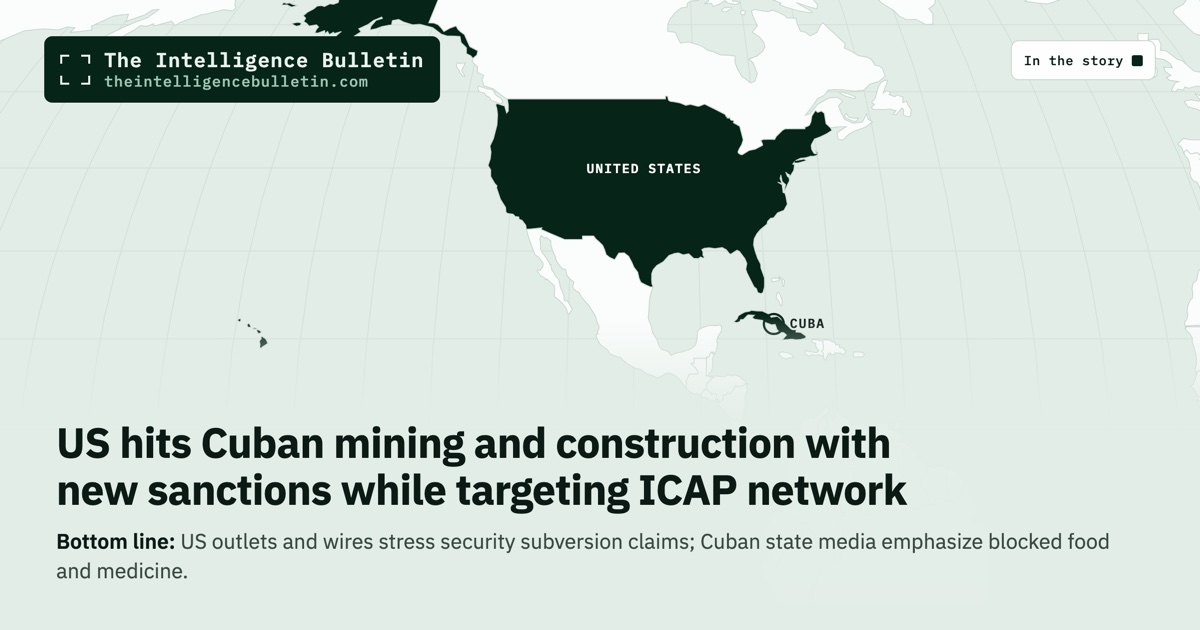
US outlets and wires stress security subversion claims; Cuban state media emphasize blocked food and medicine.
The reporting converges on the specific targets and Rubio’s core accusation that ICAP runs a decades-long subversive operation inside the United States, yet parts company sharply on whether those designations serve national security or simply intensify civilian hardship. Al Jazeera and the Jamaica Gleaner both record the nine entities and three ICAP officials while noting UN warnings of energy starvation and rising infant mortality; the Independent adds the Miami airport detentions of returning Americans. Cubaheadlines and Diario de Cuba carry Rodríguez’s and Díaz-Canel’s rebuttals almost verbatim, with the Cuban foreign minister naming Rubio personally and insisting the sanctions obstruct private imports of food and medicine despite US claims of exemptions. Diario de Cuba alone foregrounds Rubio’s language about infiltration and radicalization of US citizens. The Jamaican and British pieces treat the visitor enforcement as the practical new development, while the Cuban outlets omit it. This pattern shows the sanctions themselves are corroborated across independent chains, but the humanitarian versus security framing splits cleanly along national lines and cannot be reconciled from the published accounts.
Full analysis
The United States announced sanctions on August 20, 2026, that added nine Cuban state-owned companies in mining, metals and construction to the Treasury’s SDN list and designated three officials at the Cuban Institute of Friendship with the Peoples. The entities included the Ministry of Construction, Geominsal, the Comandante Ernesto Che Guevara Nickel Company, Metalcuba, Acinox Comercial, Acorec, Coratur, Transimport and Consumimport. The three individuals named were ICAP president Fernando González Llort, first vice president Noemí Ramona Rabaza Fernández and North America director Leima Martínez Freire.
Secretary of State Marco Rubio issued the accompanying statement. He described ICAP as one of the main organizations involved in efforts to infiltrate, corrupt and radicalize Americans, and he linked the designations to recent Cuban activity around the centenary of Fidel Castro. Rubio wrote that the Trump administration would not stand by while a hostile foreign power exploited US freedoms by misleading citizens with lies, spy tradecraft and other malfeasance as part of exporting Marxism, racial resentment and Communist violence. The statement also warned that anyone supporting or providing services to the sanctioned actors risked secondary sanctions themselves.
The measures sit inside a wider campaign that began after the US military operation that removed Venezuelan President Nicolás Maduro in January 2026. That operation cut Cuba’s primary source of subsidized oil from Venezuela. The Trump administration then threatened tariffs on any country shipping fuel to the island, leaving only one Russian tanker to reach Cuban ports since. An executive order signed in May authorized sanctions on those responsible for repression, and Thursday’s designations cited that order. The cumulative effect has included repeated power blackouts across the island and shortages of medicine and other goods.
Cuban Foreign Minister Bruno Rodríguez responded on X that the sanctions were intended to damage the economy and prevent the government from guaranteeing basic services. He said the measures hindered the transport of containers carrying food, medicines and medical devices purchased largely by private small and medium-sized enterprises. Rodríguez defended ICAP as an institution that for more than six decades had promoted friendship, international solidarity, justice and peace, and he called Rubio’s policy corrupt. Cuban President Miguel Díaz-Canel posted that the only offense of the sanctioned people and institutions was serving Cuba and facing what he termed a genocidal blockade, adding that the people would resist and prevail.
The two accounts of purpose stand in direct opposition. Rodríguez maintained that the sanctions block humanitarian supplies despite explicit US claims of exemptions for food, medicine and medical devices. Rubio’s statement framed the same actions as necessary to counter a national-security threat posed by Cuban operations inside the United States. Neither side offered new evidence that would reconcile the two descriptions.
Coverage from outside the United States and Cuba added one further concrete development. Several Americans who had traveled to Cuba for events marking Castro’s centenary were detained briefly at Miami airport upon return for secondary screening by Customs and Border Protection. Some had electronic devices seized for inspection. Officials said the travelers were eventually released but could still face prosecution if found to have violated sanctions that bar transactions with Cuban government-owned entities.
The sanctions themselves appear in every account examined. The nine companies, the three ICAP officials and the core language from Rubio on subversion are recorded by the Treasury notice itself and repeated across the reporting. The Cuban rebuttals from Rodríguez and Díaz-Canel are carried in full by the Cuban state-aligned outlet and quoted at length by the Spanish-language exile publication. The airport detentions surface only in the British and Jamaican pieces, both of which draw from the same underlying dispatch.
A reader limited to Cuban state sources would encounter the personal attribution to Rubio and the claim that private importers of food and medicine are directly affected, but would not see the airport enforcement actions or the explicit US exemption language. A reader limited to the British or Jamaican accounts would learn of the traveler detentions and the scale of the entity list, yet would miss the Cuban government’s direct counter-claim that the sanctions obstruct private humanitarian shipments. The exile outlet alone gives extended space to Rubio’s language on infiltration and radicalization while treating the Cuban responses as secondary.
The sanctions list and the two opposing statements of purpose are the elements that hold across independent reporting chains. The humanitarian-block claim and the security-subversion claim cannot both be true in the form each side presents them. The Treasury notice and Rubio’s on-record statement supply the warrant for the US framing. The Cuban foreign minister’s and president’s public posts supply the warrant for the counter-framing. No additional document or count in the published coverage bridges the gap.
What to Watch
The Trump administration’s interest lies in sustaining the narrative that Cuba poses an active internal threat, which justifies continued economic isolation and secondary enforcement. The Cuban government’s interest lies in sustaining the narrative that the measures deliberately target civilian welfare, which supports its domestic mobilization and international appeals. The next steps most directly implied by the reporting are further designations under the same executive order and continued Cuban public diplomacy framing the sanctions as an attack on ordinary Cubans. The pattern of Thursday announcements suggests the cadence of designations will remain weekly or near-weekly for the remainder of the pressure campaign.
That’s how the world told the story.
Get our daily open-source intelligence on world events in your inbox — one email a day, up to six stories.
Subscribe freeNo spam. One-click unsubscribe. See the latest email →