 AI-generated analysis published under the editorial responsibility of Rohit Sinnas. How it works →
Press quoted
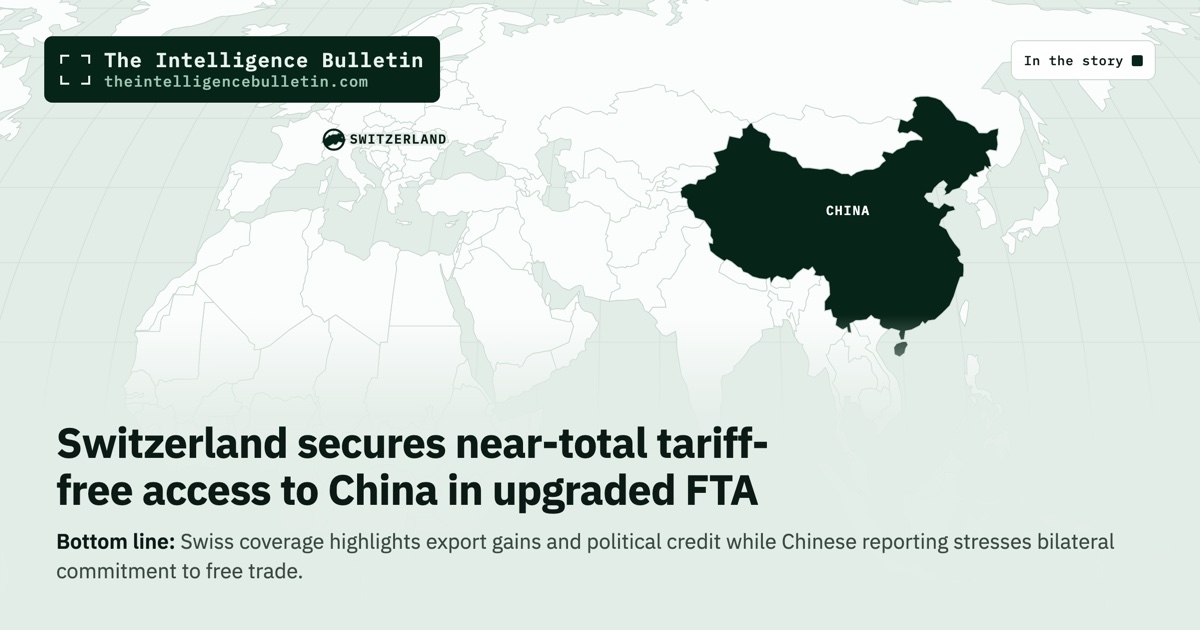
Swiss coverage highlights export gains and political credit while Chinese reporting stresses bilateral commitment to free trade.
The reporting converges on the core announcement of an upgraded China-Switzerland FTA that will eventually clear tariffs from nearly all Swiss exports, yet the outlets diverge sharply on framing and emphasis. Swiss government-aligned pieces stress concrete economic gains and ministerial achievement, while the Chinese state outlet presents the outcome as mutual commitment to certainty in uncertain times. One Swiss outlet alone raises whether Beijing seeks geopolitical cover rather than purely commercial advantage, noting rising global pressure on Chinese exports and questions over enforcement of new labor and environmental clauses. Official Swiss statements and agency copy provide the 99.8 percent figure, industry savings estimates and timeline details that appear consistently across domestic reports. The absence of comparable detail in the Chinese account suggests the upgrade serves different domestic narratives: Swiss readers receive export-specific relief and political credit, Chinese readers receive a bilateral success story amid trade tensions elsewhere. Parliamentary ratification in Switzerland remains an open variable that none of the immediate coverage resolves.
Full analysis
Switzerland and China announced on August 20, 2026, that they had completed negotiations to upgrade the free trade agreement first signed in 2013 and in force since 2014. The two ministers who met in Bern that day, Swiss Economic Affairs Minister Guy Parmelin and Chinese Commerce Minister Wang Wentao, issued statements that described the outcome in nearly identical language as a milestone that would expand two-way trade and investment. The upgrade adds higher-standard rules on goods, services, investment and new chapters covering digital trade, competition and economic cooperation. Once domestic procedures are complete, the protocol is expected to be signed later in 2026.
Under the terms now agreed, 99.8 percent of current Swiss exports to China will eventually enter duty-free after transition periods. Only about half of those shipments enjoy zero tariffs today. Swiss officials calculate that the change will save exporters roughly 244 million Swiss francs in duties once fully phased in. Watches, precision machinery and pharmaceuticals stand to gain the most immediate relief. Food producers receive narrower but still concrete improvements: tariffs on roasted coffee and cheese are scheduled to disappear after a ten-year transition. Chinese imports into Switzerland, already nearly all duty-free under the original agreement, see no major further change.
The original 2014 pact was China’s first free trade deal with any continental European country. China ranks as Switzerland’s third-largest trading partner after the European Union and the United States. In 2025 Swiss exports to China reached 15.2 billion francs while imports stood at 18.3 billion francs. Trade volumes have grown steadily since the first agreement took effect, a trend Swiss reports attribute in part to the existing tariff reductions. The upgrade negotiations themselves began in September 2024 and concluded after five rounds.
Chinese Commerce Minister Wang Wentao told the meeting in Bern that the outcome showed both sides choosing certainty and supporting free trade in an uncertain international environment. He noted that 2026 marks the start of China’s 15th Five-Year Plan and the tenth anniversary of the countries’ innovative strategic partnership. Swiss President and Economic Affairs Minister Parmelin replied that the upgrade supplies more stable, transparent and predictable rules for companies on both sides and sends a positive signal for open cooperation and a rules-based trading system. Both sides committed to finishing domestic approvals quickly so the upgraded agreement can enter into force.
Swiss domestic coverage supplied additional operational detail absent from the Chinese account. One report listed the precise 99.8 percent target, the 244-million-franc savings estimate and the list of sectors expected to benefit most. It also recorded that the new text strengthens provisions on environmental standards and labor rights in addition to the chapters on services and digital commerce. Another Swiss outlet relayed the federal government’s statement that the Swiss side had reached its negotiating goals and that the agreement would give Swiss investors clearer market access in China. These figures and sector breakdowns appear consistently across Swiss government statements and the agency copy that carried them.
The Chinese state-linked account instead presented the result as a bilateral success achieved through joint effort and five rounds of talks. It quoted both ministers on the value of the existing relationship and on the need to implement the leaders’ consensus. It did not repeat the 99.8 percent figure, the savings calculation or the specific industry impacts. The emphasis remained on the political message of continued openness rather than on measurable export relief for one side.
One Swiss public broadcaster added a layer of analysis not present in the other reports. Its economic editor noted that, according to diplomats and experts he had spoken with, China appears to value the deal partly for geopolitical reasons at a moment when many countries are imposing protective measures against Chinese exports. The same piece observed that the democratic Swiss government could be viewed by critics as lending legitimacy to an increasingly authoritarian partner, though it presented this view as one circulating in expert circles rather than as established fact. It also flagged that the final text remains unpublished and that binding, enforceable language on labor rights, human rights and the environment will likely determine how easily the agreement passes the Swiss parliament and any possible popular referendum.
The accounts converge on the date, the location, the two ministers involved, the fact that negotiations ended after five rounds, and the inclusion of new rules on environment, labor, services and digital trade. They diverge on the weight given to concrete Swiss export gains versus the broader political framing. Swiss readers encounter specific tariff percentages, franc savings and sector lists that Chinese readers do not see in the state account. Chinese readers encounter a narrative of mutual commitment to free trade that Swiss domestic pieces treat as background rather than the main story.
The Swiss government statements and the agency copy that reproduced them supply the only detailed, cross-checked numbers on tariff coverage and fiscal impact. Those numbers appear in multiple independent Swiss outlets and rest on an official announcement issued the same day. The Chinese report draws directly from the Ministry of Commerce statement and therefore reflects Beijing’s chosen emphasis. The single analytical piece that raises geopolitical motives draws on unnamed diplomats and experts and stands alone in the source set; no other report examined here makes the same claim or supplies evidence that would contradict it.
What to Watch
The most reliable picture for a reader is therefore the one that begins with the Swiss government’s quantified description of tariff relief and then notes the additional political context supplied by the Chinese statement. The geopolitical speculation remains an open question that the immediate coverage neither confirms nor refutes. What the reporting does establish is that Swiss exporters in watches, machinery and pharmaceuticals now have a concrete path to duty-free access on 99.8 percent of their current shipments to their third-largest market, subject only to final parliamentary approval in Bern.
That’s how the world told the story.
Get our daily open-source intelligence on world events in your inbox — one email a day, up to six stories.
Subscribe freeNo spam. One-click unsubscribe. See the latest email →