 AI-generated analysis published under the editorial responsibility of Rohit Sinnas. How it works →
Press quoted
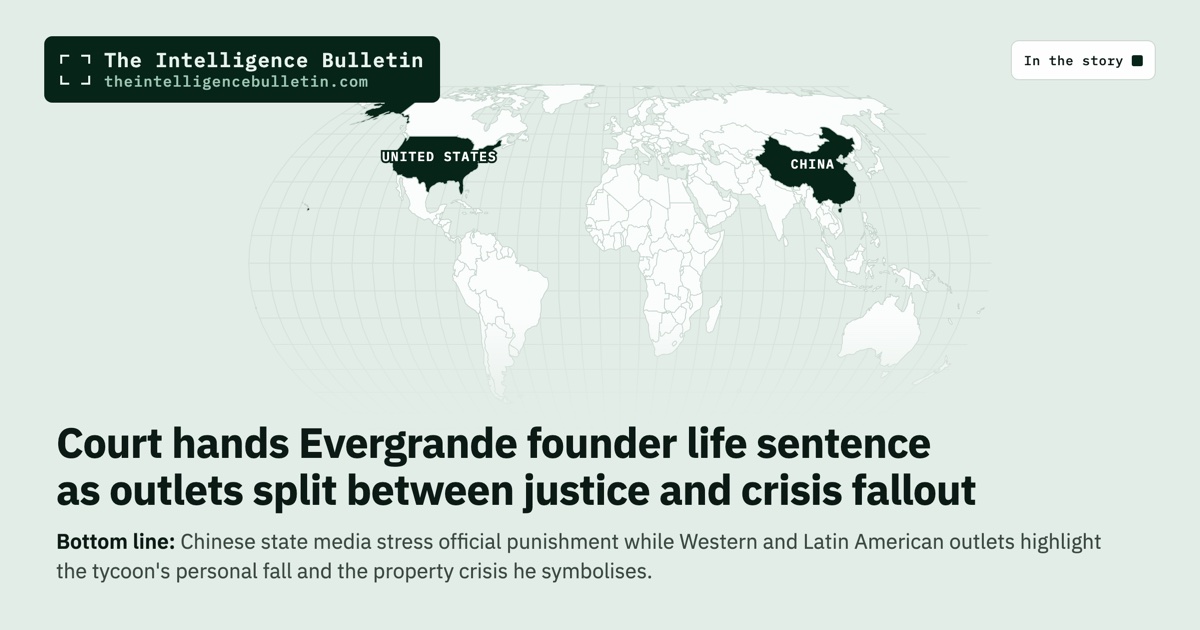
Chinese state media stress official punishment while Western and Latin American outlets highlight the tycoon’s personal fall and the property crisis he symbolises.
All reporting chains trace the verdict directly to the Shenzhen court and Xinhua, yet the framing reveals where national priorities sit. China’s state outlet presents the outcome as straightforward punishment for disrupting the socialist market economy and causing enormous losses, with no mention of wider fallout. UK coverage turns the same facts into a personal rags-to-riches-to-prison arc, dwelling on Xu’s rural Henan origins and 2017 peak net worth. German business reporting stresses the symbolic weight of Evergrande’s collapse for China’s property sector and lingering market risks. The Chilean piece adds the Latin American observer’s view of ripple effects on global housing and finance while recounting the same biography. Greek coverage reduces it to the single emblematic detail that the country’s former richest man now faces life. The common thread is that no outlet disputes the sentence or the listed crimes; the divergence lies in whether the story is told as state justice, individual tragedy or systemic warning.
Full analysis
A Shenzhen Intermediate People’s Court sentenced Xu Jiayin, also known as Hui Ka Yan, to life in prison on August 20, 2026. The court convicted him of illegally absorbing public deposits, fundraising fraud, illegally issuing loans, fraudulent issuance of securities, unlawful disclosure of important information, corporate bribery, illegal use of funds and embezzlement. It also found Evergrande Group and Evergrande Real Estate Group guilty of related offenses. The court ordered confiscation of all Xu’s personal assets, stripped him of political rights for life and directed continued recovery of illegal gains. Evergrande Group received a fine of 8.82 billion yuan, equivalent to roughly 1.3 billion dollars, while Evergrande Real Estate Group was fined 7 billion yuan. The court described the offenses as having seriously disrupted the socialist market economy, infringed property rights and undermined official integrity, with exceptionally large sums involved and extraordinarily heavy economic losses.
Xu, 67, had pleaded guilty in April to eight charges and expressed remorse during proceedings. The court noted that between 2016 and 2021 he and the companies inflated assets, concealed liabilities through sustained financial fraud, gained control of financial institutions via bribery and obtained illegal credit and insurance funds. Xu also misappropriated company property under the guise of dividends. Separate judgments that day sentenced 56 other individuals tied to the case to prison terms ranging from 22 months to 18 years.
Xu rose from rural poverty in Henan province. Born in 1958, he lost his mother at age one, grew up eating sweet potatoes and steamed bread, and worked on a farm and as a security guard before studying metallurgy on scholarship. He left a state steel factory in 1992 with 20,000 yuan in savings and moved to Shenzhen to enter real estate. He founded Evergrande in 1996. The developer expanded aggressively through heavy borrowing, sold homes at lower margins for quick turnover and reached 700 billion yuan in annual sales by 2020. At its peak it employed 200,000 people, ran more than 1,300 projects across 280 cities and owned a championship soccer club. In 2017 Xu’s net worth exceeded 42 billion dollars and made him Asia’s richest man. By 2023 it had fallen to an estimated 3 billion dollars.
Chinese regulators began tightening limits on excessive borrowing in 2020. Evergrande defaulted on overseas debts the following year, entered liquidation after a Hong Kong court order in 2024 and saw its shares delisted from the Hong Kong exchange in 2025. Its liabilities stood at 2.39 trillion yuan as of mid-2023. The company’s collapse became a symbol of China’s broader property sector difficulties, where real estate and related industries once accounted for up to 30 percent of GDP. Housing prices have declined for three years and new-home sales fell to their lowest level since 2014.
The Shenzhen court ruling rests on a single primary source: the court’s own findings, distributed through Xinhua. Every outlet that published on the sentencing day carried those core details without contradiction. The accounts differ only in what they place beside the verdict. The Chinese state account foregrounds the court’s language on economic disruption and severe punishment. It lists the crimes and penalties in full but does not connect the case to ongoing market conditions or to Xu’s personal history. British reporting centers the individual’s trajectory, describing his rural origins, 2017 wealth peak, 2021 appearance at Communist Party centenary events in Beijing and the contrast with his grey-haired appearance in court. It notes his workaholic style, poker-club connections with Hong Kong tycoons and past statements crediting the country’s policies for his success. German business coverage emphasizes the sector symbolism and lingering risks, placing the sentence against the timeline of regulatory tightening, default and liquidation. Chilean reporting adds the scale of Evergrande’s operations and the potential for wider effects on consumer confidence and global housing finance, while recounting Xu’s early hardships and luxury tastes. Greek coverage reduces the event to the single emblematic shift from richest man to life prisoner.
A reader limited to the Chinese account would see only state justice applied to clear violations. A reader limited to the British account would encounter a personal rise-and-fall story but little on the company’s debt levels or regulatory backdrop. One limited to the German or Chilean accounts would grasp the economic stakes but might underweight the precise criminal findings. None of the published pieces disputes the sentence, the fines or the guilty plea. The convergence on those facts comes from independent reporting chains that all trace back to the court statement itself.
What to Watch
The court document supplies the strongest warrant for what actually occurred. Outlets that foreground it stay closest to the record. National interests shape the added layers: Chinese coverage aligns with emphasis on market order and official accountability, while international business and regional outlets highlight consequences for growth and investor confidence. The property sector’s weight in the Chinese economy means the verdict functions as a signal of continued regulatory pressure rather than an isolated case. Markets have already priced in years of weakness; further tightening on developers would likely extend that pressure rather than resolve it quickly.
That’s how the world told the story.
Get our daily open-source intelligence on world events in your inbox — one email a day, up to six stories.
Subscribe freeNo spam. One-click unsubscribe. See the latest email →