 AI-generated analysis published under the editorial responsibility of Rohit Sinnas. How it works →
Press quoted
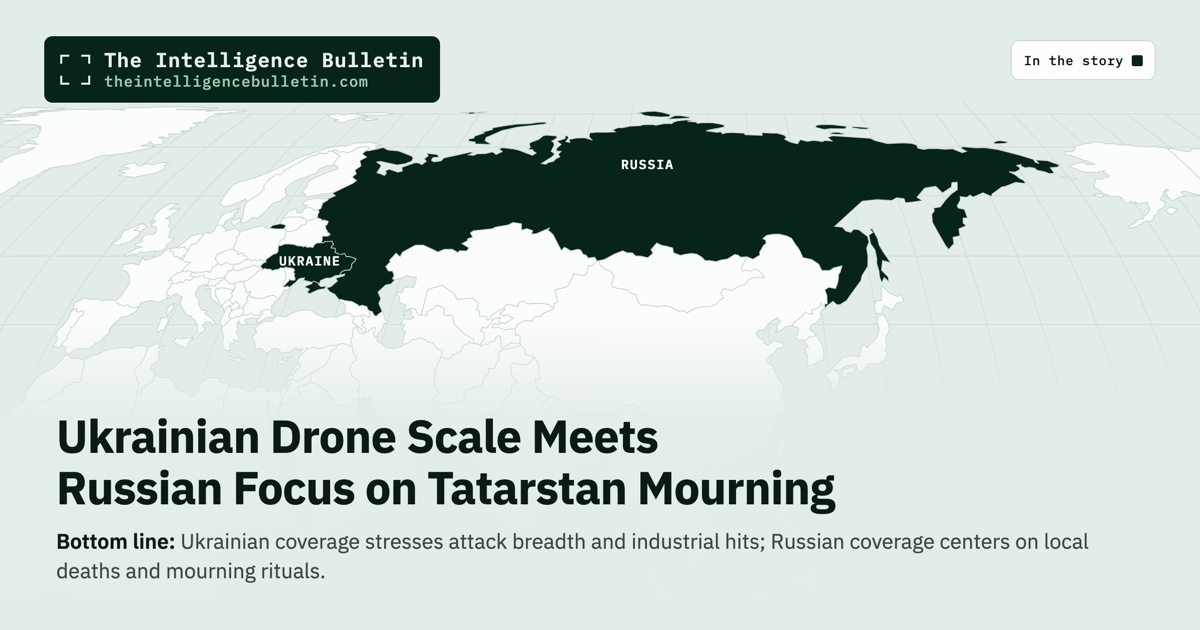
Ukrainian coverage stresses attack breadth and industrial hits; Russian coverage centers on local deaths and mourning rituals.
The reporting reveals a clear split in emphasis rather than disputed facts. Ukrainian outlets such as Kyiv Post and Korrespondent.net lead with the operation’s reported scale of over 450 drones across 16 regions and the hit on Nizhnekamskneftekhim petrochemical complex, framing it as part of a campaign against Russian energy infrastructure. Russian sources including Sib.fm, RIA Novosti and the authorities they quote instead center on the human cost in Tatarstan, with exact casualty updates varying slightly between 12 and 13 dead, mourning declared by regional head Rustam Minnikhanov, and mosque prayers announced by the mufti. CBC News reports the same casualty figures in neutral wire language without escalation framing. The modest difference in death tolls appears to reflect reporting timing rather than contradiction, while the deeper divergence lies in what each side chooses to foreground: operational reach versus local grief and official rituals. No source disputes that drones reached Nizhnekamsk and caused civilian casualties alongside industrial damage.
Full analysis
Ukraine launched a large-scale drone attack overnight into August 10, with Russian authorities stating that more than 450 unmanned aerial vehicles targeted 16 regions plus occupied Crimea. The Russian Defense Ministry reported intercepting 456 drones, with specific tallies cited by regional governors including more than 70 over Rostov and 16 over Kaluga. Moscow Mayor Sergey Sobyanin said 23 were destroyed approaching the capital. The main reported impact fell on Nizhnekamsk in Tatarstan, where local officials described strikes on both industrial and civilian facilities.
Tatarstan head Rustam Minnikhanov declared a day of mourning. Authorities there reported between 12 and 13 people killed, including one child, with the injured count ranging from 39 to 75 people seeking medical help and 21 hospitalized. Nizhnekamsk Mayor Radmir Belyaev confirmed the casualties and noted that medical assistance was being provided. The Russian Investigative Committee opened a criminal case classifying the incident as a terrorist act. Mufti Kamil Samigullin announced that prayers for the victims would be held in all mosques across Tatarstan during the midday prayer, describing the attack as monstrous and expressing condolences to the families.
Ukrainian reporting pointed to the Nizhnekamskneftekhim petrochemical complex, a major producer of synthetic rubber and part of the Sibur group, as a likely target, alongside the nearby Taneco and TAIF-NK refineries in the same industrial zone. Ukrainian Telegram channels published footage of a fire at one refinery site. The same zone had been struck in earlier months, including a June attack on the Tatneft refinery and a March incident at Nizhnekamskneftekhim itself that left one dead and 50 injured. No Ukrainian officials issued immediate statements on the overnight operation.
The attack occurred against the backdrop of intensified Russian strikes on Ukrainian cities the previous week, during which President Volodymyr Zelenskyy said Russia had fired 61 missiles, more than 1,560 attack drones and 1,540 guided bombs. Ukrainian officials have described their long-range drone strikes as responses aimed at degrading Russian energy and military production capacity.
The accounts converge on the core facts of the strike reaching Nizhnekamsk and producing civilian casualties alongside industrial damage. They diverge sharply in what they choose to foreground. Kyiv Post opened its account with the scale of the Ukrainian operation and the suspected hit on the petrochemical complex, placing the event in the context of repeated earlier strikes on the same facilities. Korrespondent.net relayed the Russian casualty figures of 12 dead and 39 injured while noting the possible petrochemical target and listing prior attacks on the same sites. Both Ukrainian-language and English-language outlets drew on domestic Telegram channels for details on the industrial impact.
Sib.fm, a Siberian outlet, focused on the sequence of air-raid alerts that began at 2:50 a.m. in Tatarstan and spread through the Zakamye region before reaching Kazan. It reported the declaration of mourning without publishing final casualty numbers at the time of publication and included condolences from the governor of Omsk region. RIA Novosti shifted attention to the religious response, quoting the mufti at length and confirming the updated toll of 13 dead including a child. Both Russian outlets quoted Tatarstan officials directly and framed the event through the lens of local loss and official rituals.
CBC News reported the figure of 13 killed including a child and 48 wounded, adding that Ukrainian officials had made no immediate comment. Its account remained at the level of the casualty announcement and noted the city’s role as an oil-refining hub roughly 1,200 kilometres from the Ukrainian border, without additional operational or mourning details.
A reader limited to Ukrainian outlets would come away with a clear picture of the attack’s reported geographic reach and its focus on energy infrastructure, including the specific complex named in multiple accounts. A reader limited to Russian domestic coverage would receive the precise local timeline, the mourning declaration and the religious commemoration, along with the slight upward revision in the death toll from 12 to 13. The Canadian wire account supplies the casualty numbers in isolation from either framing. The modest difference between 12 and 13 dead aligns with the timing of successive official updates rather than any substantive disagreement.
The convergence on the occurrence of the strike, the number of regions named by Russian authorities, and the civilian toll in Nizhnekamsk rests on multiple independent reporting chains. The emphasis each side places on either operational scale or local consequence follows directly from the sources each outlet draws upon and the audience it addresses. No account disputes the presence of casualties or the targeting of industrial sites.
What to Watch
The most complete picture therefore requires both the Ukrainian reporting on the breadth of the operation and the Russian reporting on the immediate human and ritual response in Tatarstan. The Canadian account serves as a neutral benchmark for the casualty count alone. Future reporting will likely track whether additional regions confirm damage or whether further updates revise the casualty figures, but the split in emphasis already shows how the same event registers differently depending on proximity to the impact site.
That’s how the world told the story.
Get our daily open-source intelligence on world events in your inbox — one email a day, up to six stories.
Subscribe freeNo spam. One-click unsubscribe. See the latest email →