 AI-generated analysis published under the editorial responsibility of Rohit Sinnas. How it works →
Press quoted
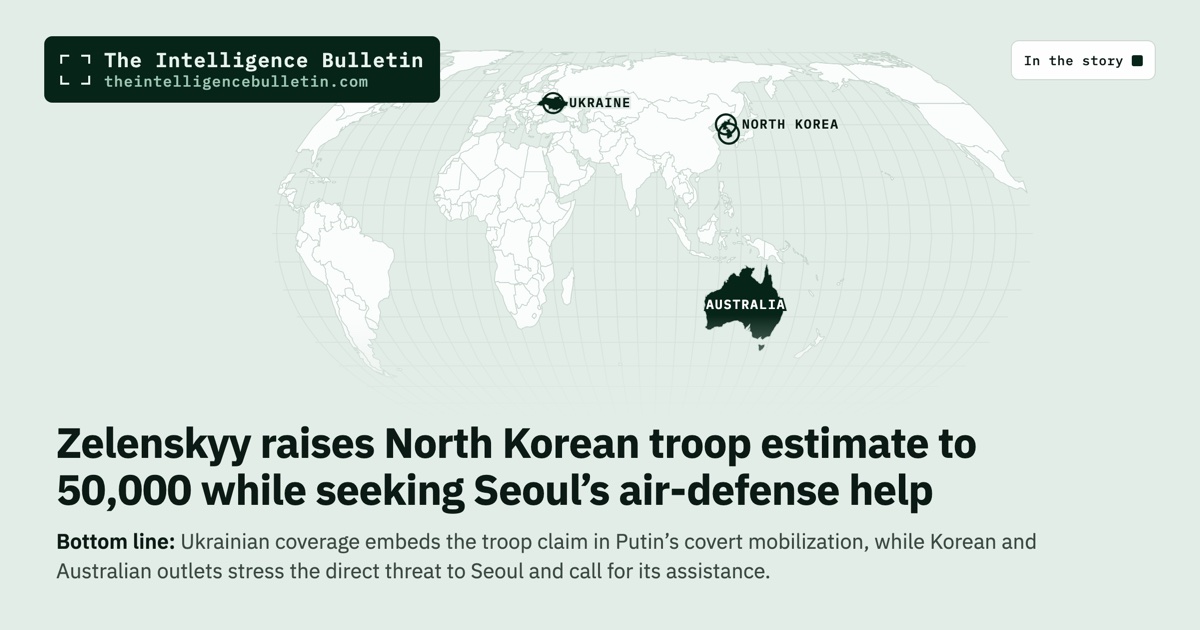
Ukrainian coverage embeds the troop claim in Putin’s covert mobilization, while Korean and Australian outlets stress the direct threat to Seoul and call for its assistance.
The reporting converges on Zelenskyy’s upgraded troop figure and his explicit request for South Korean air-defense aid, yet the selected outlets split sharply on what the story is primarily about. Kyiv Post frames the announcement inside Putin’s broader covert mobilization and border-tightening plans aimed at a Donbas victory he can sell at home, complete with references to backchannel Anchorage talks. Korean and Australian pieces foreground the direct security implication for Seoul and the Asia-Pacific balance, noting Pyongyang’s growing revenue and battlefield experience. NBC and the French regional daily treat the claim as an escalation alert that demands Western or European attention to sanctions and support for Ukraine. These differences arise because each outlet draws on the same core statements from Zelenskyy but places them against its own national or regional preoccupations: Ukrainian domestic mobilization worries, Korean Peninsula stability, or European worries about Russian-North Korean military integration. The absence of any independent verification or Russian rebuttal in the set leaves the number itself resting on a single originating chain.
Full analysis
Ukrainian President Volodymyr Zelenskyy said on August 8 and 9 that Russia has decided to station between 30,000 and 50,000 North Korean personnel on its own territory. He described the move as an increase from earlier estimates that began with hundreds and then rose to thousands. The statement came in an interview with the United News telethon and in a post on X, where he quoted his own remarks. All five outlets that carried the story reported the same range and the same source.
Zelenskyy added that the personnel would receive training and combat experience under Russian direction. In return, North Korea would obtain licenses and military equipment from Russia. He said the arrangement would allow Pyongyang to build experience in modern warfare while supplying Russia with additional manpower. The same point appears in the Kyiv Post account of the national telethon remarks, in the Korea Times dispatch from Yonhap, in the Reuters copy used by NBC News and ABC News, and in L’Indépendant’s report of the RBC-Ukraine interview.
Zelenskyy also urged South Korea to expand cooperation with Ukraine. He specifically asked for air-defense systems, noting that Ukraine faces a shortage in that area. He mentioned possible work on drones and other equipment, while acknowledging that South Korean law restricts lethal-arms exports to countries at war. Ukrainian diplomats remain in contact with Seoul, he said. This request is recorded in every one of the five articles.
The claim sits against the background of the June 2024 comprehensive strategic partnership treaty signed by Vladimir Putin and Kim Jong-un during the Russian president’s visit to Pyongyang. That pact includes a mutual-assistance clause. Earlier North Korean deployments to Russia’s Kursk region were estimated by Ukrainian military intelligence at around 14,000 soldiers and engineers in 2024. North Korea has also supplied Russia with millions of artillery shells, ballistic missiles, and multiple-launch rocket systems, according to the same assessments cited across the coverage.
Kyiv Post placed the troop announcement inside a larger account of Russian efforts to increase manpower without a formal draft. Zelenskyy described shadow contracts, border closures, and other steps taken to avoid public announcement of mobilization. He tied the need for additional forces to Putin’s requirement for a visible victory in the Donbas that could be presented to the Russian public, possibly by reinterpreting earlier backchannel discussions referred to as the Anchorage terms. The same article added Ukrainian intelligence details on a planned North Korean missile unit of about 90 personnel to be stationed in the Voronezh region with up to 120 ballistic missiles, plus recent deliveries of KN-23 and KN-24 short-range missiles. It further noted Ukrainian estimates that North Korea had supplied up to half of Russia’s 122 mm and 152 mm artillery shells by the end of 2025 and had earned up to $22 billion in foreign revenue since 2022 from munitions and troop-related arrangements.
The Korea Times and ABC News both foregrounded the direct implications for South Korea. They quoted Zelenskyy’s request for air-defense support and his observation that North Korea would continue to acquire Russian technology and experience. The Australian piece added that Ukraine is short of high-end air defenses and that Russia has increased use of ballistic missiles that are difficult to intercept. NBC News carried the same Reuters material but framed the story around the broader call for international attention to sanctions enforcement and the existing Russia-North Korea defense relationship.
L’Indépendant reported the same core statements from the RBC-Ukraine interview and added that the deployments and missile transfers would intensify strikes on Ukrainian territory while giving Pyongyang operational experience against Western defense systems. It noted North Korea’s financial gains from the arrangement and presented the development as an escalation that carries risks for stability in Asia.
No article in the set contained an independent confirmation of the 30,000-to-50,000 figure, nor did any contain a Russian or North Korean response. The number therefore rests entirely on Zelenskyy’s statements as relayed through the five outlets.
A reader who saw only the Kyiv Post account would come away with the impression that the central development is Putin’s domestic political maneuvering and the risk of a surprise Russian mobilization. The Korean and Australian pieces would instead leave the impression that the main development is the direct security challenge to Seoul and the need for South Korean policy adjustments. The NBC and L’Indépendant accounts would suggest the story is chiefly an escalation that should prompt stronger Western or European measures. Each framing draws on the identical statements from Zelenskyy but situates them against different national or regional concerns.
The single originating chain for the troop count means that any reader relying on one outlet receives only that outlet’s additional context layered onto Zelenskyy’s claim. The corroborated elements—the expectation that North Korea will gain modern-warfare experience and technology, and the request for South Korean air-defense assistance—appear consistently because they are direct repetitions of the same Zelenskyy remarks.
What to Watch
The reporting that stays closest to the recorded statements themselves, without extensive additional layering, is the material carried by the Korea Times and ABC News. Those accounts report the revised range, the exchange of experience for technology, and the explicit call for South Korean systems, and they add only the background of the 2024 treaty and prior deployments that every other outlet also accepts. Outlets with stronger institutional interest in either Russian domestic weakness or European sanctions enforcement have more reason to embed the claim inside those larger narratives. The next developments to watch are whether South Korea responds publicly to the cooperation request and whether any additional reporting chains surface that can test the scale of the North Korean presence.
That’s how the world told the story.
Get our daily open-source intelligence on world events in your inbox — one email a day, up to six stories.
Subscribe freeNo spam. One-click unsubscribe. See the latest email →