 AI-generated analysis published under the editorial responsibility of Rohit Sinnas. How it works →
Press quoted
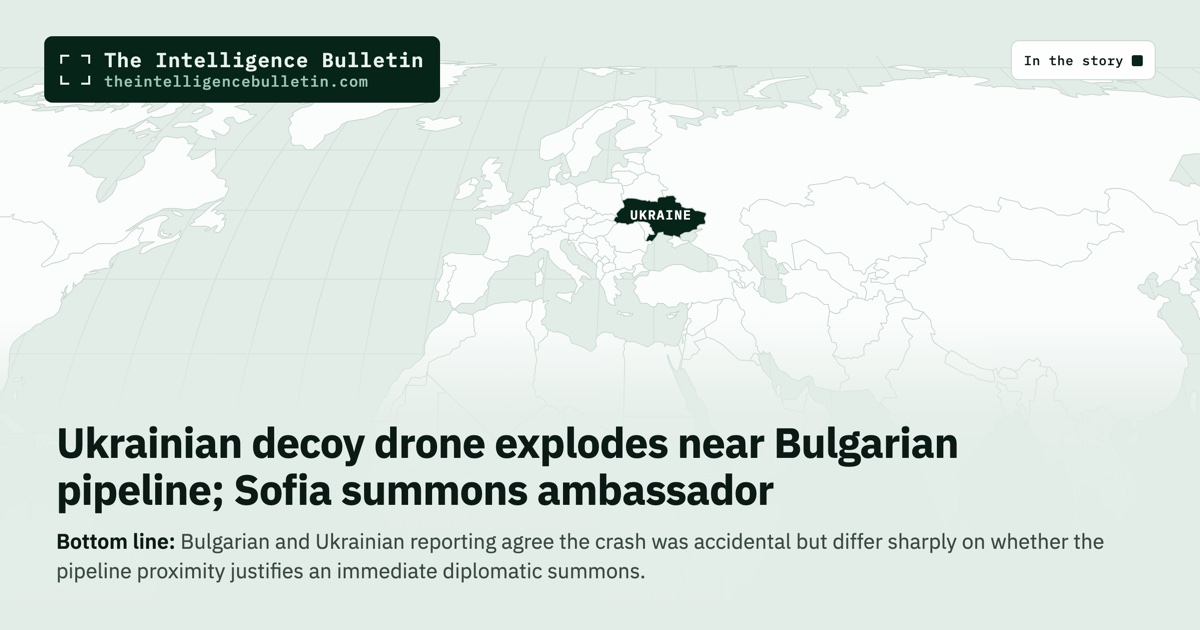
Bulgarian and Ukrainian reporting agree the crash was accidental but differ sharply on whether the pipeline proximity justifies an immediate diplomatic summons.
The reporting converges on the core facts: the drone was a low-flying decoy of a type used by Ukrainian forces, the crash was not deliberate, and no harm occurred. Bulgarian outlets and officials stress the proximity to critical energy infrastructure and the failure of detection systems, leading directly to the ambassadorial summons and enhanced border security measures. Ukrainian accounts frame the event as an unintended spillover whose root cause lies in the wider conflict, while offering full transparency. Austrian and Hungarian coverage highlights the resulting diplomatic friction more explicitly than the actor-country sources, noting Bulgaria’s recent halt to military aid to Ukraine as background tension. Turkish reporting echoes the Bulgarian reassurance that the act was not intentional. This pattern shows that independent chains in Bulgaria, Ukraine, and neighboring states independently corroborate the accidental nature and the diplomatic step, yet the choice to foreground either pipeline risk or wartime context splits along national lines. The absence of any claim that the drone was Russian or deliberately aimed underscores how the incident tests NATO-border resilience without fracturing the shared factual baseline.
Full analysis
A Ukrainian decoy drone crossed from Romanian airspace into Bulgaria early on August 8 and detonated in a sunflower field roughly 100 meters inside the border near the former Kardam checkpoint. Bulgarian border police heard the impact and saw black smoke; Romanian patrols had earlier noted the distinctive engine noise. The device carried a substantial explosive payload, yet it caused neither injuries nor damage to buildings or infrastructure. It came to rest about one kilometer from a compressor station serving the Trans-Balkan gas pipeline.
Prime Minister Rumen Radev convened an emergency session of the security council that same morning. He told reporters that neither Romanian nor Bulgarian air-defense systems had registered the low-flying object, nor had the Combined Air Operations Centre in Torrejón, which monitors southern European airspace. Small drones at low altitude remain difficult to track, he noted, and Bulgaria would therefore shift additional anti-drone equipment and border personnel from the Turkish frontier to the Romanian sector. The government also plans to raise the matter at the next North Atlantic Council meeting, where Poland and Romania are expected to report comparable incidents.
Initial analysis of the wreckage by the Bulgarian Defense Ministry identified the object as a Maya-type decoy drone of the sort widely employed by Ukrainian forces. The ministry stated there was no indication the crash had been intentional. Foreign Minister Velislava Petrova therefore instructed that Ukrainian Ambassador Olesya Ilashchuk be summoned for an explanation; the meeting was set for August 10 because the ambassador was then in Kyiv.
Ukrainian Foreign Ministry spokesperson Georgy Tikhyi addressed the incident the same day. He said Ukrainian forces had not deliberately directed any assets toward Bulgarian territory and that Kyiv stood ready to cooperate fully in clarifying the technical circumstances. Tikhyi added that the underlying source of such cross-border events remained Russia’s war against Ukraine and that an early end to the fighting would improve regional security for all neighbors.
The Trans-Balkan pipeline has carried natural gas in both directions between Turkey and markets farther north; its compressor stations therefore constitute sensitive nodes in southeast European energy supply. The Kardam station’s proximity to the explosion site—roughly one kilometer—placed the incident inside the operational radius of a device that had already evaded detection across two NATO members’ airspace.
Bulgaria’s most recent government, formed in May under Radev’s Progressives Bulgaria coalition, halted military deliveries to Ukraine in June. Officials described the decision as a choice to pursue diplomatic routes rather than join arms-supply coalitions. That policy shift forms part of the immediate background against which the August 8 summons occurred.
Reporting from Austrian and Hungarian outlets placed greater weight on the diplomatic cooling between Sofia and Kyiv than the primary Bulgarian and Ukrainian accounts. The Austrian piece described the episode as producing “diplomatic irritation,” while the Hungarian account framed it as a “storm” and explicitly linked the tension to Bulgaria’s earlier suspension of weapons aid. Turkish coverage, by contrast, foregrounded the Bulgarian defense ministry’s assurance that the crash carried no hostile intent.
Bulgarian domestic commentary, carried in the Sofia Globe’s account, turned quickly to the limits of existing surveillance. Opposition figures and former officials called for improved early-warning systems and greater European cooperation on drone defense along the eastern flank. Ukrainian reporting, for its part, consistently paired the offer of technical cooperation with the reminder that the conflict’s continuation makes such stray trajectories more likely.
The five independent reporting chains that reached English-language readers all converged on four core points: the wreckage matched a Ukrainian Maya decoy, the flight path was not deliberate, the explosion produced no casualties or infrastructure damage, and Bulgaria requested a formal diplomatic exchange. No outlet asserted that the drone had been Russian or that Ukraine had aimed it at Bulgarian territory. The single point of visible divergence lay in emphasis—whether the one-kilometer margin to the pipeline compressor and the undetected transit constituted a distinct security failure requiring immediate bilateral attention, or whether the episode illustrated the wider spillover effects of an ongoing war whose termination would reduce such risks for every adjacent state.
The distance and the energy infrastructure involved supply a concrete measure that any single national account understates when read in isolation. A reader limited to Ukrainian sources would correctly register Kyiv’s cooperation pledge and the contextual reference to Russian aggression, yet would not encounter the specific pipeline-station measurement or the planned redeployment of anti-drone assets along the Romanian border. A reader limited to Bulgarian sources would register those operational steps and the summons but would not see the explicit Ukrainian statement that no targeting had occurred or the linkage, offered by Kyiv, between the incident and the broader conflict. Austrian and Hungarian reporting supplies the additional observation that the diplomatic step itself carries weight against the recent aid cutoff, an angle absent from the primary actor accounts.
What to Watch
The corroborated record therefore shows an accidental transit that tested detection systems on NATO’s southeastern flank and prompted a formal diplomatic contact. The 1-kilometer margin to a functioning compressor station and the prior decision to stop weapons deliveries together indicate why Sofia treated the episode as requiring an on-record exchange rather than a routine technical clarification. Kyiv’s offer of full cooperation and its reference to the war’s continuation accurately locate the incident within a larger pattern, yet do not alter the fact that two alliance members’ airspace proved permeable to a military drone originating from the conflict zone. The next concrete development will be the August 10 meeting between the Bulgarian foreign minister and the Ukrainian ambassador; whatever technical details emerge there will determine whether the episode remains an isolated border incident or becomes the occasion for coordinated air-surveillance improvements across the region.
That’s how the world told the story.
Get our daily open-source intelligence on world events in your inbox — one email a day, up to six stories.
Subscribe freeNo spam. One-click unsubscribe. See the latest email →