 AI-generated analysis published under the editorial responsibility of Rohit Sinnas. How it works →
Press quoted
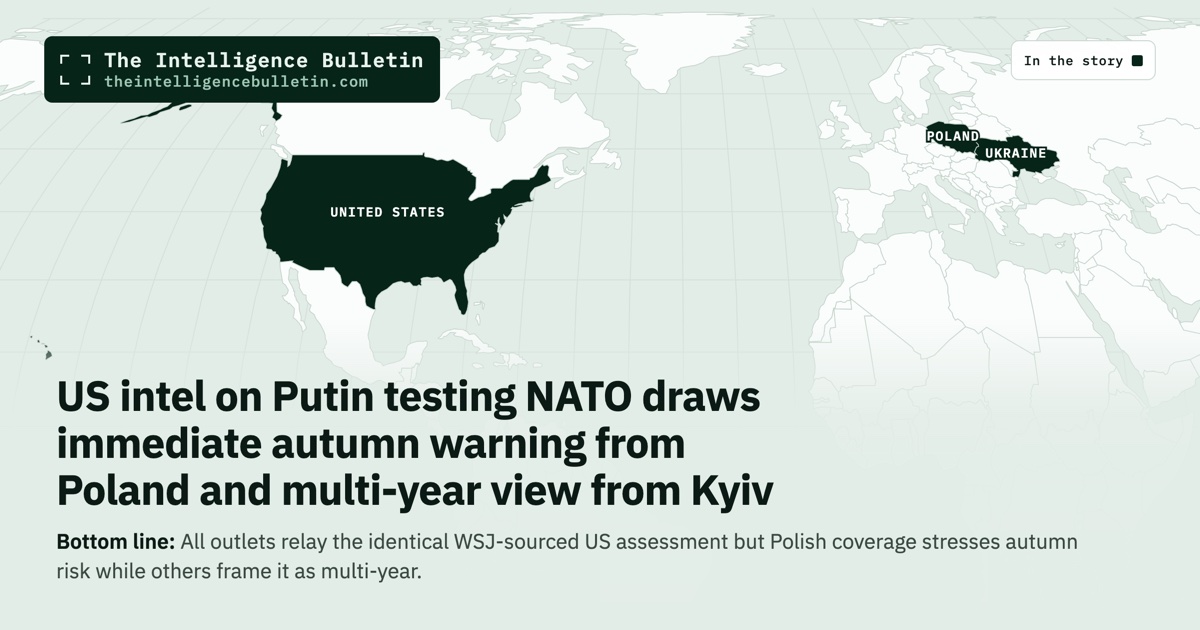
All outlets relay the identical WSJ-sourced US assessment but Polish coverage stresses autumn risk while others frame it as multi-year.
The reporting across these five outlets rests on one shared source, The Wall Street Journal’s account of classified US intelligence, and the accounts agree on the core assessment that Putin could probe NATO’s resolve with sub-Article 5 actions in coming years. What stands out is how national positions shape the emphasis placed on timing and risk level. The Polish Rzeczpospolita stresses an autumn window and frames the threat as immediate for eastern flank members, consistent with longstanding European warnings. Kyiv Post highlights the shift from prior US views that Russia would avoid NATO provocation during the Ukraine war and notes European agencies had already flagged the risk. CNN presents the assessment as a direct US intelligence product with scenarios and likely targets named. InoSMI, carrying the WSJ piece, casts the warning as Washington stoking European fears while masking its own ammunition shortfalls from the Iran conflict. The Independent folds the item into daily Ukraine war updates without elevating it. No outlet offers independent corroboration or contradiction; the pattern shows how one American wire-derived report travels through different editorial filters without altering the underlying claim.
Full analysis
US intelligence assessments first reported by The Wall Street Journal describe Russian President Vladimir Putin weighing a limited probe against a NATO member to test the alliance’s willingness to treat an attack on one as an attack on all. The scenarios outlined in the reporting include cyberattacks, sabotage operations or a small-scale ground incursion aimed at the eastern flank, most often named as the Baltics or Poland. The assessments place the window for such action between the present and 2029, with the highest risk period running from this autumn onward, though a limited ground move is described as the least probable of the options. The same dispatch notes that US officials now see the risk as having risen because of battlefield setbacks in Ukraine and domestic pressures on the Kremlin.
Every article examined here traces directly to that single Wall Street Journal account of unnamed US officials familiar with the classified material. No outlet conducted its own sourcing of the underlying intelligence. What differs is how each masthead chose to lead, what local material it folded around the dispatch, and where it placed the item in its coverage.
CNN opened its piece with the assessment itself and supplied the most granular operational detail from the original reporting: possible targets in the Baltics or Poland, the range of escalation options from cyber to small incursion, and the stated goal of challenging Article 5 without necessarily triggering a full allied response. It added recent incidents of Russian drones entering NATO airspace, including the explosive-laden device discovered at a German airport earlier in the week, and placed the assessment alongside American concerns over depleted munitions stockpiles after operations against Iran. A NATO military spokesperson was quoted declining comment on the classified material while affirming readiness.
Rzeczpospolita led its headline with an autumn timeline and framed the material as an unofficial warning that Putin could move against a NATO country “already this autumn.” The body quoted the same Heather Conley of the American Enterprise Institute who appears in the Journal dispatch on the Russian interest in fracturing alliance credibility. It added Polish government statements, including remarks by Deputy Prime Minister Władysław Kosiniak-Kamysz on seized Ukrainian drones and repeated warnings from Prime Minister Donald Tusk about an approaching difficult moment in the war. The article also supplied concrete figures on US interceptor shortages drawn from a CSIS report—fewer than 1,000 Patriot and fewer than 250 THAAD missiles remaining—and noted President Trump’s public denial of any shortfall.
Kyiv Post placed the story under its war section and led with the multi-year risk window stretching from autumn through 2029. It noted the shift in Washington’s prior view that Russia would avoid provoking NATO while still fighting in Ukraine, and it recorded that European intelligence services had already been raising the possibility. The piece included the same Conley quotation and the munitions depletion context, then linked the assessment to ongoing Ukrainian long-range strikes on Russian economic targets.
InoSMI carried the Journal article under a Russian-language headline that rendered the assessment as US intelligence “scaring Europe with an invasion” and added its own framing that Washington was attempting to conceal critical ammunition shortages. The translation preserved the scenarios and timeline but surrounded them with commentary on American stockpiles and the separate Iran conflict, presenting the warning itself as an expression of paranoia.
The Independent embedded a single paragraph on the assessment inside its rolling Ukraine war live blog. The item sat among updates on Ukrainian drone strikes against Wildberries warehouses and Russian oil facilities, with a brief reference to the same munitions context. No separate treatment or additional sourcing appeared.
Because the originating dispatch is the sole factual spine, the observable differences lie entirely in selection, emphasis and surrounding material. CNN chose to foreground operational scenarios and US domestic context. Rzeczpospolita chose seasonal urgency and Polish policy statements. Kyiv Post chose the evolution of Washington’s assessment and European prior warnings. InoSMI chose a skeptical overlay that questioned the motive behind the release. The Independent chose integration into the daily flow of battlefield news rather than elevation as a standalone security alert.
These choices produce distinct impressions for readers who encounter only one version. A Polish reader sees an immediate seasonal threat to the eastern flank reinforced by national officials. A Ukrainian reader sees confirmation that Washington has revised an earlier, more cautious stance. A Russian reader sees the warning presented as Washington manufacturing alarm to mask its own supply problems. A British reader sees it as one data point among many in the ongoing conflict. A US reader sees the assessment presented with the most detailed scenario language and recent incidents attached.
What to Watch
The single-chain origin means the underlying claim—that US intelligence now judges a limited Russian probe against NATO more plausible than before—travels unchanged. What changes is the lens each outlet applies when it decides which part of that claim to place first and what national material to place beside it. That pattern, visible across the five articles, shows how one American reporting product is refracted through different editorial priorities without any new facts being introduced on the ground.
That’s how the world told the story.
Get our daily open-source intelligence on world events in your inbox — one email a day, up to six stories.
Subscribe freeNo spam. One-click unsubscribe. See the latest email →