 AI-generated analysis published under the editorial responsibility of Rohit Sinnas. How it works →
Press quoted
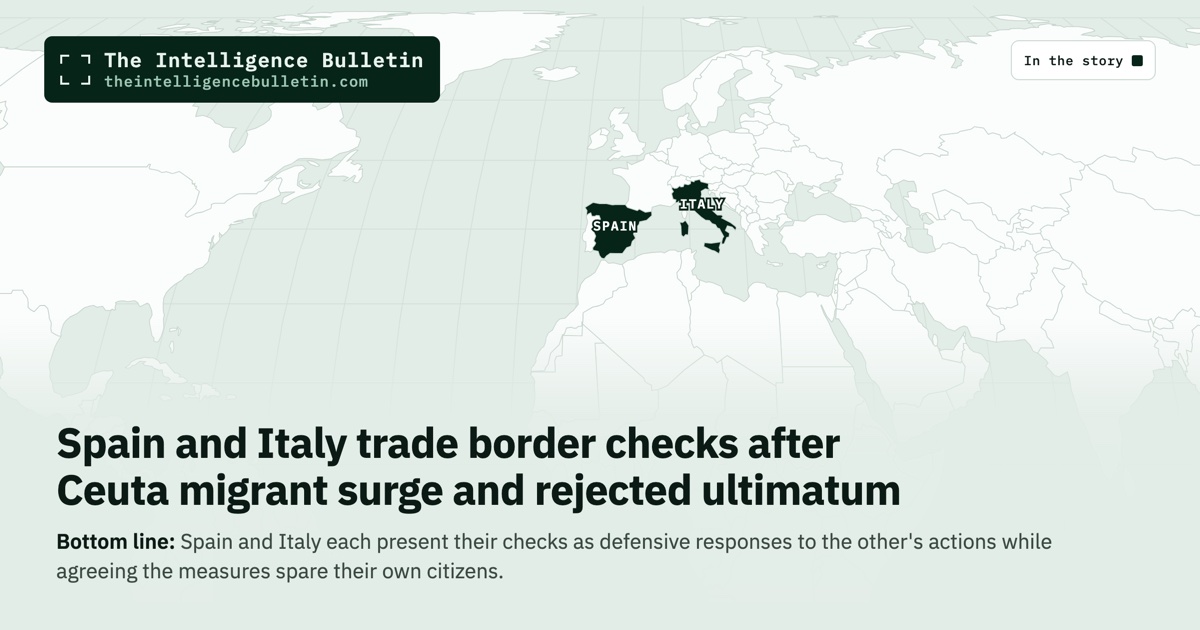
Spain and Italy each present their checks as defensive responses to the other’s actions while agreeing the measures spare their own citizens.
Spain and Italy are locked in a direct bilateral standoff that exposes how national security claims can override Schengen rules when migration pressure hits one member state. The Local and Guardian both trace the escalation to Italy’s July 31 decision after the Ceuta influx, with Spain framing its reciprocal move as a necessary defense of equal treatment for its citizens. ANSA and Al Jazeera quote Rome’s explicit refusal of any ultimatum, stressing that checks target only third-country nationals and will persist until Italy sees no further risk from a possible second wave in mid-August. Morocco World News alone connects the dispute to Ceuta’s geography and Morocco’s role as origin point, noting that most of the 72,000 arrivals have already returned while rights groups record higher death tolls than official Spanish figures. Across the set the same sequence of statements appears, yet the Moroccan outlet alone treats the episode as a regional migration flashpoint rather than a purely intra-EU quarrel. The absence of direct EU-institution voices leaves the conflict presented as two governments asserting sovereignty, with no outlet showing evidence that either side expects the checks to affect ordinary Spanish or Italian travelers.
Full analysis
Spain and Italy have begun a reciprocal exchange of temporary internal border controls inside the Schengen area after a sudden surge of migrants into the Spanish North African enclave of Ceuta. Italy announced on July 31 that it would suspend free movement for third-country nationals arriving from Spain by air and sea, citing national security risks tied to the Ceuta events. Spain replied on August 7 by setting a two-day deadline for Rome to lift those controls and warning of proportional countermeasures if it did not. When Italy rejected the deadline and said the measures would stay in place at least until August 15, Madrid announced its own checks on arrivals from Italy, to begin at midnight on August 8 and run until September 7.
The Ceuta influx occurred on July 30 and 31. Spanish official figures recorded 72,000 people crossing from Morocco into the enclave. Of that total, 70,000 had returned to Morocco by early August, according to the same counts. Spanish authorities reported 80 deaths during the crossings. Moroccan interior ministry statements put the death toll at 11 on the Moroccan side, nearly all by drowning. Moroccan rights organizations, including the Moroccan Association for Human Rights, recorded at least 141 deaths and stated the figure was likely to rise. Several hundred unaccompanied children remained in Ceuta after the main returns, housed in facilities whose capacity the enclave authorities described as far below demand.
Italy linked its controls to the risk that some of those who reached Ceuta might continue onward to Italian territory. Rome framed the step as an extraordinary and temporary precaution, consistent with earlier Italian actions toward Slovenia and with measures other European governments had applied in comparable situations. The Italian statement made clear that Spanish and other European Union citizens would face no additional restrictions at air and sea entry points. Italy also noted that a further wave of arrivals was expected in Ceuta around August 15 and said controls would continue until security and terrorism risks tied to irregular migration were eliminated.
Spain described Italy’s move as unfair, contrary to European Union interests, and discriminatory toward Spanish citizens. Madrid urged Rome to end the checks before August 9 and stated that failure to do so would oblige Spain to adopt proportional measures to protect the interests and dignity of its citizens. The Spanish interior ministry announcement on August 7 cited persistent irregular migration pressure on Italy as the justification for the reciprocal controls. Spain emphasized that entry into Ceuta does not automatically grant access to the Schengen area and that the vast majority of those who arrived had already left.
The two governments share the same basic chronology and the same set of official statements. Every outlet in the available coverage carries the Italian rejection of the August 9 deadline in nearly identical language drawn from the Meloni government’s office. Every outlet also records Spain’s announcement of its own checks with the same dates and the same stated rationale. The sequence of events therefore stands as a single corroborated account rather than competing versions.
Differences appear in emphasis and in the additional context each outlet supplies. Italian reporting foregrounds the security rationale and the explicit refusal of foreign ultimatums, quoting the Meloni office at length on the conditions that would have to be met before any reconsideration. Spanish reporting stresses the language of equal treatment for citizens and the risk of rifts driven by internal electoral motives. The Guardian places the exchange inside a wider pattern of temporary Schengen suspensions and notes that Spain and Italy share no land border, so the controls affect only maritime and air routes. Al Jazeera and Morocco World News add details on conditions inside Ceuta after the main returns, including the presence of more than 1,300 children and the gap between official and rights-group death counts. Morocco World News alone situates the entire dispute inside the geography of Ceuta as a Spanish enclave on the North African coast and records that most of those who crossed have already gone back to Morocco.
No coverage in the set includes statements from EU institutions or from the European Commission on whether either set of controls complies with Schengen rules. The absence leaves the conflict framed strictly as an exchange between two national governments, each asserting its right to protect its own security interests. None of the reports indicates that either side expects the checks to impede travel by ordinary Spanish or Italian citizens.
The reporting converges on the core sequence because each outlet draws from the same public statements issued by the two governments. The Moroccan outlet’s additional geographic and humanitarian framing is the only element that does not appear in the European accounts, and it supplies context that a reader limited to Italian or Spanish sources would not encounter. The Italian and Spanish domestic outlets each present their government’s position as reasonable and proportionate while recording the other side’s objections. The external outlets record both positions without adopting either framing as their own.
What to Watch
The most reliable account of what occurred is therefore the one that treats the bilateral exchange as a straightforward assertion of national authority over Schengen rules in response to a localized migration event. The shared factual spine across independent reporting chains is the sequence of Italy’s July 31 announcement, Spain’s August 7 deadline and subsequent reciprocal decision, and Rome’s rejection of any change before August 15. The Moroccan outlet’s placement of Ceuta at the center of the story supplies the geographic link that explains why Italy saw a direct connection between the enclave and its own borders. Future movement of people through Ceuta will determine whether the controls remain in place or are lifted on the schedule each government has described.
That’s how the world told the story.
Get our daily open-source intelligence on world events in your inbox — one email a day, up to six stories.
Subscribe freeNo spam. One-click unsubscribe. See the latest email →