 AI-generated analysis published under the editorial responsibility of Rohit Sinnas. How it works →
Press quoted
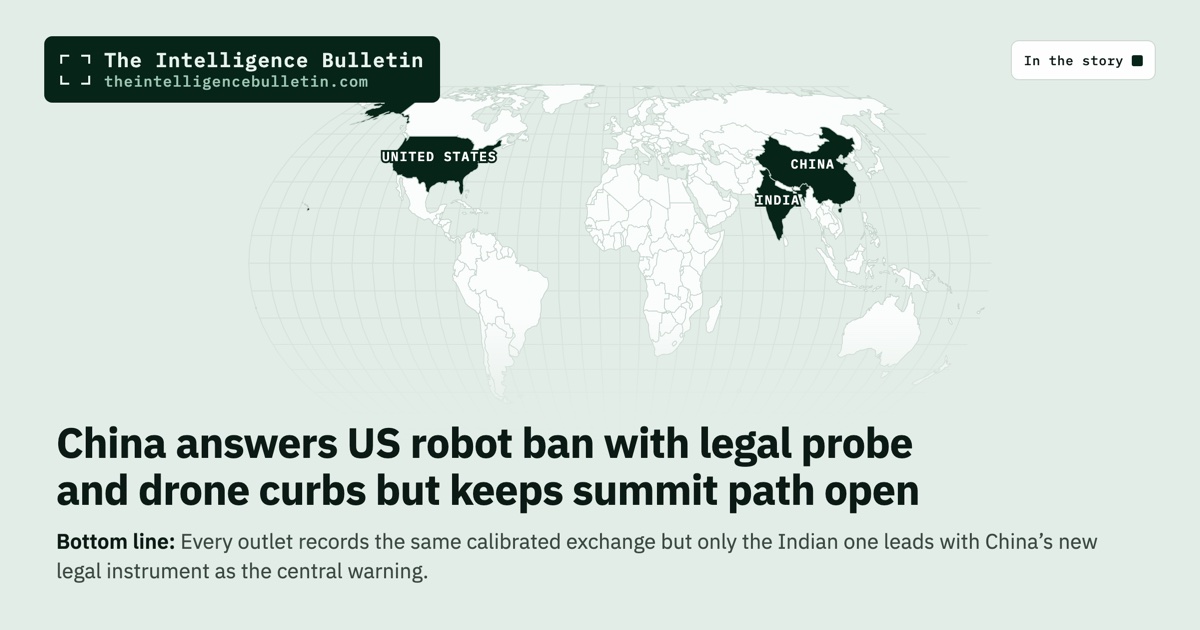
Every outlet records the same calibrated exchange but only the Indian one leads with China’s new legal instrument as the central warning.
The selected reporting converges on a narrow point: both sides calibrated their latest tech and trade moves to signal resolve without crossing the threshold that would cancel the September summit. Moneycontrol’s Bloomberg-sourced account stands apart by foregrounding China’s use of the revised Foreign Trade Law as the first national-security investigation of its kind, framing the package as deliberate pre-summit leverage rather than simple retaliation. The Korean, Ukrainian and Taiwanese pieces open instead with the sequence of US actions—FCC robot ban, UFLPA additions, and polysilicon tariffs—then record China’s replies, treating the exchange as a predictable cycle whose escalation risk remains bounded by shared interest in high-level dialogue on AI. Three of the four cite the same expert judgment from Tsinghua’s Sun Chenghao that Beijing seeks to avoid an uncontrolled action-reaction spiral ahead of the meeting, while retaining rare-earth leverage and AI market access as longer-term counters; the Bloomberg-sourced account quotes a different analyst instead. The absence of any selected outlet from Beijing or Washington means the story is told entirely through third-country relays of the same underlying dispatches; the legal-arsenal emphasis therefore appears only where the Bloomberg chain surfaces it, while the other three converge on the summit-stability question. That convergence itself is the clearest signal the reporting carries: the episode is being presented as managed friction, not rupture.
Full analysis
In the first week of August 2026 the United States moved first with three distinct restrictions aimed at Chinese technology and supply chains. The Federal Communications Commission announced a ban on imports of new humanoid and quadruped robots, a measure that effectively targeted the dominant Chinese producers of those machines. The Department of Homeland Security added forty-three Chinese companies to the entity list under the Uyghur Forced Labor Prevention Act on grounds of alleged human-rights violations in Xinjiang. President Donald Trump then signed a proclamation setting a minimum import price for polysilicon and its derivatives together with a fifteen-percent additional tariff, steps presented as defenses against dumping and protections for domestic production.
China answered within days through its Commerce Ministry. The ministry imposed sanctions on seven American entities, strengthened controls on exports of drones and related dual-use items to the United States, and suspended cooperation on product certification and inspection for goods entering China. A separate cybersecurity review of Palo Alto Networks products sold in China was opened on national-security grounds. One account, carried by Bloomberg and published in India, recorded an additional element: the first national-security investigation launched under China’s recently revised Foreign Trade Law, directed at certain office equipment containing foreign software.
These steps arrived three to four weeks before Xi Jinping’s expected visit to Washington for a summit with Trump in September. All four published reports that reached readers outside China and the United States framed the Chinese measures as a calibrated reply rather than an open-ended escalation. The Korean, Ukrainian and Taiwanese accounts each quoted or paraphrased Beijing’s description of its actions as “restrained,” and each noted the shared interest in preserving high-level channels, especially for discussion of artificial intelligence. A Tsinghua University analyst, Sun Chenghao, appeared in three of the four pieces with the same assessment: China wanted to keep diplomatic space open and avoid an uncontrolled cycle of action and reaction before the meeting.
The reporting therefore presents a single sequence of moves whose dimensions are consistent across the accounts. The United States restricted robots, added dozens of firms to a forced-labor list, and raised tariffs on a key semiconductor input. China responded with targeted sanctions on seven counterpart entities, export tightening on drones, suspension of one certification channel, a cybersecurity probe of one American firm, and, in the Bloomberg-sourced version, a new-form legal investigation. The number seven for the sanctioned American entities and the figure of forty-three for the Chinese firms added to the Uyghur list appear uniformly; the fifteen-percent tariff on polysilicon is recorded without contradiction. The September timing of the summit is treated as fixed in all four texts.
Where the accounts diverge is in emphasis and framing rather than in the underlying facts. The Indian outlet that relayed Bloomberg opened on China’s expanding legal toolkit and presented the Foreign Trade Law investigation as evidence of Beijing’s growing capacity to retaliate while still leaving room for de-escalation. The other three pieces began instead with the sequence of American actions and then recorded China’s replies, treating the exchange as a predictable round in an ongoing competition whose immediate risk remained limited. The South Korean account, relayed from Yonhap, placed the episode in the context of regional stability and quoted the same Tsinghua analyst on the likelihood that any friction would be kept below the level that would force postponement. The Ukrainian piece, drawn from CNN, highlighted the parallel to last year’s sharper trade conflict and asked whether further escalation on artificial-intelligence models could yet force the summit off the calendar. The Taiwanese account stressed the strength of China’s counter-move on drone exports and noted the rapid closing of the gap between Chinese and Silicon Valley artificial-intelligence offerings over the previous eighteen months.
Because the source set contains no outlet edited in Beijing or Washington, the story reaches readers entirely through third-country relays of the same underlying international dispatches. The legal-arsenal detail therefore surfaces only where the Bloomberg chain is carried; the other three converge instead on the question of summit stability and the shared expert judgment that both capitals still see value in the September encounter. That convergence itself supplies the clearest signal the published reporting contains: the episode is presented as managed friction whose outer bounds are set by mutual interest in continued high-level contact on artificial intelligence and by China’s retained leverage over rare-earth supply chains.
What to Watch
The reporting therefore supports the conclusion that the immediate round of measures was designed to register resolve without rupturing the diplomatic calendar. Multiple independent chains—Bloomberg, Yonhap and CNN—carry the identical language of restraint, but the expert view that Beijing will avoid an uncontrolled spiral ahead of the meeting reaches readers only through the Yonhap and CNN chains. The single-source observation of the Foreign Trade Law investigation adds a concrete mechanism to China’s response but does not alter the cross-chain assessment that both sides continue to treat the summit as a working channel rather than a prize that must be earned. The next moves most likely to matter are any American decision on broader restrictions against Chinese artificial-intelligence models and any Chinese decision on whether to tighten rare-earth flows; either step would test whether the current calibration holds or whether the shared interest in the September encounter gives way to sharper economic pressure.
Correction — 9 August 2026
Two passages overstated how widely a single expert assessment was carried across the sources. Three of the four sources quote Sun Chenghao of Tsinghua University; the fourth, drawn from Bloomberg, quotes Henry Gao of Singapore Management University and makes a firmer argument about Beijing’s readiness to retaliate. The bulletin’s account of the measures taken by both governments is unchanged.
The error was found during a review prompted by a reader’s question about the bulletin’s sourcing.
Previously: “All four cite the same expert judgment from Tsinghua’s Sun Chenghao that Beijing seeks to avoid an uncontrolled action-reaction spiral ahead of the meeting, while retaining rare-earth leverage and AI market access as longer-term counters.”
Now: “Three of the four cite the same expert judgment from Tsinghua’s Sun Chenghao that Beijing seeks to avoid an uncontrolled action-reaction spiral ahead of the meeting, while retaining rare-earth leverage and AI market access as longer-term counters; the Bloomberg-sourced account quotes a different analyst instead.”
Previously: “Multiple independent chains—Bloomberg, Yonhap and CNN—carry the identical language of restraint and the identical expert view that Beijing will avoid an uncontrolled spiral ahead of the meeting.”
Now: “Multiple independent chains—Bloomberg, Yonhap and CNN—carry the identical language of restraint, but the expert view that Beijing will avoid an uncontrolled spiral ahead of the meeting reaches readers only through the Yonhap and CNN chains.”
That’s how the world told the story.
Get our daily open-source intelligence on world events in your inbox — one email a day, up to six stories.
Subscribe freeNo spam. One-click unsubscribe. See the latest email →