 AI-generated analysis published under the editorial responsibility of Rohit Sinnas. How it works →
Press quoted
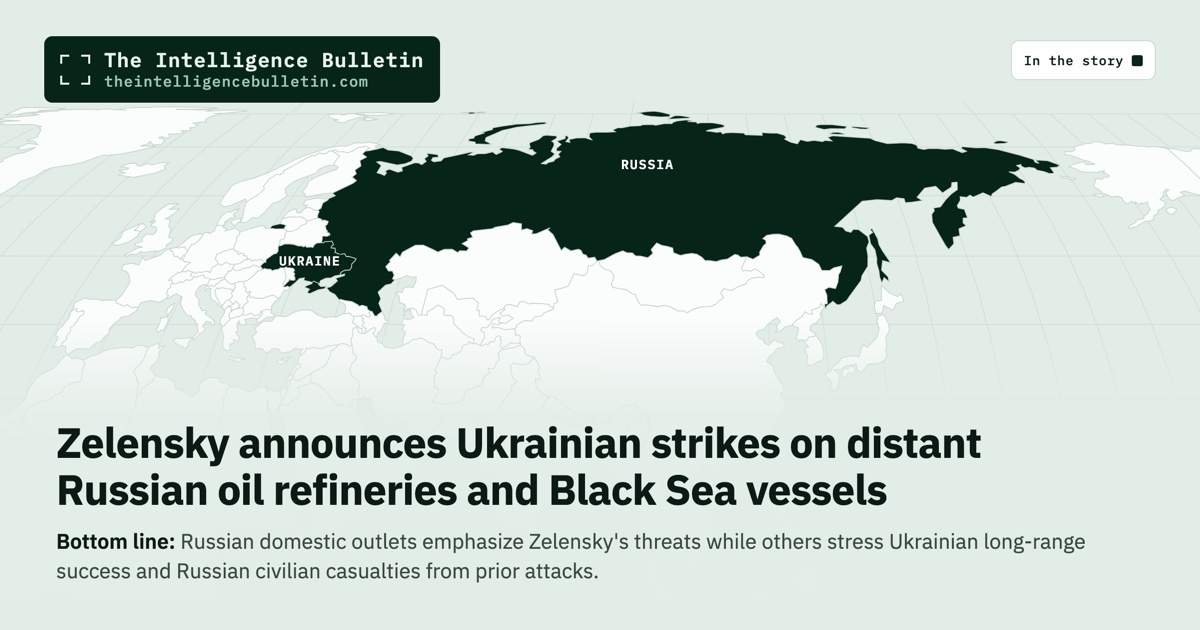
Russian domestic outlets emphasize Zelensky’s threats while others stress Ukrainian long-range success and Russian civilian casualties from prior attacks.
Reporting across the sources converges on Zelensky’s claim of successful long-range strikes on two specific Russian refineries and Black Sea targets, with Russia confirming extensive drone interceptions but providing no damage details. Turkish and Azerbaijani coverage explicitly ties the Ukrainian action to recent Russian strikes that killed civilians in Sumy, Kharkiv and elsewhere, presenting it as retaliation while noting Ukrainian appeals for air defense missiles. Kenyan and Azerbaijani pieces stress the geographic reach and economic intent to curb Russian oil revenues. Russian domestic coverage instead quotes Zelensky vowing continued attacks on launchers to protect Ukrainian infrastructure and references prior Russian successes in downing drones over Moscow and Crimea. The exiled Moscow Times stands apart with commentary arguing that such strikes on economic targets like warehouses and refineries are unlikely to erode Russian public support for Putin and may instead foster cynicism or cohesion. This pattern shows how actor-country outlets embed the announcement in their preferred narrative of Ukrainian threat or Russian resilience, while third-party wires highlight capability and context without endorsing either side’s framing.
Full analysis
Ukrainian President Volodymyr Zelensky announced on August 6 that Ukrainian forces had struck two oil refineries deep inside Russia, one in the Bashkortostan region more than 1,300 kilometers from the front line and another in the Yaroslavl region nearly 700 kilometers from the Ukrainian border. He described the targets as the Bashneft-Novoil facility and the Slavneft-YANOS refinery, part of what he called Ukraine’s long-range sanctions operations aimed at limiting Russian oil revenues that fund the war. Zelensky also reported successful strikes on two Russian military patrol boats and vessels from Moscow’s shadow fleet in the Black Sea, operations he said expanded Ukrainian capabilities and increased chances for diplomacy.
Russian authorities responded by reporting that air defenses had intercepted 605 Ukrainian drones overnight across multiple regions, including illegally annexed Crimea and the Black and Azov seas. The Russian Defence Ministry statement, carried in several outlets, made no mention of damage to the refineries or naval targets. In Yaroslavl, regional governor Mikhail Yevrayev described the drone activity as the largest enemy attack the region had faced, noting that 92 drones had been destroyed there alone and that three homes caught fire.
The Ukrainian strikes came amid a night of Russian attacks on Ukrainian territory that killed at least three civilians and wounded 22 others. In the Kharkiv region, strikes on Balakliia killed a woman in one home and a man and woman in another. Glide bombs damaged apartment buildings in the Sumy region, wounding 12 people and shattering hundreds of windows. A drone struck a bus carrying farmworkers in Kherson, wounding six, while another hit a residential area in Zaporizhzhia, wounding four. Ukrainian officials said Russia had fired four missiles and 101 long-range strike drones at Ukraine that night, with air defenses downing or jamming 66 of the drones.
Zelensky linked the Ukrainian operations to the need for stronger air defenses, stating he had spoken with NATO Secretary General Mark Rutte and Finnish President Alexander Stubb about procuring interceptor missiles from partner stockpiles. He described Russian ballistic missile and glide bomb attacks as exploiting Ukraine’s weakened defenses after the Iran conflict drained Patriot missile supplies. Rutte confirmed coordination on missile supplies and urged rapid political decisions to bypass red tape.
Russian domestic reporting presented Zelensky’s comments primarily as a renewed threat to continue destroying launchers in order to reduce strikes on Ukrainian strategic infrastructure. One account quoted him saying Ukrainian forces knew they needed to eliminate enemy launchers and would keep doing so, while noting prior Russian successes in downing Ukrainian drones over the Moscow region and Crimea on recent nights. It placed the announcement against a backdrop of ongoing Russian strikes on Ukrainian energy and military sites and Ukrainian admissions of missile shortages for defending Kyiv.
Coverage from third-party outlets emphasized the geographic reach of the refinery strikes and their stated economic purpose. One account specified the distances involved and noted visible smoke over the Yaroslavl facility after the attack. Another relayed Zelensky’s claim that the operations systematically expanded long-range capabilities while thanking Ukrainian forces for increasing diplomatic leverage. Both described the Black Sea strikes on patrol boats and shadow fleet vessels without providing further details on damage or outcomes.
The exiled Moscow Times offered a different internal Russian perspective on the broader campaign of which these strikes formed a part. Its analysis argued that repeated attacks on economic targets such as oil refineries and warehouses would not generate public opposition to President Vladimir Putin. It pointed to sellers on the Wildberries platform who lost goods valued in the hundreds of billions of rubles yet directed complaints at the company rather than the government, and noted that some anti-war Russians expressed growing disillusionment with Ukrainian tactics they viewed as indiscriminate. The piece cited historical research showing that aerial bombardment often strengthens cohesion behind the targeted government rather than sparking uprisings.
Accounts diverged most sharply in how they situated the strikes within the larger conflict. Turkish and Kenyan reporting foregrounded Russian civilian casualties from the preceding night and Ukraine’s urgent requests for air defense support, framing the Ukrainian action as a direct response to those losses. Azerbaijani coverage highlighted the simultaneous naval dimension and the explicit goal of cutting Russian oil income. Russian domestic accounts instead stressed Ukrainian intentions to degrade launch capacity and referenced Russian defensive achievements without confirming refinery impacts. The Moscow Times analysis stood apart by examining domestic Russian reactions to economic disruption rather than military claims.
What to Watch
The strongest warrant for the core sequence lies in the repeated, independent reporting of Zelensky’s specific announcement across outlets that do not share sourcing chains, combined with the Russian Defence Ministry’s consistent figure of 605 drones intercepted. These elements appear in both actor-country and third-party accounts without contradiction on the basic claims of which facilities and vessels were named. Russian domestic framing serves the interest of portraying Ukrainian actions as ongoing threats met by effective defenses, while outlets outside the conflict zone have less stake in that narrative and more in documenting the mechanics of escalation. The pattern of long-range Ukrainian strikes on energy infrastructure has now extended to facilities over 1,300 kilometers from the line of contact, a development that narrows Russia’s perceived sanctuary for war-related economic assets even as its air defenses continue to claim high interception rates. This dynamic is likely to sustain pressure on Russian fuel supplies and logistics while prompting further Ukrainian appeals for defensive systems that Western partners have so far been reluctant to release in sufficient volume.
That’s how the world told the story.
Get our daily open-source intelligence on world events in your inbox — one email a day, up to six stories.
Subscribe freeNo spam. One-click unsubscribe. See the latest email →