 AI-generated analysis published under the editorial responsibility of Rohit Sinnas. How it works →
Press quoted
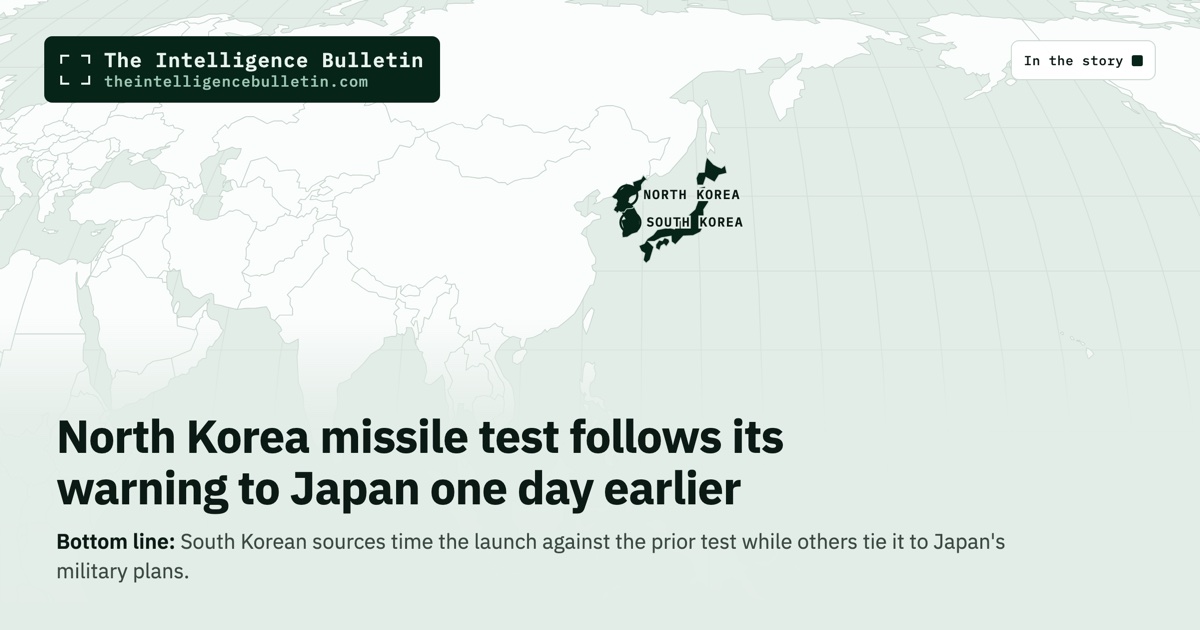
South Korean sources time the launch against the prior test while others tie it to Japan’s military plans.
The core report originates from South Korea’s Joint Chiefs of Staff and travels largely intact across the set, with every outlet relaying the same detection details from Wonsan and the same coordination language with Washington and Tokyo. South Korean outlets add the 42-day interval and immediate surveillance measures while staying inside the official statement. Japanese coverage broadens the frame to ongoing weapons testing and regional implications for Tokyo’s rearmament debate without altering the facts. Australian reporting inserts the direct link to Kim Yo Jong’s criticism of Japan the previous day, an element absent from the actor-country dispatches. The British tabloid alone layers on unconfirmed speculation about Kim Jong-un’s absence, a claim no other source carries. The pattern shows a single originating chain from Seoul that every subsequent account either preserves or decorates with context already circulating in public statements, rather than independent verification or contradiction.
Full analysis
South Korea’s Joint Chiefs of Staff stated that North Korea launched a short-range ballistic missile from the Wonsan area on its eastern coast at approximately 5 p.m. local time on August 6. The projectile flew toward the East Sea. Seoul’s military said it had strengthened surveillance and was working with the United States to assess the details of the flight. Japan’s Defense Ministry reported that the launch produced no impact on or near Japanese territory, though its coast guard advised vessels to watch for debris.
The test marked the first North Korean ballistic missile launch since late June. One South Korean account placed the interval at 42 days from the previous known event on June 25. Another South Korean report described a longer gap of roughly five months from the last major short-range ballistic missile volley, when around ten such weapons were fired. All five outlets that covered the event relayed the same core detection from the Joint Chiefs of Staff and the same language about coordination with Washington and Tokyo.
The timing sits one day after North Korean state media carried a statement from Kim Yo Jong criticizing Japan’s military buildup in the Pacific. That statement warned that Pyongyang’s leadership would develop additional military options in response to what it called Japan’s transformation. Australian coverage placed the missile launch in direct sequence with that criticism. South Korean and Japanese accounts did not make that one-day connection explicit in their published pieces.
North Korea has conducted ballistic missile tests throughout 2026, with one account counting this event as the tenth of the year if confirmed as ballistic. The country has also tested nuclear-capable cruise missiles from a new 5,000-ton destroyer and has pursued naval capabilities that include plans for a nuclear-powered submarine. These activities follow the collapse of high-level diplomacy with the United States in 2019. North Korea has since declared itself an irreversible nuclear state and has expanded weapons ties with Russia, including the supply of conventional arms and troops for the war in Ukraine.
Upcoming annual United States–South Korea military exercises, scheduled for later in August, formed part of the surrounding context. South Korean officials described those drills as defensive. North Korea has long viewed similar maneuvers as practice for an invasion and has responded to them with missile tests and sharp rhetoric in previous cycles. The August 6 launch occurred as those exercises approached.
Japan’s defense spending rose 9.7 percent in 2025 to roughly 88.3 billion dollars, the highest share of gross domestic product since 1958. Japanese officials have spoken of the need for military strengthening with a sense of urgency and crisis. North Korean statements have framed this buildup as a direct provocation requiring countermeasures.
The five published accounts share the same originating description of the launch itself. Every outlet reported the Wonsan origin, the approximate time, the direction of flight, and the immediate South Korean response of heightened vigilance plus trilateral coordination. Japan’s confirmation of no territorial impact appeared in three of the five pieces. The 42-day interval appeared in one South Korean report. The explicit link to Kim Yo Jong’s statement the day before appeared only in the Australian account. Speculation that the test reflected anger over United States drills and that Kim Jong-un has been absent from public view for months appeared only in the British tabloid account.
A reader limited to South Korean coverage would see a precise military detection timeline and an emphasis on readiness under the combined defense posture with the United States. The same reader would miss the explicit sequencing with Japanese rearmament rhetoric that the Australian account supplied. A reader limited to Japanese coverage would receive the event inside the longer arc of North Korea’s post-2019 weapons expansion and Tokyo’s own security concerns, but would not encounter the 42-day or five-month interval that one or both South Korean outlets recorded. A reader limited to the Australian piece would gain the clearest public statement tying the test to Japan’s buildup, yet would still rely on the same Joint Chiefs of Staff facts for the launch itself. The British account alone introduced leadership-visibility claims that no other source in the set recorded.
The Joint Chiefs of Staff statement supplies the only on-record detection of the launch and the only contemporaneous description of South Korean actions. That statement travels unchanged through every account. The connection to Japan’s military plans rests on a single published North Korean statement from the previous day. The claim of Kim Jong-un’s extended absence rests on no named source beyond the tabloid’s own framing. The core facts of the August 6 launch therefore stand on the widest corroboration within the set, while the surrounding political interpretations rest on narrower or single-source attributions.
What to Watch
The pattern indicates that the next tests or statements from Pyongyang will continue to be measured against the same South Korean detection chain, with additional outlets likely to add or omit the Japan timing link depending on whether they foreground regional rearmament or immediate military metrics.
That’s how the world told the story.
Get our daily open-source intelligence on world events in your inbox — one email a day, up to six stories.
Subscribe freeNo spam. One-click unsubscribe. See the latest email →