 AI-generated analysis published under the editorial responsibility of Rohit Sinnas. How it works →
Press quoted
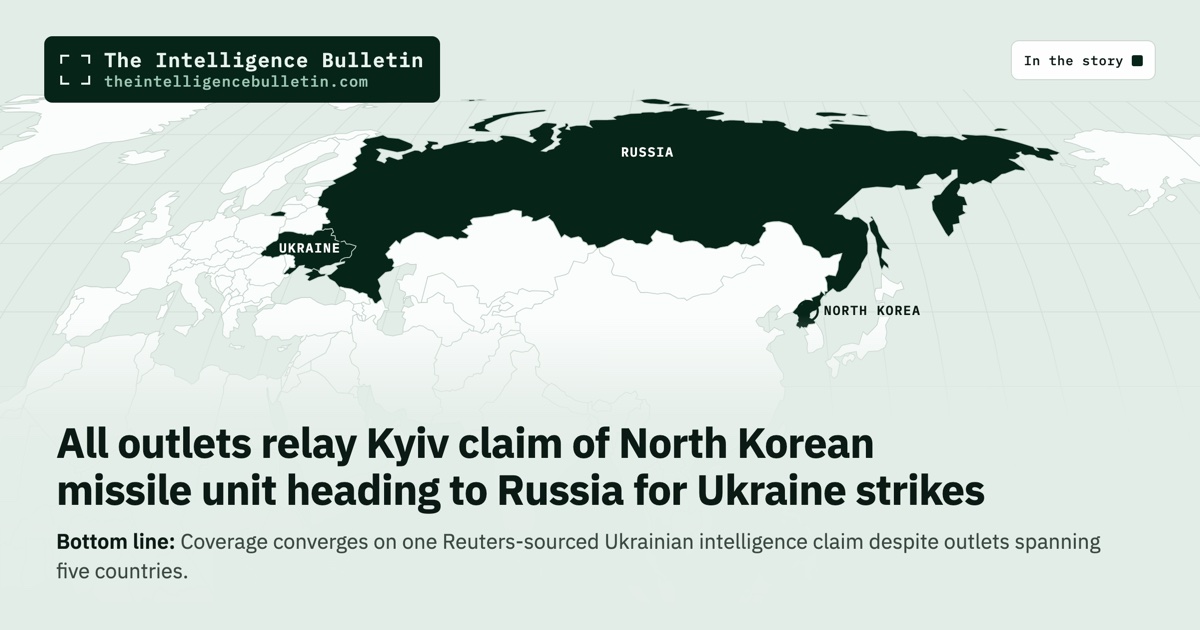
Coverage converges on one Reuters-sourced Ukrainian intelligence claim despite outlets spanning five countries.
Every selected outlet traces the story to the same Ukrainian intelligence statement given to Reuters, producing near-identical factual cores across Ukrainian, Russian, Turkish, Austrian and Norwegian mastheads. Kyiv Post foregrounds the scale of the planned deployment and its place in expanding Moscow-Pyongyang military ties, while Bloknot headlines Kim Jong Un’s initiative and places the item inside its domestic SMO coverage. Anadolu Agency isolates Kyiv’s threat to target the systems if used, Die Presse adds context on Ukrainian air-defense shortfalls and quotes an independent expert, and TV 2 stresses the escalation analogy drawn by a Norwegian military academic. The absence of any outlet from North Korea or Russia that offers an originating account means the selected coverage functions as a single international relay of one claim rather than competing national narratives. Where accounts diverge is only in emphasis: Ukrainian and Western European pieces highlight vulnerability and escalation risk, the Russian site presents it as proactive North Korean assistance, and the Turkish piece isolates the counter-threat. No source supplies contradictory facts or on-record denials.
Full analysis
The central claim in this story originates with Andrii Cherniak of Ukraine’s Military Intelligence Directorate, who spoke to Reuters. Cherniak stated that North Korea is preparing to station roughly 90 personnel from a missile unit in Russia’s Voronezh region, where they would join the 112th Missile Brigade. The unit is expected to bring up to 120 ballistic missiles and six launchers for use against Ukraine. The deployment would follow a recent North Korean delivery of around 40 KN-23 and KN-24 missiles plus associated personnel, with final numbers and structure to be settled in high-level talks next month.
That single Reuters dispatch, dated August 5, 2026, supplied every concrete figure and attribution that appears across the five articles. No outlet added new sourcing or independent confirmation. Kyiv Post ran the fullest version of the Ukrainian intelligence account, written by Alisa Orlova. Its opening paragraph listed the 90 personnel, the Voronezh location, the brigade designation, the 120-missile ceiling and the six launchers. The piece then placed the move inside an existing pattern: North Korea has supplied Russia with artillery shells, troops and ballistic missiles since late 2023, including forces sent to Kursk in 2024 and another batch of 40 missiles delivered in recent weeks. It noted that Russia had used North Korean ballistic missiles against Ukraine for the first time since August 2025 and that the KN-23 and KN-24 weapons have longer range and larger payload than Iskanders but lower accuracy, a trait Ukrainian officials link to civilian casualties. President Zelensky’s earlier warning of another 30,000 North Korean troops was referenced as context.
Bloknot published the same Reuters facts under a headline that names Kim Jong Un as the actor: “Kim Jong Un deploys missile unit in Russia to strike Ukraine – Reuters.” The article sits inside a running feed of special military operation updates rather than a dedicated foreign-news slot. Its wording shifts agency toward Pyongyang’s initiative while embedding the item among domestic Russian developments such as strikes on Ukrainian logistics and political commentary on Zelensky. No additional numbers or operational details beyond the Reuters core appear.
Anadolu Agency’s English-language piece isolates one sentence from the Ukrainian side: Kyiv warns that North Korean missile systems will be targeted if used against Ukraine. The article carries no further operational figures and does not mention personnel numbers, brigade integration or the September talks. Its placement in the Eurasia section and its headline choice foreground the counter-threat rather than the deployment itself.
Die Presse opened with the intelligence warning and added two layers of context not present in the Reuters dispatch. It quoted military expert Rob Lee of the Foreign Policy Research Institute on the particular difficulty Ukrainian air defenses face against ballistic missiles and on the risk to the power grid in the coming winter. The piece also supplied background on the 2024 mutual defense pact between Moscow and Pyongyang, the delivery of millions of artillery shells, the presence of roughly 9,500 North Korean soldiers in Kursk, and a specific recent incident in which at least five members of one family died in the village of Radushne from a North Korean missile strike. It recorded that neither the Russian Defence Ministry nor North Korea’s UN mission had responded to requests for comment.
TV 2’s Norwegian article likewise began with the Reuters-sourced Ukrainian claim and then turned to an independent local voice. Military academy instructor Palle Ydstebø described the planned missile-unit deployment as an escalation comparable to Western forces operating from Ukrainian territory against Russia. The piece repeated the 90-personnel and 120-missile figures, noted that the missiles have ranges between 400 and 900 kilometres, and cited Zelensky’s statement that Russia is helping North Korea gain real combat experience. It also referenced the failure of Ukrainian air defenses during a recent barrage that killed 17 people in Kyiv and observed that interception systems for ballistic missiles could have altered that outcome.
Because every outlet drew from the identical Reuters wire, differences appear only in selection and framing. Kyiv Post and Die Presse supplied the greatest volume of surrounding detail on prior deliveries and weapon characteristics. Anadolu Agency stripped the story down to the single warning sentence. Bloknot folded the item into a domestic news stream and foregrounded Kim Jong Un in the headline. TV 2 added a Nordic military-academic assessment of escalation risk. None of the five articles contained an on-record statement from Russian or North Korean officials, nor did any report an independent confirmation of the deployment timeline or numbers.
The pattern that emerges is therefore not one of competing factual accounts but of distinct editorial choices applied to the same set of numbers and the same named source. A reader who saw only the Kyiv Post piece would carry away the operational scale, the integration into an existing Russian brigade, and the link to recent missile strikes on Ukrainian territory. A reader limited to Anadolu Agency would register primarily the Ukrainian threat to respond. A Bloknot reader would encounter the development inside a narrative of North Korean assistance to Russia. The Austrian and Norwegian pieces each supplied an external expert lens on air-defense vulnerability and alliance implications that the originating dispatch itself did not contain.
What to Watch
The shared origin also explains the absence of any originating Russian or North Korean voice in the selected set. The coverage therefore illustrates how a single intelligence statement travels through different national filters, each choosing which element of the same 90-personnel, 120-missile claim to place at the front and which additional context to attach. The September high-level talks mentioned in the Kyiv Post account remain the only scheduled point at which the final configuration of the unit is expected to be decided.
That’s how the world told the story.
Get our daily open-source intelligence on world events in your inbox — one email a day, up to six stories.
Subscribe freeNo spam. One-click unsubscribe. See the latest email →