 AI-generated analysis published under the editorial responsibility of Rohit Sinnas. How it works →
Press quoted
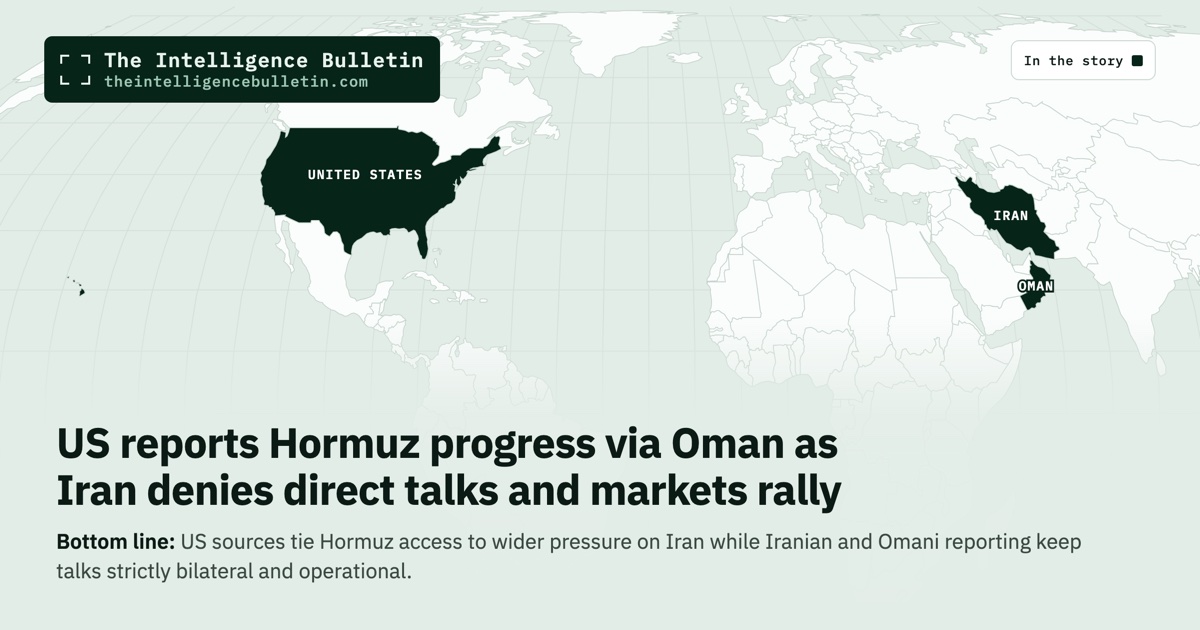
US sources tie Hormuz access to wider pressure on Iran while Iranian and Omani reporting keep talks strictly bilateral and operational.
The reporting reveals a split between US emphasis on progress and threats versus Iranian insistence on Oman-only bilateral management. Arab News and The Tribune frame the story around Trump’s ultimatum and Rubio’s linkage of Hormuz access to eventual Iranian denuclearization, treating Oman mediation as a US-led channel. Times of Oman relays CENTCOM statements that stress operational openness without Iranian control or fees. Al Jazeera focuses on market gains from the diplomatic signals. Gooya’s commentary widens the lens to US-China-Russia energy competition, portraying Hormuz as leverage rather than a simple bilateral fix. Independent chains converge on the existence of Oman-mediated talks and Iranian denials of direct US contact, but diverge on whether Washington is a direct party or sidelined. No source from Yemen appears, even though Red Sea Houthi actions are referenced as context. The pattern shows actor outlets protecting national narratives on control and threat, while the observer and market-focused pieces treat reopening as an economic positive without resolving the underlying dispute over authority in the strait.
Full analysis
US officials described advancing talks between Iran and Oman aimed at restoring greater commercial traffic through the Strait of Hormuz, a waterway that carried roughly one-fifth of global oil supplies before the current conflict. President Donald Trump said on Tuesday that a deal could come as soon as Wednesday or Thursday, while warning that if negotiations collapsed Iran would be “hit very hard” and the strait would still open. Secretary of State Marco Rubio stated that Washington was participating in the Oman-mediated discussions, with the immediate goal of safe passage and the longer-term objective of Iranian denuclearization. Treasury Secretary Scott Bessent told CNBC there was a chance of an agreement by Wednesday or Thursday.
Iran’s Foreign Ministry spokesperson Esmaeil Baghaei said talks with Omani officials on designating safe routes had been positive, yet repeatedly denied any direct or indirect negotiations with the United States. A senior Iranian military adviser, Mohsen Rezaee, rejected unauthorized routes and said Iran would target any US warships using them. US Central Command reported that the southern route through the strait remained free and open, with American forces having assisted more than 1,000 vessels over the past three months despite what it called unwarranted Iranian aggression. An unnamed US official added that any temporary routes would require no permits, approvals or fees.
Market reaction was immediate. The S&P 500 rose 1.8 percent on Tuesday to surpass 7,700 for the first time, according to reporting that tracked the surge alongside corporate earnings and the diplomatic signals. Brent crude futures settled near $80 after falling about 5 percent overnight. Before the conflict began in late February, the strait saw roughly 130 daily transits; by Sunday the number had fallen to nine vessels, per ship-tracking data.
The same reporting placed the Hormuz talks against a backdrop of continued maritime incidents. A merchant ship suffered a projectile strike in the strait off Oman on Tuesday, leaving one crew member missing. In the Red Sea an Indian-flagged vessel sank after an unattributed attack, with all crew rescued. Houthi forces in Yemen have declared a blockade on Saudi shipping lanes, including the Red Sea port of Yanbu, forcing some traffic to reroute around Africa.
Accounts converge on two core points. Multiple outlets carried the Iranian Foreign Ministry’s confirmation of constructive exchanges with Oman and its denial of direct US talks. Separate reporting chains also recorded CENTCOM’s assertion that the southern route stays open for commercial traffic. These elements appear across independent sources rather than repeated agency copy under different mastheads.
The accounts diverge on Washington’s precise role and on the framing of control. Arab News, relaying AFP material, led with Trump’s threat of a hard strike and presented the Oman channel as part of US pressure that could still turn military. The Tribune, carrying ANI, quoted Rubio tying the strait explicitly to eventual denuclearization as the ultimate American goal. Times of Oman relayed CENTCOM’s statement that no single party controls navigation and that temporary routes need no fees or approvals, foregrounding operational continuity under existing international rules. Al Jazeera centered the economic effects, noting the S&P record and oil-price relief without dwelling on enforcement disputes. Gooya’s commentary stepped outside the bilateral frame altogether, describing the strait as a node in US-China-Russia competition over energy leverage and warning that Iranian threats could ultimately constrain Tehran’s own exports and those of its partners.
A reader limited to Saudi-sourced material would encounter repeated emphasis on US military options and Iranian restrictions, while an Omani-sourced account would stress that shipping lanes function without Iranian permits. An Iranian domestic analysis would highlight great-power stakes beyond Washington and Tehran. None of the five selected outlets carried reporting from Yemen, even though Houthi actions at Yanbu and in the Red Sea appear as context in several pieces; the set therefore contains no direct Yemeni official voice on how the Hormuz talks intersect with Red Sea shipping disputes.
The corroborated elements—positive Oman-Iran exchanges and the denial of direct US-Iran talks—rest on on-record statements from the Iranian Foreign Ministry that appear in at least two independent chains. The single-source claims, including the 60-day interim arrangement floated via Axios and the precise market record cited by Al Jazeera, remain tied to their originating outlets. US statements consistently place Oman mediation inside a wider American agenda that includes nuclear limits and the threat of force; Iranian and Omani reporting keep the channel strictly bilateral and operational.
What to Watch
The pattern indicates that a short-term arrangement on routing and fees is the nearest plausible next step, because it satisfies the narrow convergence on Oman-mediated talks without forcing either side to concede the larger question of who sets the rules. Such an interim step would likely produce the observed market relief while leaving the underlying disagreement over authority in the strait intact.
That’s how the world told the story.
Get our daily open-source intelligence on world events in your inbox — one email a day, up to six stories.
Subscribe freeNo spam. One-click unsubscribe. See the latest email →