 AI-generated analysis published under the editorial responsibility of Rohit Sinnas. How it works →
Press quoted
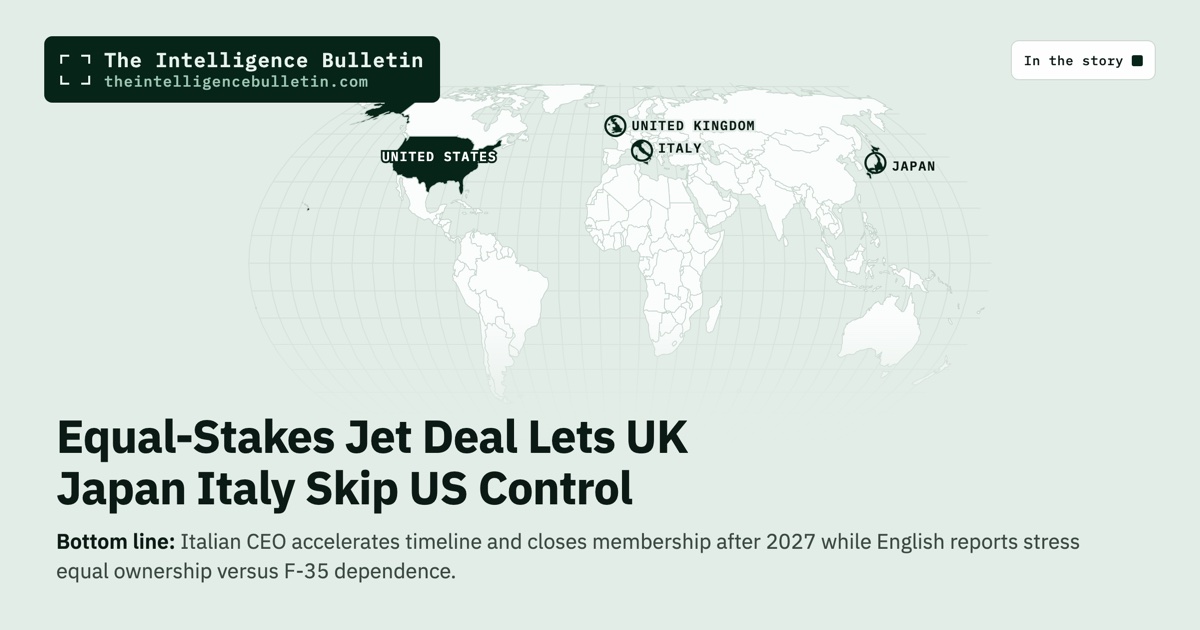
Italian CEO accelerates timeline and closes membership after 2027 while English reports stress equal ownership versus F-35 dependence.
The two English-language outlets carry identical text from The Conversation that stresses the partners’ homegrown stealth demonstrators, F-35 assembly experience and, above all, the equal one-third stakes that give each nation independent control over upgrades—explicitly unlike the F-35. That shared piece frames the July contract as settling industrial leadership early to avoid the Dassault-Airbus disputes that killed FCAS. The sole non-English source, TechNews Taiwan, relays Leonardo CEO Lorenzo Mariani’s claim that defence ministers are compressing the schedule by two years to 2033 via phased delivery and that the window for new members closes after 2027. Together the coverage shows the programme’s industrial logic: equal ownership and accelerated Italian-led timelines aimed at sovereign fleets rather than reliance on Washington. No selected outlet foregrounds post-Brexit leverage or pure jobs numbers; the concrete signal is trilateral discipline on cost, integration and membership timing.
Full analysis
The United Kingdom, Italy and Japan signed a £4.6 billion contract on 3 July 2026 that moved their sixth-generation fighter programme into its next design phase. The deal funds work on the Global Combat Air Programme aircraft, known as Tempest in Britain, through a joint venture called Edgewing owned in equal 33.3 percent shares by BAE Systems, Leonardo and the Japan Aircraft Industrial Enhancement Company. The partners set the structure before any metal is cut, giving each country independent rights to modify hardware and software on aircraft built for its own fleet.
The project replaces Britain’s and Italy’s Eurofighter Typhoon squadrons and Japan’s F-2 fighters with an aircraft intended to enter service by 2035. It is designed as a system of systems that fuses data from its own sensors, satellites, ships and ground stations in real time and can direct uncrewed loyal wingman drones. Japan tested its own stealth demonstrator, the Mitsubishi X-2, in 2016, becoming only the fourth country to fly such an aircraft. Britain flew the BAE Systems Taranis stealth drone in 2013. Both countries’ experience, plus Italy’s and Japan’s F-35 final assembly lines outside the United States, supplies proven stealth and manufacturing skills that transfer directly to the new jet. What remains unproven is full integration of stealth, multi-sensor fusion and artificial intelligence in one airframe, and the ability to sustain production at the required scale.
The contract followed nine months of delay while Britain completed its defence spending plans. It came after the collapse of the rival Future Combat Air System project between France, Germany and Spain, which foundered on disputes over design leadership, work share and intellectual property. The GCAP partners avoided those conflicts by locking in equal ownership and decision rights at the outset, a structure the reporting describes as materially different from the F-35 programme, where the United States retains final authority over upgrades.
Two of the three published reports carry identical full text of an analysis written by Marco Chan, senior lecturer in aviation operations at Kingston University. That dispatch appears under the Japan Herald masthead and again under the Mirage News masthead. Both run the complete piece, including the author’s disclosure of no relevant financial interests beyond his academic post. The Taiwan outlet TechNews instead published a shorter report that relays statements from Leonardo chief executive Lorenzo Mariani, originally carried by Breaking Defense. Mariani said defence ministers are pressing for the first operational aircraft in 2033, two years ahead of the original target, through a phased delivery approach that begins with a reduced-specification version later upgraded to full capability. He also stated that the window for adding new member countries closes after 2027, after which further partners would disrupt the compressed schedule.
The Japan Herald and Mirage News versions therefore present the same detailed account of technological readiness, industrial safeguards and cost uncertainties. The TechNews version foregrounds the accelerated timeline and membership deadline drawn from the Leonardo executive. No selected report adds independent on-the-ground reporting or new primary documents beyond these two originating dispatches.
The shared Conversation analysis notes that total programme costs remain unquantified because neither unit price nor order quantities have been fixed, even after Britain’s £8.6 billion Defence Investment Plan commitment. It also flags historical underestimation of costs in multinational fighter programmes and the additional training burden of teaching pilots to direct loyal wingmen. The TechNews report does not address these points. Conversely, the Conversation text does not mention the 2033 target or the 2027 membership cutoff.
What to Watch
The most detailed and cross-checked account of the programme’s industrial architecture and technological foundation remains the Conversation dispatch carried by the two English-language outlets. Its description of equal stakes and pre-existing demonstrator aircraft rests on named company and government milestones already in the public record. Mariani’s acceleration claim is an on-record industry statement carried by one chain and therefore carries narrower corroboration. The next milestones are the detailed design reviews and the first flight of a technology demonstrator, both of which will test whether the equal-ownership model delivers the promised independence from single-nation veto.
That’s how the world told the story.
Get our daily open-source intelligence on world events in your inbox — one email a day, up to six stories.
Subscribe freeNo spam. One-click unsubscribe. See the latest email →