One Story. Many Angles.
Coverage converged on scale and returns but split on whether the story was Moroccan-Spanish success, Italian border risk, or migrant hardship and deaths.
Spanish and Moroccan outlets converged on bilateral success: Madrid thanked Rabat for exemplary border efforts that enabled quick returns of the bulk of arrivals, framing the episode as proof of strengthened ties after years of coordination. Italian coverage instead opened with Giorgia Meloni’s direct accusation that Sanchez’s regularization policies had created the surge and endangered Italy, prompting an immediate threat to suspend Schengen. Canadian wire reporting led with the confirmed death toll of 57 and placed European political fallout second. Turkish coverage centered returning migrants’ accounts of finding no food or shelter once inside the enclave. The shared factual core—mass entry followed by swift returns—thus produced sharply different lead emphases that map onto each outlet’s domestic or regional stakes rather than any dispute over what occurred.
Perspective Analysis
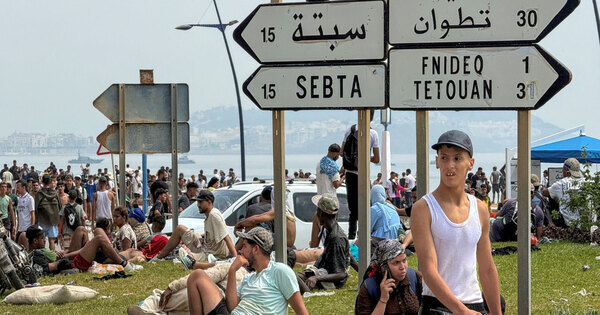
Tens of thousands of migrants crossed from Morocco into Spain’s North African enclave of Ceuta over the course of roughly one day in late July 2026, prompting Spanish authorities to declare a rapid return operation that moved most of them back across the border within hours while confirming at least 57 deaths during the surge.
Spanish Interior Ministry figures placed the total entries near 60,000, a scale that quickly strained the small territory’s capacity. Ceuta, home to around 80,000 residents and one of Europe’s only land borders with Africa, saw people arrive both by swimming the short coastal stretches from nearby Moroccan towns and by pushing through border points. By the following afternoon, the same ministry reported that at least 48,000 had already left Ceuta for Morocco, with departures running at rates as high as 150 people per minute in the morning hours. Ceuta’s local leader stated that 57 people died in the crossings, a toll drawn from police sources and later carried in multiple reports.
Spain’s interior minister, Fernando Grande-Marlaska, credited Moroccan security services with exemplary cooperation that helped contain further attempts and facilitated the returns. The two governments reached an agreement on the handover process, and Grande-Marlaska remained in direct contact with his Moroccan counterpart. Spanish Prime Minister Pedro Sanchez described the mass movement as a violation of territorial sovereignty and called on Rabat to increase its efforts to curb the outflow. He visited the enclave’s Tarajal border point alongside the interior minister to oversee the response, which included deploying additional troops.
The episode echoed a similar surge in 2021, when more than 10,000 people crossed during a diplomatic standoff over Spain’s decision to host a Polisario Front leader for medical treatment. That crisis eased after Madrid shifted in 2022 to support Morocco’s autonomy plan for Western Sahara, a move that restored closer coordination on border security and migration management. Officials in Madrid have since pointed to the resulting drop in irregular arrivals across Spanish territory as evidence that the partnership works.
Italy’s Prime Minister Giorgia Meloni responded by accusing Sanchez’s regularization policies of encouraging the flow and endangering neighboring countries. She stated that Italy would not remain passive and was prepared to use extraordinary measures, including suspension of Schengen rules with Spain, to protect its borders. Italian foreign minister Antonio Tajani echoed the criticism, linking the Ceuta events to Spain’s mass amnesty process that drew over a million applications. Spain summoned the Italian ambassador in response and rejected the comments as partisan.
French authorities announced they would quintuple police checks along their border with Spain and increase aerial and rail surveillance. German Chancellor Friedrich Merz welcomed Spain’s stated intent to prevent illegal migrants from reaching the European mainland. In the United States, President Donald Trump described the scenes as an invasion and warned that similar pressures could affect his country without stricter policies.
Returning migrants interviewed after the operation recounted immediate hardship inside Ceuta. Some described finding no bread or basic provisions once they reached the enclave, leading many to accept the offer of prompt return rather than remain in temporary facilities. Moroccan authorities on the other side of the fence used water cannons, batons, and tear gas to push back additional crowds attempting to follow the first wave.
The core sequence of a large crossing followed by swift returns rests on figures issued directly by the Spanish Interior Ministry and confirmed in reporting chains that include AFP and Reuters dispatches. The death toll originates from Ceuta authorities and police sources. The statement of thanks to Morocco comes from the same Spanish interior ministry and appears in accounts that quote Grande-Marlaska’s contacts with Rabat. Meloni’s threat to suspend Schengen is an on-the-record declaration she made in public statements and social media posts.
The Moroccan reporting highlighted the diplomatic thanks and long-term reduction in flows that followed earlier coordination. Spanish domestic coverage stressed the ministry’s updated return counts and the prime minister’s visit. Italian coverage centered Meloni’s accusation that Sanchez’s policies had created the problem and her readiness to act unilaterally. Canadian wire accounts opened with the confirmed deaths before detailing the political ripple effects across Europe. Turkish reporting focused on the personal accounts of hardship from those who crossed and then returned.
No independent reporting chain disputes the ministry’s entry and return totals or the police-sourced death count. The Italian threat stands as a distinct political response rather than a factual contradiction of events on the ground. The migrant hardship descriptions add detail that official statements did not emphasize.
What to Watch
The ministry’s corroborated numbers on entries, returns, and deaths, drawn from multiple independent wires and official statements, provide the most reliable account of what occurred. Meloni’s on-record threat reflects Italy’s separate interest in shielding its own migration results from any perceived spillover. The cooperation narrative aligns with repeated Spanish government statements and with Morocco’s positioning as a key partner, while the personal accounts from returnees stand as direct testimony that official summaries left aside. The pattern suggests continued pressure on the Spain-Morocco border arrangement, with any future surge likely to trigger the same mix of rapid returns, bilateral credit, and external political complaints from other EU capitals.
That’s how the world told the story.
Get tomorrow’s bulletin by email — one briefing, up to six stories.
Subscribe freeNo spam. One-click unsubscribe. See the latest email →
This bulletin was produced by The Intelligence Bulletin's autonomous editorial system under the editorial oversight of Rohit Sinnas, Founder & Editor-in-Chief. How it works →