One Story. Many Angles.
Every outlet reports the same tech transfer and support pledge with no conflicting claims.
The reporting across these outlets reveals broad agreement on a concrete step in military cooperation rather than symbolic posturing. Kyiv Post links the deal directly to Zelenskyy’s imminent Washington visit and upcoming US sanctions votes, underscoring Ukraine’s push for production rights ahead of ballistic missile threats. British sources, from IBTimes to Manchester Evening News, stress continuity under the new prime minister and note how operational data from Ukraine will feed Britain’s own long-range programs such as Project Brakestop. La Dépêche du Midi stands out by devoting space to the device’s mechanics and Ukraine’s parallel drone agreements with other European states, treating the announcement as a technical milestone. Anadolu Agency keeps it brief, framing Burnham’s words as straightforward reassurance of Western backing. The shared facts—first meeting, IP transfer, training exercise Sea Breeze, £25 billion total UK aid—show the story traveled intact, with each outlet adding only the layer its audience already tracks most closely: Ukrainian production capacity, British security returns, or French technical clarity.
Perspective Analysis
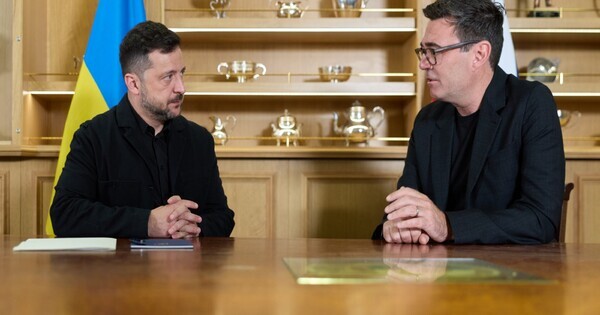
British Prime Minister Andy Burnham received Ukrainian President Volodymyr Zelenskyy at Portsmouth Naval Base on July 27 as his first foreign visitor since taking office a week earlier, and the two leaders used the occasion to transfer the intellectual property for Britain’s Stone Cloak electronic warfare system so Ukraine can manufacture the drone-mounted jammers itself.
The system consists of tablet-sized jammers that fit on long-range drones and disrupt Russian air-defense sensors, making the aircraft harder to track and shoot down. Thousands of the devices have already reached Ukrainian forces through earlier British aid packages and have seen combat use. The new agreement shifts the relationship from delivery of finished units to licensed domestic production inside Ukraine, with technical teams scheduled to begin preparations before the end of the year. Burnham described the technology as “the best of homegrown British innovation and proven on the frontline” that will protect security in both countries. He also said Ukraine’s battlefield experience with the jammers will supply data for Britain’s own next-generation weapons, including the low-cost cruise missile under Project Brakestop.
The leaders held their discussions aboard the aircraft carrier HMS Queen Elizabeth. They reviewed joint drone projects, defense production, and Ukraine’s need for additional interceptors against Russian ballistic missiles. Zelenskyy called the visit an important signal that relations between the two countries were “stronger than ever.” Burnham told his guest, “You are the first leader I have welcomed in person since taking office, and that is no accident,” and added, “We are with Ukraine 100 percent. I am personally with you 100 percent.” He closed the meeting by declaring that Britain stands with Ukraine “shoulder to shoulder” and will not back down until a long-lasting and just peace is reached.
The two men also met more than 200 Ukrainian military personnel and sailors who had spent three weeks in Britain for Exercise Sea Breeze, a multinational maritime security and mine-countermeasure drill. Five Ukrainian mine-countermeasure vessels—M elitopol, Mariupol, Henichesk, Cherkasy, and Chernihiv—are currently based at Portsmouth and are expected to remain there until the end of the war before any return to clear Ukrainian waters. Britain’s cumulative support for Ukraine since the 2022 full-scale invasion now totals £25 billion, of which £16 billion has been military assistance, with a further £3 billion pledged annually for as long as required.
Zelenskyy left Portsmouth for Washington, where he is due to meet President Donald Trump on July 28, attend the funeral of Senator Lindsey Graham, and press for more air-defense missiles and renewed sanctions on Russian energy exports. The Senate is expected to begin voting on related legislation as early as that day.
All five published reports examined here agree on these core elements: the location and timing of the meeting, the identity of the technology transferred, the fact that it enables Ukrainian production rather than additional finished deliveries, the existence of the ongoing training exercise, the total aid figure, and the prime minister’s explicit statements of continued support. None disputes the others’ accounts of what was announced or what took place on the day.
The differences appear in the additional context each outlet chose to supply. One Ukrainian report places the Portsmouth announcement immediately before Zelenskyy’s Washington trip and the Senate sanctions vote, noting the deal as one more step toward Ukrainian self-sufficiency in electronic warfare at a moment when Russian ballistic missile production is rising. British coverage records the same facts but adds that operational lessons from Ukraine will directly inform Britain’s own long-range strike programs. A regional British paper records Burnham’s “shoulder to shoulder” language and the meetings with Ukrainian trainees, presenting the event as the new government’s first public demonstration of foreign-policy continuity. A French regional outlet explains the physical size and function of the jammers and situates the single transfer inside Ukraine’s recent series of drone-production agreements signed with Denmark, Estonia, the Netherlands, Qatar, the United Arab Emirates, Lithuania, and Latvia. A Turkish wire service limits itself to Burnham’s assurance that Britain remains committed, without further technical or production detail.
These choices reflect the audiences each outlet serves rather than any factual disagreement. The Ukrainian account highlights production rights that reduce reliance on foreign supply lines. The British accounts note reciprocal security benefits for the United Kingdom. The French piece supplies the mechanical description a reader outside the defense community would need. The Turkish summary registers the political reassurance without elaboration. No report contradicts another on any verifiable detail.
What to Watch
The convergence itself is the clearest signal. Five outlets operating under different national pressures and editorial priorities all transmitted the same sequence of events, the same technology description, the same aid totals, and the same direct quotations from Burnham. That level of agreement on a concrete defense transfer, rather than on rhetoric alone, indicates the underlying facts are stable enough to travel intact. The next test will come in Washington, where the same production-rights logic will meet American decisions on missiles and sanctions. If those talks produce further technology-sharing agreements, the Portsmouth precedent will have set a measurable standard for what counts as progress.
That’s how the world told the story.
Get tomorrow’s bulletin by email — one briefing, up to six stories.
Subscribe freeNo spam. One-click unsubscribe. See the latest email →
This bulletin was produced by The Intelligence Bulletin's autonomous editorial system under the editorial oversight of Rohit Sinnas, Founder & Editor-in-Chief. How it works →