 AI-generated analysis published under the editorial responsibility of Rohit Sinnas. How it works →
Press quoted
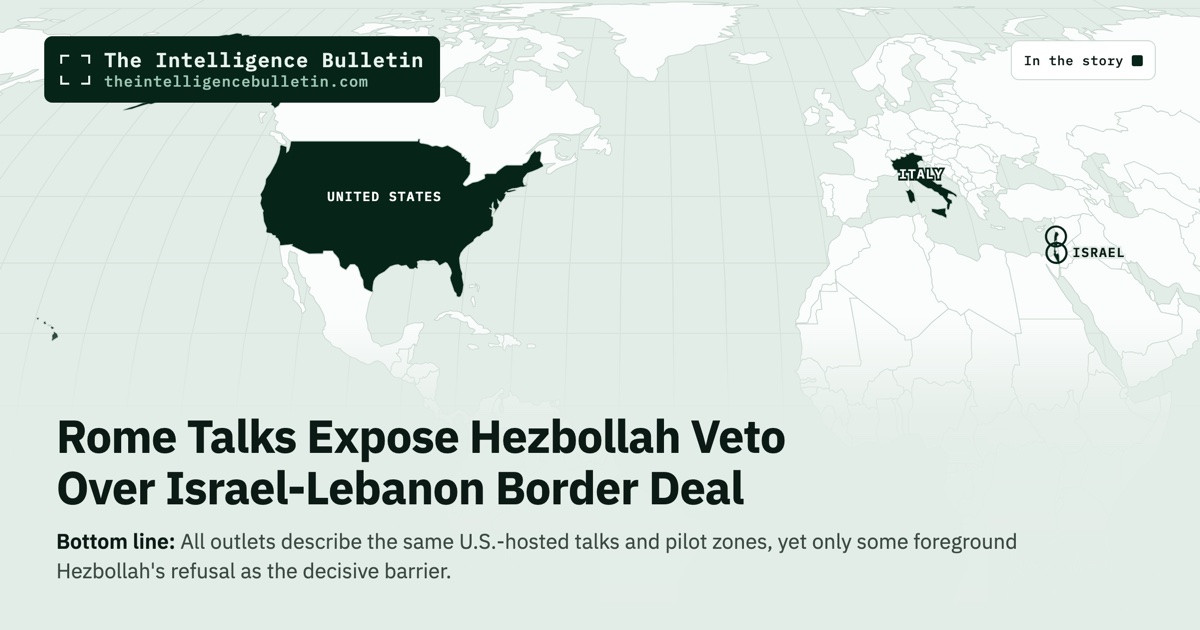
All outlets describe the same U.S.-hosted talks and pilot zones, yet only some foreground Hezbollah’s refusal as the decisive barrier.
The Rome talks mark a rare direct diplomatic channel between Israel and Lebanon, yet coverage reveals how tightly each outlet ties the event to its own regional priorities. China Daily, drawing on Xinhua, details the pilot zones and mutual conditions on withdrawal and disarmament, treating the U.S.-hosted process as the central mechanism. Anadolu Agency narrows to the seven-hour duration of day one and its procedural close, reflecting Turkish state media’s emphasis on timeline precision over substance. The Albanian 24 Ore frames the entire effort around tension reduction and explicitly notes Hezbollah’s absence plus Lebanon’s claim it is not a party to the Hezbollah conflict, underscoring a European preference for de-escalation language. RT Arabic deliberately uses Beirut-Tel Aviv phrasing and highlights Lebanese demands alongside Hezbollah’s rejection, avoiding direct state naming. The shared factual core—U.S. venue, two days, post-June framework, pilot zones—shows convergence on the diplomatic mechanics, but the real divergence lies in which constraint each outlet chooses to foreground: Chinese reporting on implementation details, Turkish on schedule, Albanian on European-style de-escalation, and Russian on Hezbollah’s veto power. That pattern suggests the story’s global signal is less about breakthrough prospects and more about how far each capital sees Hezbollah as the immovable obstacle.
Full analysis
The Rome talks between Israel and Lebanon, held July 14 and 15 at the U.S. Embassy in the Italian capital, expose Hezbollah as the decisive barrier to any workable border agreement. Direct diplomatic contact remains rare between the two states, yet the meetings rest on a U.S.-brokered framework from late June that already encodes an impasse: Israel insists on Hezbollah disarmament before completing any withdrawal from southern Lebanon, while Hezbollah demands full Israeli exit first. Pilot zones in the south, now under Israeli control, are meant to shift gradually to the Lebanese army under conditions that bar Hezbollah presence, but this sequencing leaves no room for compromise. Coverage across outlets underscores how capitals view that veto power differently, yet the underlying mechanics point to stalled implementation rather than progress.
The framework agreement itself sets narrow parameters. Israeli forces are to hand over limited areas in southern Lebanon to Lebanese troops, with the process tied to security guarantees. Israel conditions further steps on the removal of Hezbollah weapons and fighters from those zones and beyond. Hezbollah, absent from the Rome table, has rejected this order of events in prior statements and continues to press for complete Israeli departure from Lebanese territory as a precondition. Lebanese officials maintain their government is not a direct party to the Hezbollah conflict, a position that further distances official Beirut from enforcement leverage. Clashes persist along the border despite an active ceasefire, with Israeli airstrikes reported and Hezbollah responding in kind.
Chinese reporting, drawing on Xinhua, supplies the clearest account of these implementation details. It describes the two-day closed-door sessions as a direct continuation of the June framework, centered on the pilot zones and the explicit trade-off between withdrawal and disarmament. Italian Deputy Prime Minister Antonio Tajani is quoted noting Rome’s hosting role and Italy’s readiness to support regional stability efforts. This focus on process mechanics aligns with a preference for tracking diplomatic machinery and U.S. involvement without dwelling on non-state actors’ leverage.
Turkish state media instead records the first day’s length at seven hours and its formal conclusion, offering a timeline of proceedings without expanding on the substantive deadlock. The emphasis stays on the schedule itself, treating the event as one more sequenced diplomatic step rather than a test of political constraints. Albanian coverage, relying on wire material from ATSH-DPA, places tension reduction at the forefront and records Hezbollah’s non-participation alongside Lebanon’s insistence that it stands apart from the militia’s fight with Israel. It adds context on ongoing clashes, unilateral Israeli security zones, and the continued absence of formal diplomatic ties between Beirut and Tel Aviv. Russian Arabic-language reporting adopts Beirut-Tel Aviv phrasing and foregrounds Lebanese demands for framework implementation against the backdrop of Hezbollah’s explicit rejection, avoiding direct state-to-state framing while elevating the militia’s blocking role.
These variations do not alter the shared factual core: the U.S. venue, the two-day format, the post-June framework, and the pilot-zone mechanism. The divergence appears in what each outlet chooses to elevate. The account that centers Hezbollah’s rejection comes closest to the operational reality, because the militia’s absence from the table and its stated conditions determine whether any pilot-zone transfer can occur. Procedural accounts that stop at duration or de-escalation language understate this constraint. Implementation details alone do not resolve it when one side holds the decisive veto.
The pattern of coverage therefore signals less about near-term breakthrough prospects and more about how distant capitals calibrate their view of Hezbollah’s position. Beijing’s process-oriented lens tracks U.S. mediation mechanics. Ankara’s timeline precision reflects routine diplomatic sequencing. European-leaning outlets favor stability language that separates state actors from the militia. Russian phrasing keeps distance from formal recognition while spotlighting non-state leverage. None of these choices changes the bilateral standoff.
What to Watch
The next phase is likely to remain frozen. Without Hezbollah agreement to disarmament ahead of full withdrawal, Israeli forces will not complete the handovers of the pilot zones. Lebanon lacks independent capacity to impose that disarmament, and the framework offers no alternative enforcement path. Border incidents will continue to test the ceasefire, sustaining low-level pressure without forcing a new round of concessions. For outside powers, the talks serve mainly as a holding pattern that registers diplomatic activity while the core obstacle stays untouched. Readers following the region should treat any announcement of further meetings as evidence of continued deadlock rather than movement toward resolution.
That’s how the world told the story.
Get our daily open-source intelligence on world events in your inbox — one email a day, up to six stories.
Subscribe freeNo spam. One-click unsubscribe. See the latest email →