 AI-generated analysis published under the editorial responsibility of Rohit Sinnas. How it works →
Press quoted
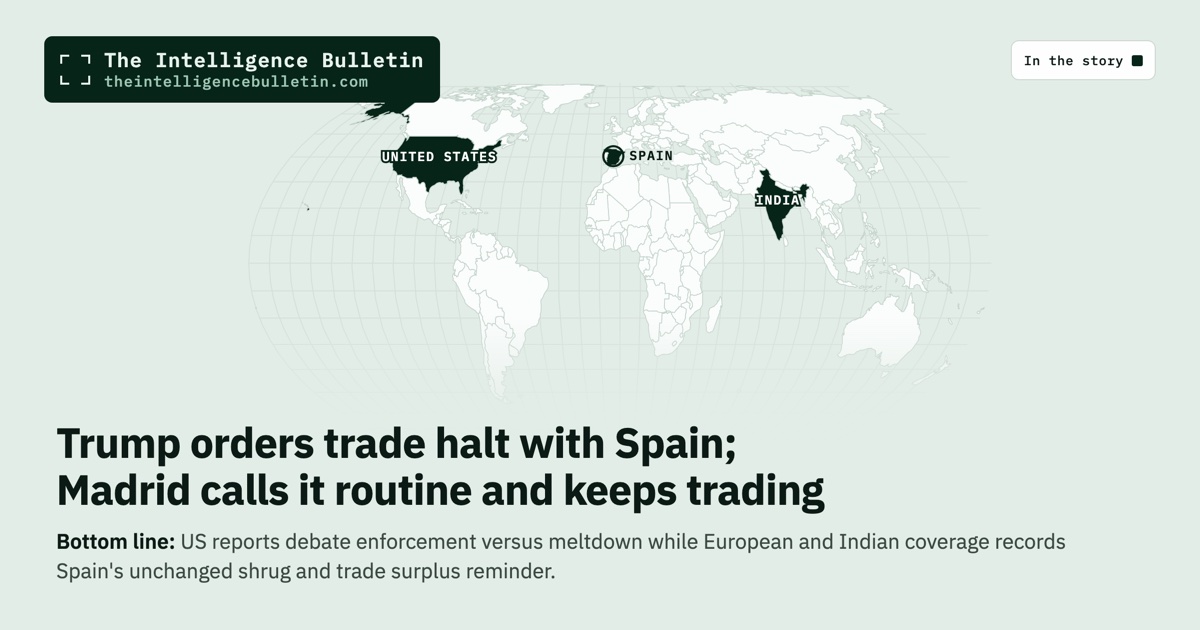
US reports debate enforcement versus meltdown while European and Indian coverage records Spain’s unchanged shrug and trade surplus reminder.
Every report confirms Spain’s government met the order with the same calm dismissal: routine rhetoric, no intention to alter ties, and a reminder that the US runs a trade surplus. Breitbart treats the move as overdue enforcement against a freeloading ally that also refused Iran support and clings to outdated 2 percent spending. The Daily Beast instead presents it as an erratic personal eruption after a snub. Greek outlet Ta Nea centers Madrid’s prepared rebuttal that relations stay excellent across economic, cultural and defense lines. Polish site WNP notes Sanchez’s claim of a friendly football chat with Trump and no tensions, underscoring Eastern European interest in alliance stability. Indian business outlet Moneycontrol stresses the commercial numbers and Madrid’s shrug while tying the episode to broader NATO burden-sharing disputes. The uniform Spanish non-reaction across these accounts reveals the order’s immediate practical limits: unilateral US action collides with EU single-market rules and existing trade flows that benefit Washington more than Madrid.
Full analysis
President Donald Trump’s order to halt all U.S. trade with Spain during the July 8 NATO summit in Ankara exposes the narrow practical reach of unilateral American pressure on a European ally. The move, aimed at Spain’s refusal to adopt a 5 percent of GDP defense spending target and its decision to withhold support for U.S. operations tied to the Iran conflict, collides immediately with the European Union’s single-market structure and with trade patterns that already run in Washington’s favor. Spain’s government met the directive with the same prepared calm across multiple accounts: it labeled the language routine posturing, noted that commercial ties are shaped by private firms rather than governments, and pointed out that the United States runs a bilateral surplus. That consistent dismissal, rather than any reported scramble or concession, reveals the order’s limited enforceability and the real stakes in ongoing NATO burden-sharing disputes.
Trump issued the instruction directly to Treasury Secretary Scott Bessent while seated with NATO Secretary General Mark Rutte. He described Spain as a “terrible partner” that “doesn’t participate, doesn’t pay,” and instructed Bessent to cut off all trade “immediately” and “don’t even talk to them.” The president linked the step to Spain’s adherence to the older 2 percent spending benchmark and its refusal to open airspace or bases for Iran-related missions. Past threats of the same kind, including one issued in March, produced no measurable interruption in flows. Spain’s response, prepared in advance according to one European report, treated the remarks as familiar and reiterated that bilateral economic, cultural, and defense relations remain strong and mutually beneficial.
Accounts differ sharply in emphasis. One American outlet aligned with the administration framed the step as overdue enforcement against a freeloading ally, highlighting U.S. liquefied natural gas exports that make up a growing share of Spain’s energy imports and noting Spain’s energy-grid vulnerabilities after recent blackouts. Another American outlet presented the episode as an 80-year-old president’s personal eruption after a perceived snub, stressing emotional language and the absence of any formal mechanism to deliver the cutoff. Greek coverage centered Madrid’s prepared rebuttal that relations stay excellent across multiple domains and that the United States benefits more from existing trade volumes. A Polish business-security site recorded Spanish Prime Minister Pedro Sánchez’s claim of a friendly, low-tension conversation with Trump that touched on football and the World Cup, underscoring Eastern European interest in keeping alliance cohesion intact. An Indian financial outlet stressed the concrete trade figures—Spain exported roughly €16.7 billion to the United States in 2025 while importing €30.2 billion—and Madrid’s shrug, reading the episode through commercial and market implications rather than alliance enforcement or domestic drama.
The Spanish non-reaction is the account closest to operational reality. EU rules prevent any member state from being singled out for a bilateral embargo; trade agreements operate at the union level. Existing numbers already show Washington selling more goods and energy to Spain than it buys, so any sustained disruption would remove a surplus rather than punish Madrid disproportionately. Sánchez’s public description of the exchange as cordial and tension-free aligns with the absence of any reported follow-through steps beyond the initial directive. European officials noted that the United States cannot simply embargo a single member without broader consequences, while Spanish sources emphasized that private companies, not governments, drive the flows.
What to Watch
What happens next is therefore likely to remain rhetorical. Trump has repeated similar threats without producing structural change in European spending patterns or in Spain’s specific stance. The underlying friction over burden-sharing will persist because the 5 percent target exceeds what most allies have accepted, and Spain continues to cite its contributions to NATO missions on the eastern flank. Trade volumes, governed by EU-wide rules and private contracts, will continue unless Washington pursues a formal, union-wide negotiation or tariff package. For readers tracking alliance cohesion, the episode demonstrates that public presidential pressure can generate headlines but rarely overrides the legal and commercial architecture that already tilts the economic relationship toward the United States. The real test remains whether future summits convert spending pledges into sustained increases or whether the pattern of threats and shrugs simply repeats.
That’s how the world told the story.
Get our daily open-source intelligence on world events in your inbox — one email a day, up to six stories.
Subscribe freeNo spam. One-click unsubscribe. See the latest email →