 AI-generated analysis published under the editorial responsibility of Rohit Sinnas. How it works →
Press quoted
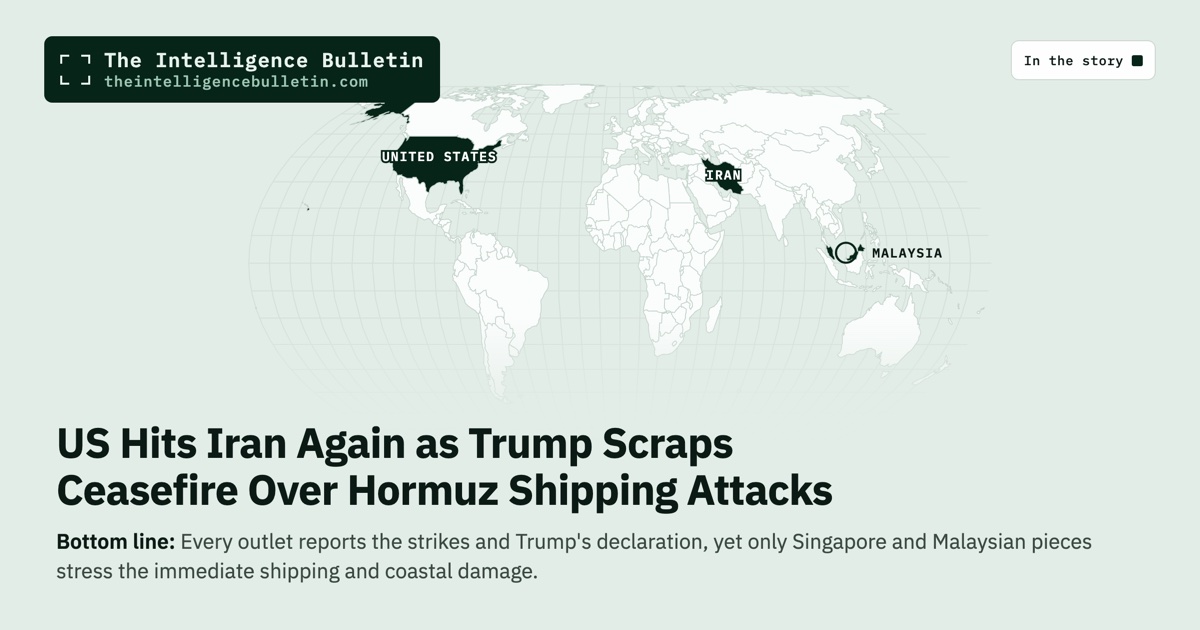
Every outlet reports the strikes and Trump’s declaration, yet only Singapore and Malaysian pieces stress the immediate shipping and coastal damage.
US strikes on Iran after Trump ended the ceasefire expose how quickly diplomacy collapsed into renewed force. American coverage frames the action as accountability for ship attacks and decisive leadership, while Singapore reporting stresses risks to global oil routes through Hormuz and power outages along Iran’s coast. Chinese state media leads with Tehran’s condemnation of the strikes as breaches of the UN charter and the recent US-Iran memorandum, plus Iranian vows to hit back at US bases. Malaysian outlets detail local explosions from Bandar Abbas to Kharg Island and minor injuries, grounding the story in immediate regional effects. Brazilian reporting highlights Trump’s personal rhetoric—calling Iran “scum” and promising worse—over military specifics. The shared emphasis on Hormuz shipping and oil prices shows the event’s real stakes lie in energy security rather than any single capital’s preferred narrative.
Full analysis
The swift unraveling of the June 17 US-Iran memorandum into fresh American airstrikes on July 8, 2026, shows that control over the Strait of Hormuz and the oil flows it carries outweighs any interim diplomatic arrangement. Both sides resumed force after Iranian attacks on commercial tankers triggered the latest US response, and the reporting from multiple regions converges on the same core risk: disruption of a waterway that handles roughly one-fifth of global oil supplies.
US Central Command stated that its forces began additional strikes to degrade Iran’s ability to threaten freedom of navigation. The command described the action as holding Iran accountable for unjustified aggression against commercial shipping and civilian crews. Targets included air-defense systems, coastal surveillance facilities, surface-to-air and anti-ship missiles, drone launch sites, and more than sixty Islamic Revolutionary Guard Corps speedboats. No US fatalities were reported from the exchange.
President Trump declared the interim accord “over” during a NATO summit in Ankara and said further dealings with Iranian leadership would be a waste of time. He labeled Iran “scum” and its leaders “sick people” and “dishonorable,” while posting videos and photos on Truth Social of burning structures that he presented as retribution for the ship attacks. He warned that any repeat incidents would produce a much worse outcome and floated the possibility of striking power and desalination plants or seizing Kharg Island, which processes an estimated 90 percent of Iran’s oil exports. Brent crude futures reached $79.09 a barrel, reflecting an 8 percent rise over five trading days and a sharper 5 percent jump immediately after the rhetoric.
Iran’s Foreign Ministry condemned the strikes as aggressive violations of the UN Charter and the recent memorandum. It stated that US actions, combined with the revocation of an oil-sales license until August 21 and renewed naval pressure in the strait, had nullified key provisions of the understanding. Iranian officials vowed that armed forces would not hesitate to strike the source of the aggression. State media reported that the Revolutionary Guards had already hit 85 US military sites in Bahrain and Kuwait in an earlier round of the exchange. One Guard member was reported killed in Bandar-e Mahshahr.
Local accounts from Iran’s southern coast recorded explosions in Bandar Abbas, Chabahar, Konarak, Sirik, Qeshm, and on Kharg Island itself. Power outages affected parts of Chabahar. Port facilities and fishing boats sustained damage, and some individuals suffered minor injuries from blast fragments. Iranian state outlets described the sounds of strikes reaching multiple coastal cities and noted electricity cuts in affected zones.
Singapore-based coverage placed the Hormuz shipping lane at the center of the story, noting that the strait’s leverage has allowed Tehran to force a stalemate with the world’s most powerful military. It recorded the power outages and coastal blasts alongside the economic stakes for global trade routes. Malaysian reporting supplied the most immediate sensory details of the explosions and their localized effects on ports and residents. Chinese state media led with Tehran’s diplomatic rejection of the strikes and the explicit promise of retaliation against US bases. Brazilian accounts emphasized Trump’s personal language and the images he circulated on social media more than the technical targets or route-specific risks.
The common thread across these accounts is the strait itself. Whether framed as accountability for tanker attacks, a breach of a recent understanding, or a direct threat to energy transit, every major outlet returns to the same physical chokepoint. That convergence indicates the real stakes lie in the uninterrupted movement of crude rather than in any single capital’s preferred justification or condemnation.
What to Watch
The pattern points to continued volatility. With Trump explicitly ruling out further negotiations as pointless and Iran pledging proportional or greater responses, the next Iranian move against shipping or US positions appears likely to draw another round of strikes. Oil markets will register each exchange first, and any sustained closure or blockade attempt would affect prices and supply far beyond the Gulf.
That’s how the world told the story.
Get our daily open-source intelligence on world events in your inbox — one email a day, up to six stories.
Subscribe freeNo spam. One-click unsubscribe. See the latest email →