 AI-generated analysis published under the editorial responsibility of Rohit Sinnas. How it works →
Press quoted
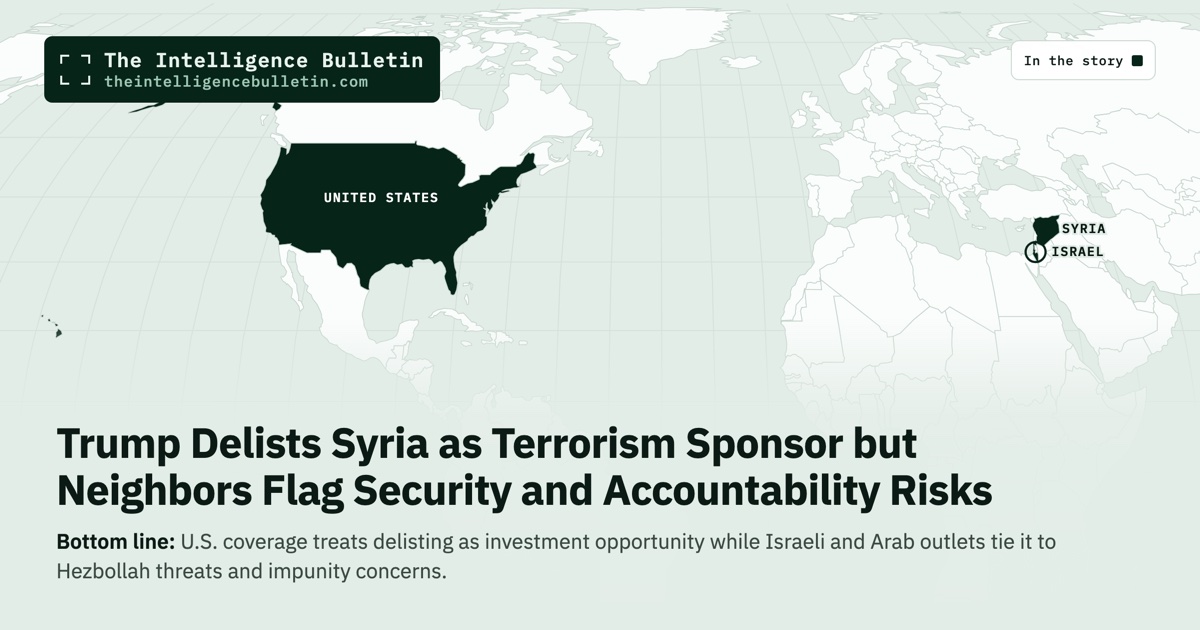
U.S. coverage treats delisting as investment opportunity while Israeli and Arab outlets tie it to Hezbollah threats and impunity concerns.
The factual announcement of the congressional notification drew near-identical treatment across U.S. Syrian Israeli Turkish and British outlets yet the real divergence sits in what each sees the delisting unlocking. Time presents the move as a direct result of Trump’s meeting with al-Sharaa and a route to reconstruction investment. SANA celebrates it as historic relief from sanctions that opens partnership. The Jerusalem Post immediately links the change to Hezbollah threats and regional stability. Middle East Eye asks whether the step rewards impunity without clear accountability steps. Anadolu situates the decision inside the NATO summit itself. The pattern shows Washington treating delisting as forward-looking policy while neighbors treat it as a test of whether past terrorism designations still constrain new power arrangements in Damascus.
Full analysis
President Donald Trump’s decision to notify Congress of his intent to remove Syria from the U.S. list of state sponsors of terrorism marks a decisive pivot toward economic reintegration rather than sustained isolation. The move, announced July 8, 2026, after Trump’s meeting with Syrian President Ahmed al-Sharaa on the margins of the NATO summit in Ankara, prioritizes reconstruction and investment over lingering designations rooted in the Assad era. Yet the same announcement exposes sharp regional fault lines: neighbors and independent observers see it as a test of whether security threats and accountability deficits will persist under the new Damascus government.
The factual core of the announcement received nearly uniform reporting. Trump stated he would rescind the designation, first applied in 1979 under Hafez al-Assad. Secretary of State Marco Rubio confirmed the formal notification to Congress, triggering a 45-day review period before any change could take effect. Rubio emphasized that al-Sharaa had provided formal assurances against future support for international terrorism and pointed to “positive changes and counterterrorism actions” already taken. The step builds on earlier U.S. actions, including an executive order last June lifting most sanctions and the removal of al-Sharaa himself from the Specially Designated Global Terrorist list in November 2025. A bipartisan Senate letter had already urged the change, citing the designation as the chief remaining barrier to private-sector investment and billions pledged for recovery.
Time frames the development explicitly as pragmatic diplomacy. Its account opens with the bilateral meeting in Ankara and Rubio’s statement that lifting the designation “will unlock international trade and investment, give Syria a chance to rebuild, and open up a new chapter for the Syrian people.” The piece notes al-Sharaa’s own remarks beside Trump crediting the earlier sanctions relief for helping unify the country. This forward-looking emphasis aligns with Washington’s domestic policy lens: the goal is stability that benefits the region and the world by enabling a unified Syria at peace with its neighbors.
Syrian state media outlet SANA presents the same facts as historic relief. It quotes Rubio’s description of the move as opening “new possibilities for economic opportunity and recovery, giving the Syrian people a chance at greatness.” The report situates the decision after the Ankara meeting and recalls the 1979 designation under the ousted regime, treating the delisting as a clean break that shifts Syria toward partnership and prosperity. As the direct beneficiary’s voice, SANA celebrates the announcement without conditions or caveats.
Regional outlets apply different tests. The Jerusalem Post report foregrounds immediate security implications, linking the change to Hezbollah threats and broader regional stability concerns that remain unaddressed by the U.S. announcement alone. Middle East Eye, in its live-blog update, notes the 45-day congressional window but situates the step within a broader question of whether rescinding the designation rewards impunity absent clear accountability mechanisms for past abuses. Anadolu Agency places the notification squarely inside the NATO summit context, underscoring alliance dynamics rather than bilateral economic gains.
These differences reveal the real stakes. U.S. coverage treats delisting as a logical next step after prior sanctions relief and al-Sharaa’s assurances, betting that economic connectivity will reinforce stability. Syrian coverage welcomes the outcome as overdue recognition of changed realities. Israeli reporting flags unresolved militant networks and border risks that predate and may outlast the designation. Turkish and Arab-focused accounts highlight alliance politics and post-conflict justice gaps. The divergence stems directly from proximity: Washington sees an opening for investment and reintegration; neighbors view the same action as a potential loosening of constraints on Damascus without guarantees against renewed threats or unaddressed wartime conduct.
What to Watch
The pattern suggests the delisting will proceed unless Congress intervenes within the 45-day window. If it does, reconstruction financing and trade may accelerate, but the absence of explicit new safeguards on counterterrorism performance or transitional justice will keep the move under scrutiny from Israel, Turkey, and Arab states. Those actors hold direct interests in whether Damascus consolidates control without reviving old networks or evading responsibility for documented abuses. The announcement therefore functions less as a settled policy victory and more as an opening wager whose success will be measured by concrete outcomes on security cooperation and accountability in the months ahead.
That’s how the world told the story.
Get our daily open-source intelligence on world events in your inbox — one email a day, up to six stories.
Subscribe freeNo spam. One-click unsubscribe. See the latest email →