 AI-generated analysis published under the editorial responsibility of Rohit Sinnas. How it works →
Press quoted
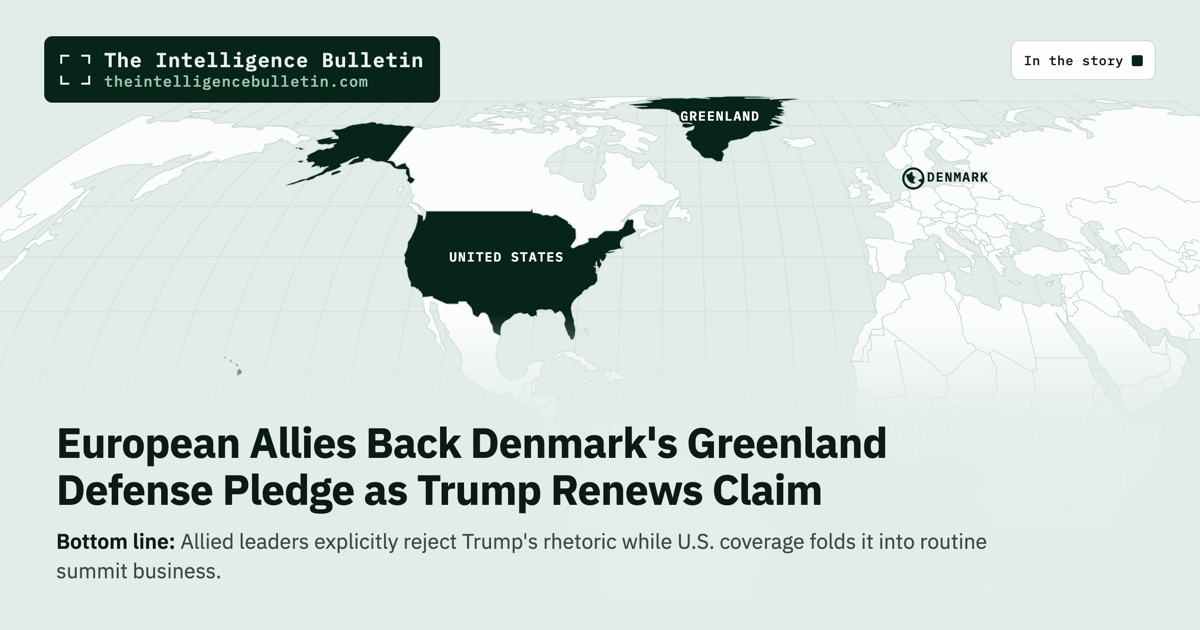
Allied leaders explicitly reject Trump’s rhetoric while U.S. coverage folds it into routine summit business.
European coverage treats the exchange as a direct sovereignty test for an Arctic NATO member, with Danish and Norwegian outlets foregrounding explicit rejection of U.S. claims and allied support. Newsday’s AP report buries the exchange inside summit logistics and unrelated topics like Iran strikes and Ukraine aid, treating it as routine Trump rhetoric rather than a potential alliance fracture. Sputnik alone highlights Denmark’s defiance to underscore Western divisions, while Xinhua sticks to bare quotes without alliance context. The shared factual core—Frederiksen’s refusal and defense pledge—reveals that even amid summit distractions, no outlet disputes the core tension: whether Trump’s remarks cross from bombast into a live territorial challenge that tests Article 5 commitments.
Full analysis
The renewed American claim on Greenland at the Ankara NATO summit tests whether alliance commitments to territorial integrity hold when the challenge comes from within rather than from Moscow or Beijing. Danish Prime Minister Mette Frederiksen made that explicit on July 8 when she told reporters that Greenland “is of course not for sale” and that Denmark stands ready to defend every inch of its territory under Article 5. Trump had restated the day before, after meetings with Turkish President Recep Tayyip Erdoğan, that the island should be controlled by the United States rather than Denmark.
Frederiksen’s statement tied the defense pledge directly to NATO obligations while invoking Greenlanders’ right to self-determination. She stressed that sovereign states expect respect for territorial integrity, a formulation that left little room for interpretation about Copenhagen’s position. Norwegian Prime Minister Jonas Gahr Støre reinforced the point the same day, rejecting the rhetoric outright and noting that Arctic security responsibilities fall to the Kingdom of Denmark and its neighbors. Icelandic and Finnish leaders added parallel affirmations that Greenland remains Danish territory and that external focus should stay on Russia.
European reporting treated these exchanges as a concrete sovereignty matter for an Arctic NATO member rather than passing rhetoric. Danish coverage led with national resolve to protect territory, while Norwegian accounts highlighted Støre’s explicit distancing as a neighbor sharing Arctic duties. The core facts—no sale, self-determination respected, readiness to defend—appeared consistently across these accounts.
By contrast, the Associated Press report carried by Newsday folded the Danish response into a roundup that also covered U.S. strikes on Iran, Ukrainian aid, and Turkish F-35 diplomacy. The exchange appeared as one item among summit logistics, with no elevation as a potential alliance fracture. Sputnik framed the same statements to emphasize internal strains, quoting the defense pledge alongside Trump’s repetition of the claim. Xinhua confined itself to the Danish quotes on sovereignty and self-determination without broader NATO context.
The shared record shows no outlet disputed the factual sequence: Trump’s July 7 remarks, Frederiksen’s July 8 rejection and defense commitment, and allied support from Norway and others. What differs is placement and emphasis. Outlets closest to the territory at stake presented the episode as a direct test of Article 5 applicability inside the alliance. Wire service treatment subordinated it to concurrent crises. Russian state media used it to illustrate division; Chinese state media kept the presentation minimal.
This pattern matters because Greenland’s strategic location already draws Russian and Chinese attention in the Arctic. When a U.S. president revives a territorial claim against a founding NATO member, the question of whether collective defense extends to intra-alliance disputes moves from abstract to immediate. Frederiksen’s invocation of Article 5 in response signals that Copenhagen views the matter in those terms. European allies’ quick alignment indicates they do as well.
What to Watch
The next phase will likely see continued public affirmations of Danish sovereignty paired with private efforts to contain the issue. NATO’s military planning and Arctic exercises will proceed under existing command arrangements, yet the precedent of a U.S. claim will remain on the table for future summits. For readers, the coverage divergence reveals less about media slant than about whose security calculations treat Arctic territory as non-negotiable: those with direct stakes treat the claim as a live test of alliance credibility, while distant accounts can still file it under routine summit noise.
That’s how the world told the story.
Get our daily open-source intelligence on world events in your inbox — one email a day, up to six stories.
Subscribe freeNo spam. One-click unsubscribe. See the latest email →