 AI-generated analysis published under the editorial responsibility of Rohit Sinnas. How it works →
Press quoted
Indian outlets celebrate export breakthroughs and one adds a China angle; Jakarta frames it as standard procurement.
Indian reporting centers on export milestones and industrial self-reliance, with The Times of India stressing that Indonesia is the first foreign buyer of the home-grown Astra missile and The Indian Express detailing the $200 million BrahMos package plus technology transfers. The Tribune alone places the sales inside a China-containment frame by calling Indonesia the third recipient in Beijing’s backyard. The Jakarta Post, by contrast, treats the contracts as routine procurement and bilateral cooperation that also includes minerals and steel ventures, quoting Prabowo on regional benefits without strategic qualifiers. The Manila Times, as a regional neighbor, sticks to a neutral announcement of long-range missile cooperation and wider economic ties. The pattern shows Indian outlets claiming a concrete win for Atmanirbhar Bharat while Indonesian coverage registers the hardware arrival without the geopolitical overlay, revealing how the same transaction registers as milestone at the source and as standard defense upgrade at the destination.
Full analysis
The July 7, 2026, defense agreements between India and Indonesia expose a clear divergence in how the same arms transfers register depending on the vantage point. Indian coverage presents the sales of BrahMos supersonic cruise missiles and the Astra beyond-visual-range air-to-air missile as concrete proof of export success and industrial self-reliance. Indonesian and regional reporting registers them as routine additions to Jakarta’s procurement list, folded into wider talks on minerals, steel, and port infrastructure without any overlay of strategic competition.
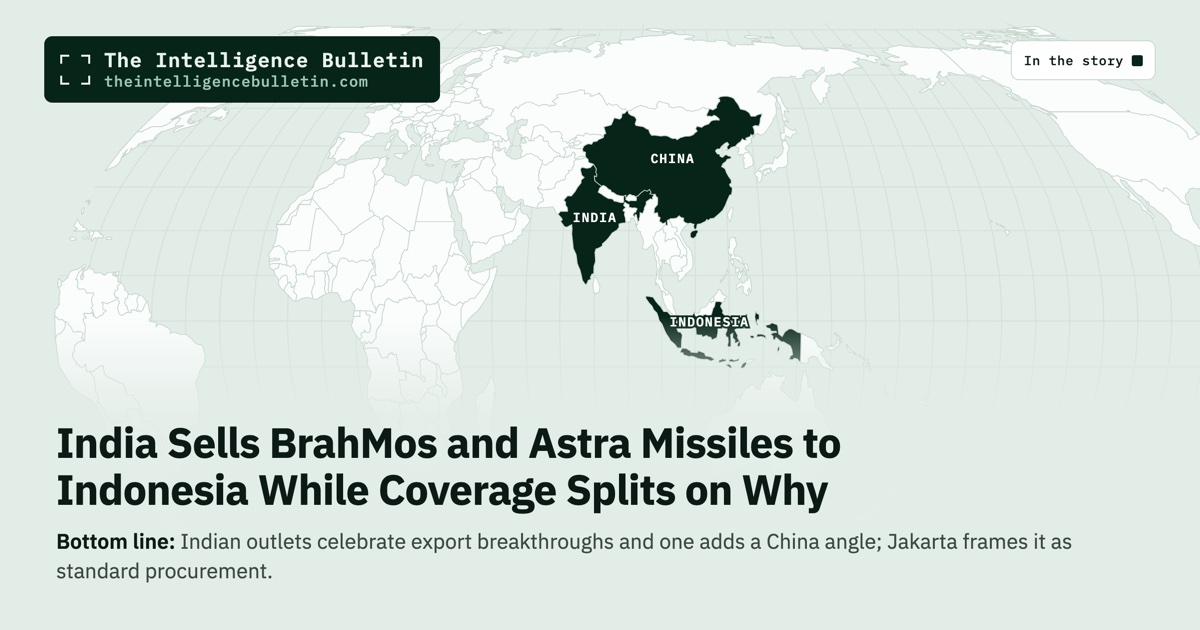
The meeting at Merdeka Palace between Prime Minister Narendra Modi and President Prabowo Subianto produced contracts for at least two BrahMos batteries valued at roughly $200 million, plus the Astra system that makes Indonesia the first foreign customer for that fully indigenous weapon. Separate pacts covered critical minerals supply chains, a joint venture between Steel Authority of India and Krakatau Steel for stainless steel production, maritime security cooperation, and development at Sabang port near the Strait of Malacca. India had already exported BrahMos systems to the Philippines and Vietnam; Indonesia marks the third recipient.
The Times of India led with the Astra milestone, noting the missile’s Mach 4.5 speed, 80-to-160-kilometer range options, and planned integration on Indonesian Sukhoi fighters. It quoted Modi’s social-media posts linking both deals to “Atmanirbhar Bharat” and “make-in-India for the world,” while highlighting the Sabang arrangement’s potential to improve monitoring of traffic through the Malacca Strait, through which an estimated 75 to 80 percent of China’s imported crude oil passes. The Indian Express supplied the $200 million figure and battery details, recorded that Indonesia becomes the third BrahMos buyer, and noted ongoing talks with at least six additional countries. These accounts treat the transaction as measurable progress for India’s defense industry and a demonstration of its ability to deliver operational systems that have already seen use in prior conflicts.
The Tribune alone added an explicit geopolitical frame, describing Indonesia as the third nation in “China’s backyard” to receive BrahMos and linking the sales to efforts to counter Chinese weapons supplies to Pakistan and Bangladesh. It observed that the Philippines and Vietnam, the prior recipients, hold maritime disputes with Beijing in the South China Sea, while noting Indonesia’s own limited coastline along that body of water. No other source in the group used this language.
The Jakarta Post, by contrast, reported the BrahMos signing as one item among several announced after the leaders’ talks. It stated that BrahMos Aerospace and Indonesia’s defense ministry signed the contract, with no further details released by the palace. Reuters was cited for the additional Astra agreement between Bharat Dynamics and Republikorp. The piece emphasized separate memorandums on critical minerals, steel, and agriculture, plus accelerated talks on a preferential trade agreement. Prabowo was quoted saying the two largest democracies in the world would bring “benefits to the region,” while Modi spoke of maritime safety and security in the Indian Ocean. The report noted that neither leader mentioned the missile deal in public remarks. Earlier 2023 discussions had put a potential BrahMos package in the $200–350 million range, but the Jakarta Post framed the outcome as standard defense procurement rather than a turning point.
The Manila Times carried a concise wire-style account that listed the long-range missile agreements alongside defense exchanges, disaster management, critical minerals, and steel cooperation. It quoted Modi on “growing trust” and Prabowo on economic cooperation as a main pillar of relations. The piece stayed with the leaders’ statements on trade acceleration and temple restoration without adding export counts or regional-balancing interpretations.
These differences arise directly from each outlet’s position. Indian national dailies with defense beats naturally foreground indigenous production records and cumulative export tallies because those metrics speak to domestic industrial policy. The single explicit China reference in one Indian paper reflects a security-oriented lens that connects arms transfers to neighboring maritime frictions. Jakarta’s leading English daily, focused on what the government acquires and how partnerships diversify suppliers, omits any external strategic narrative. A Philippine neighbor’s paper records the announcement as one more data point in regional diplomacy.
What to Watch
The pattern indicates that future deals will continue to be read differently at source and destination. Indonesia’s emphasis on immediate hardware needs and multiple economic tracks suggests additional purchases will be presented domestically as procurement successes rather than alignment signals. Indian reporting will likely keep tallying export firsts and technology-transfer totals. Regional outlets will probably maintain the neutral ledger of announced cooperation. What matters for readers is that the hardware itself has now moved; the interpretations attached to it will remain secondary to the capabilities delivered and the supply relationships established.
That’s how the world told the story.
Get our daily open-source intelligence on world events in your inbox — one email a day, up to six stories.
Subscribe freeNo spam. One-click unsubscribe. See the latest email →