 AI-generated analysis published under the editorial responsibility of Rohit Sinnas. How it works →
Press quoted
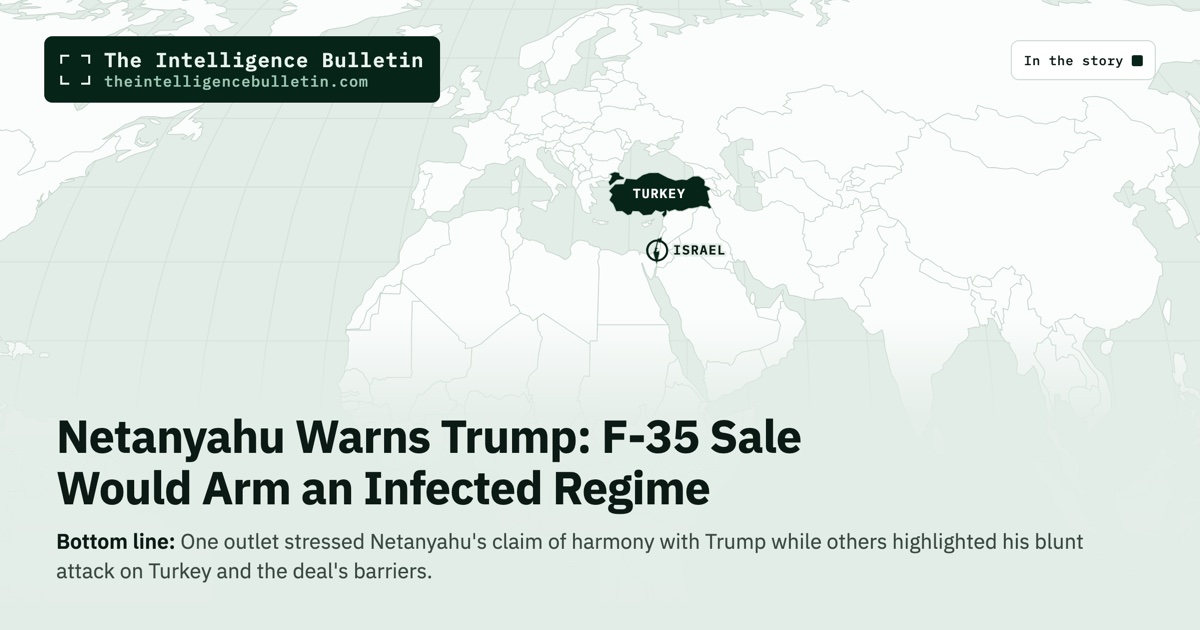
One outlet stressed Netanyahu’s claim of harmony with Trump while others highlighted his blunt attack on Turkey and the deal’s barriers.
Netanyahu’s CNN interview landed like a deliberate counterpunch. While Trump sat beside Erdogan in Ankara praising Turkey’s loyalty and floating F-35 sales, the Israeli leader used the same network to warn that giving Ankara the jets would bring aggression in their wake. CNN en Español stressed the personal rapport Netanyahu claimed with Trump, quoting him that the two see eye to eye on essentials. Middle East Eye instead drilled into the legal and congressional hurdles Trump would still face even if he wanted the deal. Lebanese site Ya Libnan and Kosovar outlet Botasot zeroed in on the harshest language, quoting Netanyahu’s claim that Turkey is not a friendly country and carries an infected regime. The pattern shows a single event read through alliance lenses: one outlet softens the friction between Washington and Jerusalem, others highlight either the structural barriers in Congress or the raw regional hostility Netanyahu voiced.
Full analysis
Netanyahu’s public opposition to selling F-35 jets to Turkey exposes a direct clash between Trump’s personal diplomacy with Erdogan and Israel’s core security demands. The Israeli prime minister used a July 7, 2026, CNN interview to warn that the advanced fighters would arm a hostile actor and destabilize the Middle East, coming hours after Trump sat with the Turkish leader in Ankara and floated lifting sanctions while praising Turkey’s loyalty.
The timing was no accident. Trump attended the NATO summit in Ankara partly as a favor to Erdogan and signaled openness to resuming F-35 deliveries that his first administration halted after Turkey bought Russia’s S-400 air defense system in 2019. Netanyahu responded by stating he had spoken directly with Trump multiple times to block the deal. He argued that supplying the jets would destroy the regional balance of power and bring aggression in its wake. Turkey, he said, is not a friendly country to the United States and operates as an infected regime tied to the Muslim Brotherhood that threatens to destroy Israel, the only Jewish state.
CNN en Español’s account of the interview stressed the personal rapport Netanyahu claimed with Trump. The Israeli leader said the two see eye to eye on essentials and that he does what serves Israel while Trump does what serves the United States, with those interests often identical. The report quoted the sharpest language about Turkey but placed it inside assurances that no serious rift existed, even after Trump had noted during the weekend that Netanyahu knows who is in charge. This framing aligns with the outlet’s access to the interview and its focus on the U.S.-Israel relationship holding steady amid the friction.
Other reporting drilled into different layers. Middle East Eye examined the concrete barriers inside Washington. Experts told the outlet that Trump has no magic wand. Turkey faces CAATSA sanctions on its defense procurement agency for the S-400 purchase, and a 2020 National Defense Authorization Act amendment bars any F-35 sale while Ankara possesses the Russian system, with no presidential waiver available. Recent engine sales to Turkish Aerospace Industries bypassed some sanctions by routing around the sanctioned agency, but returning Turkey to the F-35 production line or selling complete jets requires either congressional changes or verification that the S-400 is no longer in Turkey’s hands. Lawmakers from both parties have long viewed Turkey warily over its Syria operations, support for Palestinians, and domestic crackdowns. Any arms sale can be held up by a single chair or ranking member on the foreign affairs committees.
Lebanese and Kosovar outlets foregrounded the bluntest phrasing from Netanyahu. Ya Libnan reported his claim that personal friendship between Trump and Erdogan does not make Turkey a model ally, listing accusations that Ankara harbors Hamas, occupies Cyprus, threatens European states, jails opponents and journalists, and carries aggressive aspirations. Botasot led with Netanyahu’s direct request that the United States not sell the jets and prominently quoted the infected regime description. These accounts treat the Israeli leader’s attack on Turkey as the central development rather than diplomatic smoothing or legislative details.
The pattern across the reports shows how the same statements land differently depending on priorities. One outlet uses Netanyahu’s own words to portray continuity with Washington. Another shifts attention to the legal and political machinery that limits any president’s freedom of action. The regional outlets amplify the raw hostility between Jerusalem and Ankara. None of the accounts contradict the verified sequence: the Trump-Erdogan meeting on July 7, the immediate Netanyahu interview, and the explicit request to halt the F-35 transfer.
What is at stake goes beyond rhetoric. Israel sees advanced Turkish air power as a direct threat given ongoing disputes over Gaza, Hamas, and broader Sunni Islamist networks. Turkey views the jets as rightful compensation for its NATO role and a counter to regional rivals. Trump has shown willingness to test personal ties against institutional resistance, as seen in the recent engine sale that bypassed a congressional hold. Yet the NDAA language and lingering S-400 issue remain fixed obstacles unless Erdogan agrees to render the system inoperable or ship it elsewhere.
What to Watch
Netanyahu’s intervention makes any quick reversal harder. It signals to Congress and to U.S. officials that Israel will actively oppose the deal, adding political weight to existing skepticism. Trump may still pursue incremental steps such as further component sales or sanctions relief that do not require full F-35 reinstatement. A complete return of Turkey to the program, however, would need either legislative relief or a verifiable workaround on the S-400 that satisfies both the law and Israel’s concerns. The next weeks will show whether personal chemistry between the two presidents can override those constraints or whether the structural barriers and Netanyahu’s public stance keep the jets grounded. For the United States, the episode tests the limits of treating alliances as personal relationships when statutory rules and allied red lines collide.
That’s how the world told the story.
Get our daily open-source intelligence on world events in your inbox — one email a day, up to six stories.
Subscribe freeNo spam. One-click unsubscribe. See the latest email →