 AI-generated analysis published under the editorial responsibility of Rohit Sinnas. How it works →
Press quoted
Full analysis
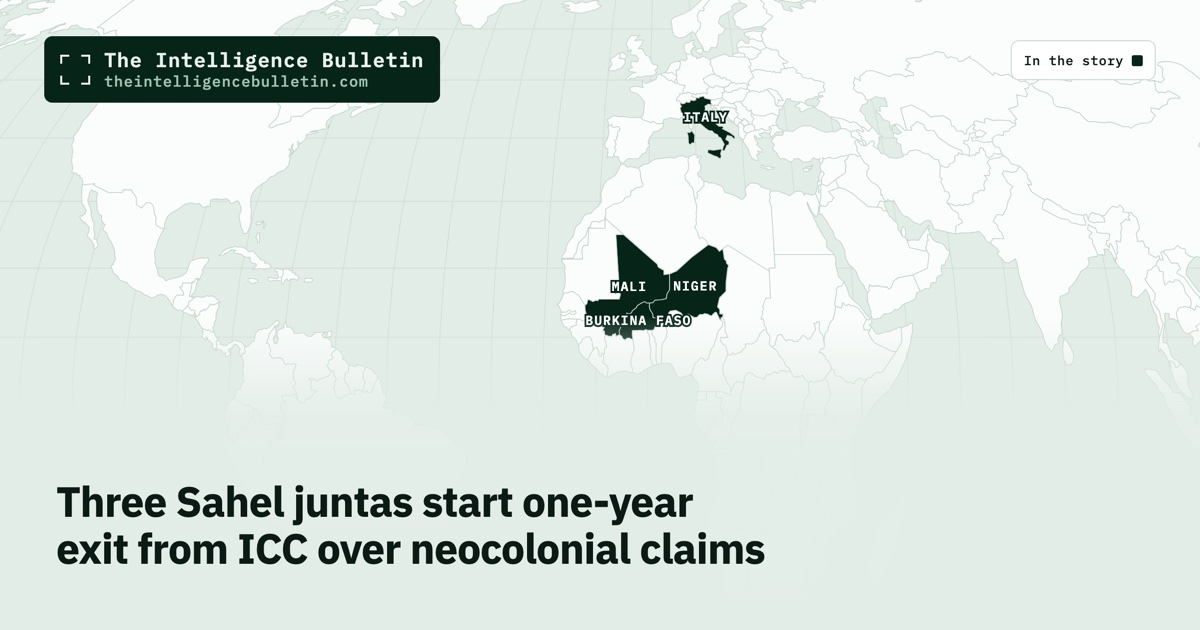
The coordinated decision by Burkina Faso, Mali, and Niger to initiate formal withdrawal from the International Criminal Court on July 3, 2026, marks a deliberate institutional rupture by the three military-led governments of the Alliance of Sahel States. This step, confirmed through official letters submitted to the United Nations Secretary-General, sets in motion a mandatory one-year exit from the Rome Statute and reflects accumulated grievances over the tribunal’s perceived selective focus on African conflicts.
The three nations have operated under military rule since coups in recent years, facing persistent Islamist insurgencies that have displaced millions and prompted allegations of atrocities on multiple sides. Their joint move comes amid broader efforts to assert regional autonomy, including withdrawal from the Economic Community of West African States and the formation of their own security and political alliance. The ICC has long drawn criticism from African leaders for investigating situations predominantly on the continent while appearing to overlook comparable violations elsewhere, a pattern the Sahel governments now explicitly label as neocolonial.
Channel Africa, the South African state broadcaster, presents the development as a clear assertion of sovereignty by the three West African states. Its reporting emphasizes the formal notification process and frames the governments’ rhetoric around rejection of the court as a tool of external interference, while noting the ongoing security challenges and rights allegations involving both militants and state forces. The outlet balances this with the ICC presidency’s warning that the withdrawals undermine global efforts against impunity, yet it prioritizes the perspective of African agency in shaping relations with international institutions.
Africanews, the pan-African outlet with French linkages, adopts a more procedural lens. Its coverage highlights the ICC’s confirmation of the letters and the one-year timeline before any withdrawal takes effect, underscoring that prior obligations and any ongoing cases remain unaffected. The report stresses the presidency’s explicit concern that the move weakens accountability mechanisms, reflecting an institutional emphasis on the tribunal’s role in combating impunity rather than extensive exploration of the governments’ sovereignty arguments.
Both outlets converge on the same verified sequence of events without introducing divergent narratives or additional sourcing that would suggest competing interpretations. The uniformity indicates that the immediate story centers on the mechanical and diplomatic steps of rupture rather than deeper geopolitical fallout or internal divisions within the Alliance. South African state media and a European-tied pan-African service thus arrive at nearly identical framing of the core facts—the letters, the neocolonial characterization from Bamako, Ouagadougou, and Niamey, and the ICC’s caution—revealing how regionally oriented coverage treats the episode primarily as an institutional milestone.
The Takeaway
This convergence carries implications for how the withdrawals will be tracked in the coming months. Observers will watch whether the one-year clock prompts any reconsideration by the three capitals or attracts parallel announcements from other African states that have voiced similar frustrations with the court. Attention will also turn to the status of existing ICC preliminary examinations or investigations involving Sahel situations, which the withdrawal does not erase, and to how the Alliance coordinates its security responses amid continued insurgencies without reference to the Rome Statute framework. The episode tests the resilience of international justice norms in regions where state legitimacy rests increasingly on assertions of sovereignty over external oversight.
That’s how the world told the story.
Get our daily open-source intelligence on world events in your inbox — one email a day, up to six stories.
Subscribe freeNo spam. One-click unsubscribe. See the latest email →