 AI-generated analysis published under the editorial responsibility of Rohit Sinnas. How it works →
Press quoted
Full analysis
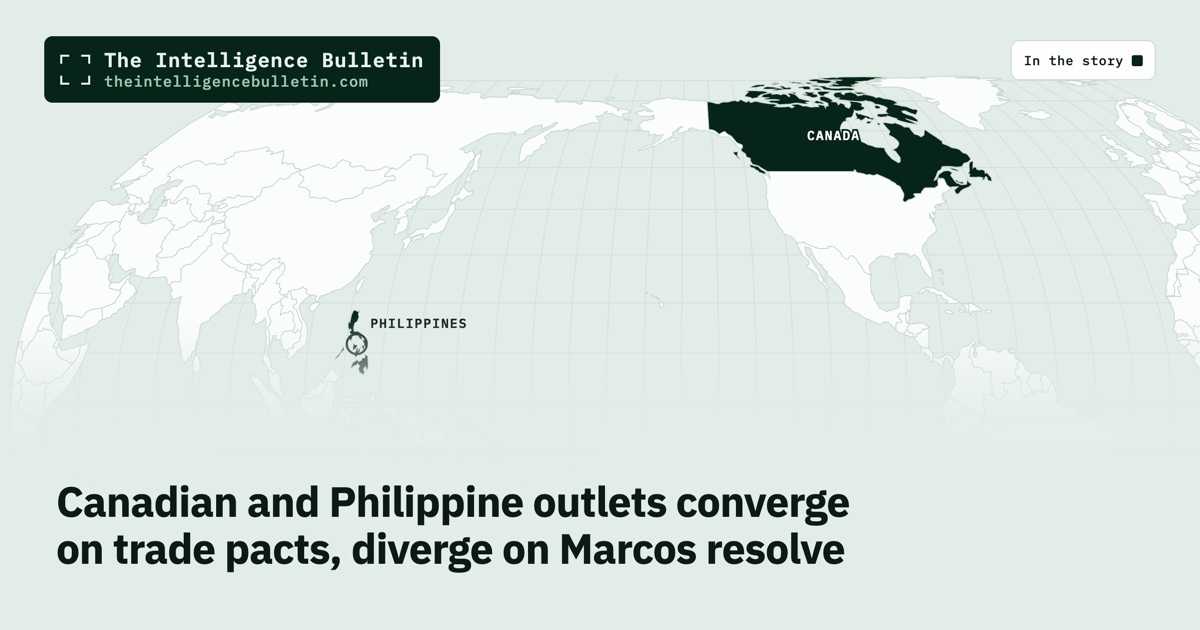
Canadian and Philippine media coverage of President Ferdinand Marcos Jr.’s July 2, 2026, visit to Vancouver revealed a clear divergence in emphasis despite broad agreement on the substance of the agreements signed. Canadian outlets presented a unified account of concrete sectoral deals and the elevation of bilateral ties under Ottawa’s Indo-Pacific strategy, while the sole Philippine report available before the trip framed the journey around Marcos’s determination to deliver results amid domestic political turbulence.
The event marked Marcos’s first official visit to Canada in 11 years. During the Vancouver meetings, Prime Minister Mark Carney and the Philippine leader oversaw the signing of memoranda covering energy, natural resources, labour mobility, worker protections and tourism. Both sides expressed hope that the sectoral steps would accelerate negotiations toward a full bilateral free-trade agreement, with an eye on concluding talks before Carney’s planned November trip to Manila for the ASEAN summit that the Philippines will chair. Nearly one million people in Canada identified as Filipino in the 2021 census, a demographic reality repeatedly cited as the foundation for deeper people-to-people and economic links.
The Globe and Mail, CityNews Toronto and the Penticton Herald all carried essentially identical copy from The Canadian Press. Their reporting detailed the signed agreements, quoted Marcos declaring that “we share the same aspirations, in terms of what we would want to achieve in the world,” and recorded Carney’s pledge that Filipino workers—particularly care workers and nurses—would be treated fairly and have their rights respected. The stories noted existing defence cooperation and highlighted an analysis by Asia Pacific Foundation vice-president Vina Nadjibulla, who argued that the visit demonstrated tangible results from Canada’s 2022 Indo-Pacific strategy, including expanded cooperation on maritime security, critical minerals and nuclear technology. The Globe and Mail added a modest layer of framing by titling its piece around boosted hopes for a trade deal, but the underlying narrative remained the same wire-service account.
Les Affaires took a different approach by reproducing the official joint statement in French rather than offering journalistic summary. The communiqué stressed the formal elevation of relations to a “partenariat stratégique,” with ministers of foreign affairs tasked to advance work on energy—especially nuclear—critical minerals, defence, cybersecurity, maritime security and food security. It reiterated the shared goal of concluding a free-trade agreement this year and underscored the Philippines’ ASEAN chairmanship as an opportunity to accelerate Canada-ASEAN trade talks. The institutional tone and full reproduction of the text gave Quebec business readers direct access to the governments’ own language of partnership rather than interpretive reporting.
In contrast, Manila Bulletin’s June 30 pre-departure article focused squarely on Marcos’s insistence on completing the trip despite ongoing domestic protests, including a surprise rally by members of Iglesia Ni Cristo along EDSA in Quezon City. Presidential Communications Office Secretary Dave Gomez confirmed that the schedule remained unchanged, and the report positioned the Canada visit as a vehicle for advancing free-trade agreement negotiations from the Philippine side. This domestic framing—absent from all Canadian coverage—highlighted the personal and political stakes for Marcos in demonstrating foreign-policy delivery.
The uniformity across Canadian outlets reflected how closely the event adhered to Ottawa’s prepared narrative of economic gains, labour protections and strategic alignment in the Indo-Pacific. Only the earlier Philippine report introduced any sense of contingency or Marcos’s resolve to push through potential disruptions at home. Taken together, the coverage shows two capitals reading the same event through different lenses: one emphasizing institutional momentum and shared values, the other underscoring presidential determination to translate diplomatic travel into tangible trade progress.
The Takeaway
Looking ahead, attention will turn to whether the sectoral agreements produce measurable increases in labour mobility and energy cooperation, and whether the November ASEAN summit in Manila yields concrete movement on a Canada-Philippines free-trade agreement or broader Canada-ASEAN talks. Implementation of the new strategic partnership framework and any follow-through on nuclear and critical-minerals cooperation will offer the clearest tests of whether the Vancouver signings mark a lasting upgrade in relations.
That’s how the world told the story.
Get our daily open-source intelligence on world events in your inbox — one email a day, up to six stories.
Subscribe freeNo spam. One-click unsubscribe. See the latest email →