 AI-generated analysis published under the editorial responsibility of Rohit Sinnas. How it works →
See the 53 countries
Argentina, Armenia, Austria, Azerbaijan, Bangladesh, Bosnia and Herzegovina, Brazil, Chile, China, Egypt, Finland, Germany, Greece, Hungary, India, Indonesia, Iran, Iraq, Ireland, Israel, Italy, Japan, Jordan, Kenya, Kuwait, Kyrgyzstan, Lebanon, Lithuania, Macedonia, Malaysia, Mexico, Pakistan, Qatar, Romania, Russia, Saudi Arabia, Senegal, Singapore, South Korea, Spain, Sri Lanka, Sudan, Switzerland, Syria, Taiwan, Tunisia, Turkey, Tuvalu, Ukraine, United Arab Emirates, United Kingdom, United States, Uzbekistan
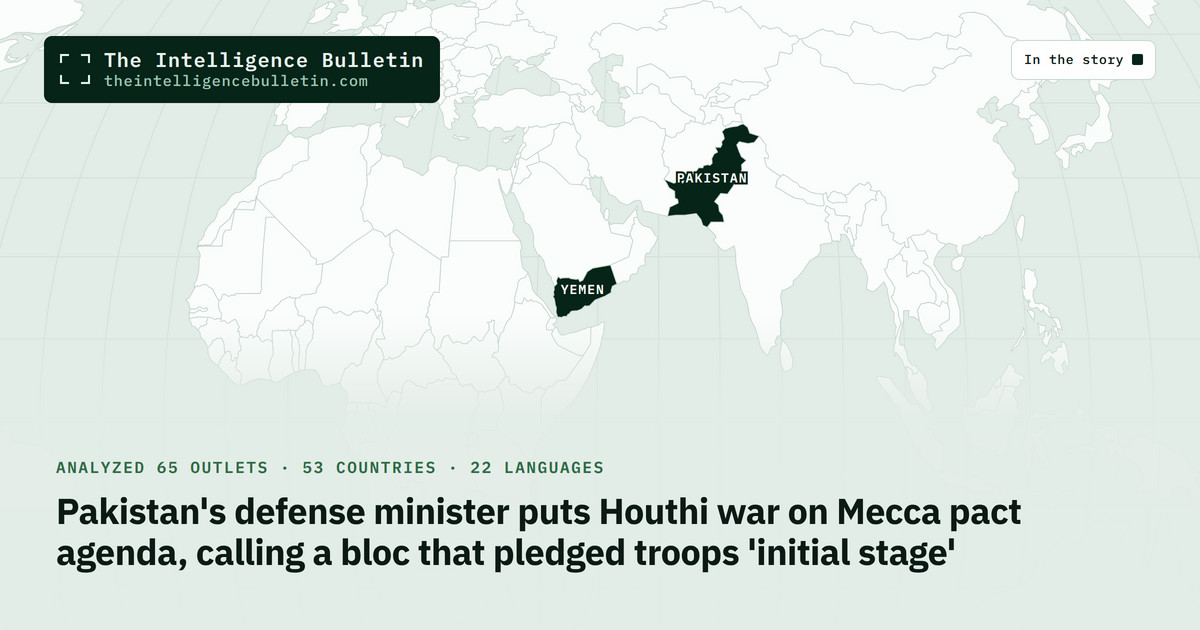
Pakistan, Saudi Arabia and Turkey meet in Islamabad November 27–28 under their August mutual-defense pact. Pakistan’s defense minister says the Houthi war is on the agenda, but calls the pact unfinished and won’t say how it would answer an Iranian attack on Saudi Arabia.
Across the press: Al Jazeera Arabic dates the pact’s troop-deployment pledge to October 5; Pakistan’s defense minister told AFP the pact is still in its initial stage.
Source base: 5 outlets quoted (Pakistan, Qatar, Israel, Azerbaijan, Egypt), selected from 65 analyzed. 4 read in full, 1 by its headline only.
- 2 of 5 · one shared reportPakistan’s Defense Minister Khawaja Asif said the Islamabad meeting will discuss the conflict between Saudi Arabia and Yemen’s Houthis.Asif in an interview with AFP, carried by Express and cited by Al Jazeera Arabic.
- 1 of 5 · Daily Express (Express News) onlyAsif said the pact is still in its initial stage and needs continuous consultation so arrangements can be completed in the next few months, and he declined to say how it would respond to a direct Iranian attack on Saudi Arabia.Asif to AFP, as carried by Express.
- 3 of 5 · reported separatelyPakistan, Saudi Arabia and Turkey are meeting in Islamabad on November 27 and 28 under their joint defense pact, with the Saudi and Turkish foreign ministers attending.Reuters, citing two Pakistani sources, relayed by APA and the Jerusalem Post; Al Jazeera Arabic separately reports the Friday-Saturday session with foreign and defense ministers.
- 3 of 5 · reported separatelyThe three countries signed the Mecca joint defense agreement in August, treating an attack on one as an attack on all.Reuters, as carried by APA and the Jerusalem Post; Al Jazeera Arabic, which dates the signing to August 7 and cites a joint statement for the collective-defense clause.
- 2 of 5 · reported separatelyIn early October the pact’s members announced they would begin implementing collective-defense commitments, including deploying agreed forces and capabilities to Saudi Arabia.Al Jazeera Arabic, citing an October 5 Riyadh emergency meeting and Saudi Defense Minister Khalid bin Salman; the Jerusalem Post in its own analysis.
- November 27–28The Islamabad session ends; any joint statement will show whether Yemen produced deployment decisions or only further coordination.
- The next few monthsAsif’s own timeline for completing the pact’s arrangements, which would test whether ‘initial stage’ gives way to operational commitments.
- Roughly a year after OctoberIshaq Dar’s estimate for full activation, after which membership bids from more than six interested countries, possibly including Egypt, can be considered.
Full analysis
What happened Why it matters How each country tells it Room for disagreement Our assessment Sources and evidence
What happened
Pakistan is hosting Saudi Arabia and Turkey in Islamabad on Friday and Saturday, November 27 and 28, for a session of their Mecca Joint Defense Agreement. Two Pakistani sources told Reuters that the Saudi and Turkish foreign ministers were arriving for it. Al Jazeera Arabic reported that the defense ministers were attending as well. It described the session as the third meeting of the committee set up under the pact, convened to strengthen military coordination and review how the agreement is being carried out. Khawaja Asif, Pakistan’s defense minister, told AFP that the members would discuss the conflict between Saudi Arabia and Yemen’s Houthis. Pakistan’s Express carried the interview.
The alliance is not new, and this is not its first working meeting. Al Jazeera’s timeline traces it to August 7. That day, Saudi Crown Prince Mohammed bin Salman, Turkish President Recep Tayyip Erdogan and Pakistani Prime Minister Shehbaz Sharif signed it at Al-Safa Palace in Mecca. A joint statement said an armed attack on any one of the three would count as an attack on all. On August 31, ministers and chiefs of staff meeting in Istanbul agreed to a general secretariat in Riyadh, to be led by a Pakistani for its first three years. In October, retired General Nauman Mahmood was named to the post. On September 25 the three chiefs of staff met in Riyadh. They condemned attacks on Mecca and on civilian infrastructure in the kingdom, and pledged to begin immediately turning the pact’s commitments into military cooperation.
On October 5, Houthi attacks were hitting Saudi airports and vital facilities. An emergency meeting in Riyadh announced immediate implementation of the collective-defense commitments, including providing forces and capabilities and deploying them quickly to Saudi Arabia. Saudi Defense Minister Prince Khalid bin Salman said collective deterrence measures had been activated. On October 8, Turkey’s defense ministry said a committee meeting in Riyadh had discussed deploying the agreed forces. It added that Turkey’s contribution would be governed by its constitution and laws. Turkey’s parliament approved the first article of the ratification bill on November 5. The Jerusalem Post adds that the pact’s text became public in October. That text covers defense-industry cooperation, joint exercises and intelligence sharing, and leaves the door open to new members.
The pact was born inside a wider war. The Reuters dispatch, carried by Azerbaijan’s APA, says it was signed amid concern over the US-Israeli war against Iran. Express reminds readers that Pakistan mediated a US-Iran agreement signed in June. That agreement briefly halted the fighting and addressed reopening the Strait of Hormuz and talks on Iran’s nuclear program. On October 26, according to Al Jazeera, Prince Khalid, Turkish intelligence chief Ibrahim Kalin and Pakistan’s army chief, Field Marshal Asim Munir, met President Masoud Pezeshkian and Foreign Minister Abbas Araghchi in Tehran to lower tensions. The Jerusalem Post notes that the Mecca agreement predates the Houthis’ latest sustained campaign against Saudi Arabia, which first intervened in Yemen in 2015.
Asif’s interview pulls in two directions. He praised Saudi strategy against the Houthis. He said it was entirely clear that, under the pact, any threat to Saudi Arabia is a threat to Pakistan and Turkey. He also said the pact is still at an initial stage. In his account, it needs continuous consultation so that its arrangements can be completed over the next few months. He declined to say how the pact would respond to a direct Iranian attack on Saudi Arabia. He named Israel as a possible threat to the region’s states. And he said Pakistan’s mediation between Washington and Tehran had been constructive but had not yet delivered the peace people expected.
Why it matters
Yemen is where the pact’s attack-on-one clause meets a live attacker, and both of its non-Saudi members have drawn lines around what they will do. On September 10, Pakistani foreign ministry spokesperson Sajjad Haider Khan was asked about a military response under the agreement. "There is no such thing under discussion right now," he said, according to Reuters as cited by the Jerusalem Post. On October 8, Turkish Foreign Minister Hakan Fidan said the pact is purely defensive and that Ankara would not send troops to another country’s territory to launch offensive operations from it, Al Jazeera reports. Reuters reported in October that Turkey’s help to Saudi Arabia was mainly defensive and technical. Naming the Houthi war as Islamabad’s business tests whether those lines hold.
The weight behind the clause is what makes that test consequential. Pakistan is the only nuclear-armed Muslim state, and Turkey fields NATO’s second-largest military. Citing its own earlier reporting, Al Jazeera puts the three members’ combined forces at about 1.4 million active troops, 3,415 military aircraft including 815 fighters and interceptors, 6,046 tanks and 200 attack helicopters. The bloc also means to grow. In October, Pakistani Foreign Minister Ishaq Dar said more than six countries had shown interest. He added that applications could not be considered until the pact was fully activated, a process he put at about a year. Fidan said Egypt could join once technical issues were settled. Whatever the pact decides about the Houthis sets the terms that any newcomer would be signing up to.
How each country tells it
- Daily Express (Express News) · Pakistan · carries AFPCarries Defense Minister Khawaja Asif’s AFP interview: the Islamabad session will take up the Saudi-Houthi conflict, any threat to Saudi Arabia is a threat to Pakistan and Turkey, yet the pact is ‘still in its initial stage’ and needs a few more months of consultation.
- Al Jazeera (Arabic) · Qatar · original reportingA dated timeline of the pact from its August 7 signing at Al-Safa Palace in Mecca to this week, which it calls the third meeting of the pact’s committee, attended by the three countries’ foreign and defense ministers.
- The Jerusalem Post · Israel · opinionAnalysis built on Reuters’ two-source report, treating the meeting as a test of whether a pact strained by Houthi attacks can become an enduring alliance, and weighing what a bloc joining nuclear Pakistan, Turkey’s army and Saudi money means for Israel.
- APA (Azerbaijan Press Agency) · Azerbaijan · wire copyA short dispatch: the meeting is set for Friday and Saturday in Islamabad, and the Saudi and Turkish foreign ministers are arriving, according to two Pakistani sources who spoke to Reuters.
- Vetogate (Al-Bawaba News) · EgyptHeadline only: the three states will discuss ‘activating’ the joint defense agreement at a three-way meeting in Islamabad.
Room for disagreement
The case that the pact will move faster than Asif suggests rests on its own record. Members declared an immediate deployment of forces to Saudi Arabia on October 5. Three days later, Turkey’s defense ministry confirmed that deploying the agreed forces was under discussion. A secretariat and a secretary-general already exist. Asif himself chose to put Yemen, not Iran, on the table, while restating that a threat to Saudi Arabia is a threat to Pakistan. The Jerusalem Post argues that judging the pact by whether Turkey and Pakistan will go to war in Yemen misreads its goals. It adds that the Houthi attacks may give members a reason to speed up cooperation. On that reading, "initial stage" describes paperwork, not resolve.
Our assessment
Pakistan and Turkey are very unlikely to leave Islamabad committed to offensive operations against the Houthis. This session’s business is machinery: coordination, arrangements for forces on Saudi soil, and steps toward full activation. The warrant is on-record statements from both governments, reaching us through independent reporting chains and pointing the same way. Fidan’s no-offensive-troops line came via Al Jazeera, the Pakistani spokesman’s September remark via Reuters, and Asif’s initial-stage description via AFP. Turkey has passed only the first article of ratification, and Dar’s estimate of a year to full activation runs well past this weekend. The October 5 declaration committed forces to defending Saudi Arabia, not to fighting in Yemen.
Each voice has a reason to be read its way. Asif needs to reassure Riyadh without spending the mediator’s standing Pakistan earned between Washington and Tehran. Abdullah Al-Emadi, the analyst Al Jazeera quotes, names Qatar, Egypt and Kuwait as likely future members, so Doha’s outlet has a stake in the bloc looking solid. The Jerusalem Post casts the Houthis as a shared Israeli-Saudi concern. The view this source set lacks is Riyadh’s own: no Saudi, Turkish, Iranian or Houthi outlet appears in it. The Jerusalem Post also notes that Arab News did not initially confirm the meeting.
What would change this: a joint statement from Islamabad assigning Pakistani or Turkish forces to operations against Houthi targets, or Turkey completing ratification with a mandate that reaches beyond defending Saudi territory.
Sources and evidence
Press quoted
- What forces or capabilities, if any, have Pakistan and Turkey actually deployed to Saudi Arabia since the October 5 declaration to begin doing so ‘immediately’?
- What does the pact oblige Pakistan to do if Iran, rather than the Houthis, strikes Saudi Arabia directly, the question Asif declined to answer?
- Will the Saudi and Turkish readouts of the Islamabad session mention the Houthi conflict, given that the only on-record word that Yemen is on the agenda comes from Pakistan’s defense minister?
That’s how the world told the story.
Get our daily open-source intelligence on world events in your inbox — one email a day, up to six stories.
Subscribe freeNo spam. One-click unsubscribe. See the latest email →