 AI-generated analysis published under the editorial responsibility of Rohit Sinnas. How it works →
See the 50 countries
Afghanistan, Armenia, Australia, Austria, Azerbaijan, Belarus, Brazil, Bulgaria, Canada, China, Cyprus, Czech Republic, Denmark, Egypt, Finland, France, Germany, Greece, Guyana, India, Indonesia, Iran, Ireland, Israel, Italy, Japan, Kenya, Latvia, Lithuania, Luxembourg, Malta, New Zealand, Peru, Portugal, Romania, Russia, Singapore, Slovakia, Slovenia, Somalia, Spain, Sweden, Switzerland, Taiwan, Turkey, Tuvalu, Ukraine, United Arab Emirates, United States, Vietnam
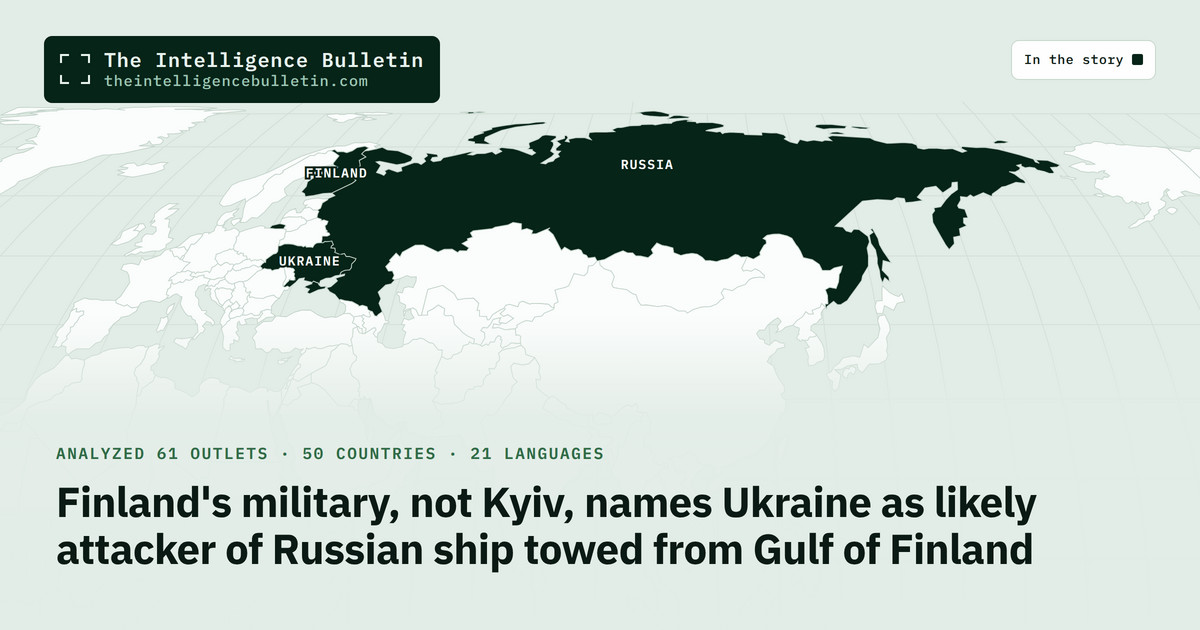
Drones struck Sparta II, a Russian Defense Ministry cargo ship, on November 21; Russia towed it from Finnish waters a day later. Finland’s military calls Ukraine the likely attacker, Kyiv claims nothing, and Finland’s Border Guard and Leningrad’s governor disagree on crew evacuation and injuries.
Across the press: Finland’s Defense Forces called Ukraine the likely attacker; Ukraine’s Focus credited Kyiv with Benghazi but not this strike, and Leningrad’s governor named no one.
Source base: 5 outlets read in full (Finland, Russia, Ukraine, Latvia, Switzerland), selected from 61 analyzed.
- DisputedFinland’s Border Guard says all 16 crew were evacuated on Saturday to a nearby Russian vessel and one was lightly injured, while Leningrad’s governor says no evacuation was needed and no one was hurt.Source: Kaleva, citing Border Guard maritime chief Jukka-Pekka Lumilahti; URA, citing Drozdenko’s Telegram channel; 20 Minuten’s interviewee says a Russian helicopter rescued the crew with Finland’s permission.
- 1 of 5 · Kaleva onlyFinland considered seizing the ship but judged bringing it into a Finnish port too risky, and on Sunday evening the Russian rescue vessel Murman towed it out of Finland’s zone, escorted by the Finnish patrol ship Uisko and Estonia’s Kindral Kurvits.Kaleva, citing Lumilahti and Hirvi of Finland’s Border Guard.
- 4 of 5 · reported separatelyDrones struck the Russian cargo ship Sparta II on the morning of Saturday, November 21, in international waters of the eastern Gulf of Finland, and the burning ship drifted into Finnish territorial waters off Loviisa.Kaleva, citing Finland’s Defense Ministry and Border Guard; URA, citing Leningrad governor Drozdenko, places the strike about 5.5 km from the Russian border, while Kaleva puts it about 50 km west of Suursaari.
- 4 of 5 · reported separatelyUkraine is treated as the attacker, but none of the sources carries a claim of responsibility from Kyiv.Kaleva cites Finland’s Defense Forces calling it likely; LSM states it as fact; Estonia’s foreign minister, via Focus and ERR, calls it Ukrainian self-defense; Peskov, via Focus and TASS, urges Baltic states to restrain Kyiv.
- 2 of 5 · reported separatelySparta II is owned by Oboronlogistika, a company under Russia’s Defense Ministry, is under US and Ukrainian sanctions on suspicion of moving military cargo, and its current cargo remains undisclosed.Kaleva, citing Border Guard maritime safety chief Mikko Hirvi and Ukraine; LSM, citing Yle and professor Henrik Ringbom.
- This week’s NATO meeting in Brussels20 Minuten’s interviewee expected allies to say only that they consulted and remain vigilant, so any stronger language on Baltic shipping would signal a shift.
- When Sparta II reaches a Russian portFinland’s Border Guard says the fire can only be fully put out as the containers are unloaded one by one, the point at which the undisclosed cargo is handled.
- AnsweredPer Kaleva, citing Finland’s authorities, the ship was struck in international waters about 50 km west of Suursaari and drifted into Finnish territorial waters off Loviisa; Finland considered seizing it but on Sunday evening let the Russian vessel Murman tow it out of Finland’s zone.
- Still openWho launched the drones and from where, given that Ukraine has not claimed the strike and a Russian expert quoted by Lenta.ru suggests they crossed or were launched from NATO territory? · What is Sparta II carrying, after Iljin told Yle that Russian authorities have given no clear answer and Finnish crews are preparing for explosives?
- 22 Nov · Drones burn Russian military cargo ship off Finland; Finland s premier backs Kyiv, Russian experts warn of Kaliningrad blockade
- 23 Nov · Zelensky claims Benghazi corvette strike; Lenta.ru says Russians were hurt, Libyan official says only port workers
- 23 Nov · Russian corvette burns in suspected Benghazi drone strike; Tripoli s government says hosting foreign forces imports outside wars
Full analysis
What happened Why it matters How each country tells it Where accounts conflict Room for disagreement Our assessment Sources and evidence
What happened
Shortly after 8 p.m. on Sunday, November 22, Finland’s Gulf of Finland Coast Guard announced on X that the Russian cargo ship Sparta II had been towed out of Finland’s exclusive economic zone. It had also left the area where Finland is responsible for responding to environmental damage. Kaleva reported that sea and air traffic restrictions were lifted and the Border Guard’s mission ended. The Russian rescue vessel Murman did the towing. According to the Border Guard, three escorts secured the tow inside Finland’s search-and-rescue zone: the Finnish patrol ship Uisko, the Estonian Navy’s Kindral Kurvits and rescue tugs from Alfons Håkans.
The ship had been burning since the morning of Saturday, November 21. Finland’s Defense Ministry said the Defense Forces detected a drone strike on it that morning in international waters in the eastern Gulf of Finland, about 50 kilometers west of the island of Suursaari. Once damaged, the ship drifted into Finnish territorial waters off Loviisa. Leningrad Region governor Alexander Drozdenko, in a Telegram post that URA carried almost word for word, used a different reference point. He said two drones hit the ship in international waters about 5.5 kilometers from the Russian border, while it was sailing from St. Petersburg to Kaliningrad. Neither account gives coordinates.
Finland’s Defense Forces judged it likely that Ukraine was behind the strike. None of the five reports TIB read carries a claim from Kyiv. That contrasts with Benghazi: TIB reported on November 23 that President Volodymyr Zelensky claimed the strike on the Russian corvette Merkury for Ukraine’s security service. Focus, a Ukrainian outlet, repeats that the SBU used seven Ukrainian-made sea drones off Libya, but it attributes nothing to Ukraine in the Gulf of Finland. Drozdenko’s post names no attacker at all.
Sparta II belongs to Oboronlogistika, a transport company founded in 2011 that operates under Russia’s Defense Ministry. Ukraine says the ship has carried military supplies from Syria to Russia, and it is on both Ukrainian and US sanctions lists. On Sunday, its cargo was still unknown. Commander Mikko Hirvi, the Border Guard’s director of maritime safety, said Finland had asked the Russians what the ship was carrying. Because it had carried military loads before, he said, crews had to treat it as if it held dangerous or explosive cargo.
The damage was heavy. Lieutenant Commander Jukka-Pekka Lumilahti, who heads the Border Guard’s maritime operations, said the worst-burned areas were the crew quarters in the bow and the two container rows behind them. Containers stood four to five high, in five to six rows side by side, and some had burned through. The bridge and the bow superstructure were largely gutted. Crews put out the visible flames on Saturday evening, but firefighting continued into Sunday afternoon while the ship kept smoking. Crews adjusted how much water they poured on it to keep the ship from listing further. The Border Guard found no fuel or hazardous leaks.
Lumilahti said Finland had considered seizing the ship. Officials judged that bringing it into a Finnish port would be very risky. Hirvi said an emergency tow of an unstable, partly listing ship into the archipelago is difficult in general and in this case too. The safest option for both the Finnish and Estonian coasts, he said, was for the Russians to tow it into Russian waters. LSM reported Finnish experts’ view that moving the ship suits both Finland and Russia, since any pollution would raise the question of liability.
Kremlin spokesman Dmitry Peskov, quoted from TASS by Focus and also reported by LSM, said the attack escalates tension and points toward "terrorism" in the Baltic. He urged the Baltic states to use their influence on Kyiv. Estonian Foreign Minister Margus Tsahkna, quoted from ERR by Focus, called the incident a side effect of Russia’s war and Ukraine’s self-defense. He said Estonia had given no foreign state use of its airspace or waters. LSM carried three more government voices. Finnish Prime Minister Petteri Orpo said the war is reaching Finland’s immediate vicinity and that Ukraine has the right to fight. Estonian Prime Minister Kristen Michal said it is time to get used to such attacks, with pollution his main worry. Lithuanian President Gitanas Nausėda said, with what he called complete certainty, that no drone was launched from Lithuania. He was answering unconfirmed reports of a strike on the Kaliningrad port of Baltiysk, and he suggested a Russian psychological operation was linking that report to the Gulf of Finland attack.
Why it matters
The ship was a Defense Ministry transport on the sea route to Kaliningrad, Russia’s exclave between Poland and Lithuania. A strike on that route lands inside the space Finland and Estonia patrol. The Russian ship’s passage home ended with Finnish and Estonian state vessels escorting it, while Helsinki weighed a seizure and turned it down.
Finland’s choices show how the governments on the gulf are absorbing the strike. They are treating it as a fire, a tow and a spill risk, not an act aimed at them. They have also moved early to pre-empt the charge Moscow is building. Tsahkna said Estonia lent no airspace or waters, and Nausėda denied that any drone came from Lithuania. Peskov’s request that Baltic capitals restrain Kyiv casts them as parties with leverage, and therefore with responsibility. LSM added a reminder of what sits nearby: Yle satellite images suggest Russia’s Kamenka garrison near Finland could grow to as many as 11,000 troops from nearly 4,500.
The editor’s question was whether this belongs to the Benghazi campaign. Klemens Fischer, a Cologne professor interviewed by 20 Minuten, treats the two as one Ukrainian gamble before winter. The record does not establish that, because no Ukrainian voice on the Gulf of Finland strike appears anywhere in the sources.
How each country tells it
- Kaleva · Finland · original reportingA Border Guard account of the operation: the 16 crew evacuated on Saturday, one lightly hurt, fires still smoldering on Sunday, the tow by the Russian rescue vessel Murman under Finnish and Estonian escort, and the disclosure that Finland considered seizing the ship before judging a Finnish port too risky.
- ura.news · Russia · carries Leningrad Region Governor Alexander Drozdenko (Telegram)Relays Leningrad governor Alexander Drozdenko’s Telegram post that the crew came ashore in St. Petersburg, that no one was hurt and that no evacuation was needed after two drones hit the ship en route from St. Petersburg to Kaliningrad.
- focus.ua · Ukraine · carries TASSSets Kremlin spokesman Dmitry Peskov’s charge of ‘terrorism in the Baltic’, and his appeal to Baltic states to restrain Kyiv, against Estonian Foreign Minister Margus Tsahkna’s statement that the incident follows from Ukraine’s right to self-defense.
- Latvian Public Broadcasting (LSM) · Latvia · carries YleGathers regional reactions: Finnish PM Orpo saying the war is spreading to Finland’s doorstep and Ukraine has the right to fight, Estonian PM Michal saying the region must get used to such attacks, maritime law professor Henrik Ringbom telling Yle that Ukraine had full right to strike, and Lithuanian President Nauseda’s denial that any drone was launched from Lithuania at Kaliningrad’s Baltiysk port.
- 20 Minuten · Switzerland · opinionAn interview with Cologne geopolitics professor Klemens Fischer that treats the Polish missile strikes, the Baltic attack and the Benghazi strike as one escalation, with Ukraine ‘playing for high stakes’ before winter.
Where accounts conflict
The crew’s fate is disputed. Lumilahti told reporters that all 16 crew were evacuated on Saturday to a nearby Russian vessel, which returned to Russia, and that one crew member was lightly injured. Drozdenko wrote that the crew came ashore at the Big Port of St. Petersburg at 8 p.m., that no one was hurt, and that after a Russian rescue ship arrived "evacuation was not required." Kaleva’s own text pulls both ways. It also cites the Coast Guard saying no one was injured, and an official it names only as Iljin saying the evacuation went without problems. Fischer told 20 Minuten that Finland let a Russian helicopter into its airspace to rescue the crew, a detail no other source carries. URA’s headline says the ship returned to Russia, though its text reports only the crew’s return.
Room for disagreement
The legal footing is less settled than the Nordic and Baltic governments’ statements suggest. Henrik Ringbom, a maritime law professor, told Yle (via LSM) that Ukraine was fully entitled to strike a Russian ship in international waters if it carries weapons or military cargo. Fischer called the attack probably "hart an der Grenze des Völkerrechts" (right at the edge of international law): proof of war cargo would be required, and the strike came very close to Finnish waters. The cargo is still unknown. If it turns out to be civilian, or a burned container leaks into the gulf, the governments that defended the strike will face pressure from their own coastlines. Michal already named pollution as the main problem. And on November 22 TIB reported Russian experts warning of a Kaliningrad blockade, a frame Moscow can press if strikes continue.
Our assessment
It is likely that Russian military-linked ships on the Kaliningrad run will be struck again, and that Finland and Estonia will keep handling such strikes as rescue and pollution operations rather than breaches of their own security. The strongest warrant is on the record: Michal told Estonians to prepare for more, Orpo and Tsahkna endorsed Ukraine’s right to strike, and Finland’s Border Guard described an escort-and-release operation. The attribution comes from Finland’s own Defense Forces, a government with no interest in inflating it. Kyiv’s silence, set against its open claim at Benghazi, is consistent with a reluctance to own a strike beside NATO waters, though that is an inference no source states. Moscow, for its part, benefits from casting the Baltic states as accomplices, which is why Tsahkna’s and Nausėda’s denials came so fast.
What would change this: evidence that the drones flew from or over Finnish, Estonian or Lithuanian territory, which would turn a Ukrainian-Russian exchange into a question of NATO members’ complicity.
Sources and evidence
Press quoted
- Will Kyiv claim the Sparta II strike as it claimed Benghazi, and from where were the drones launched, given Estonia’s statement that it gave no foreign state use of its airspace or waters?
- What was Sparta II carrying, which Finland’s Border Guard says Russia has not disclosed and which will only be known when the containers are unloaded in port?
- Did drones actually hit Baltiysk port in Kaliningrad, as the reports Lithuania’s President Nauseda dismissed claimed, and who first spread them?
That’s how the world told the story.
Get our daily open-source intelligence on world events in your inbox — one email a day, up to six stories.
Subscribe freeNo spam. One-click unsubscribe. See the latest email →